NISM Series XV Study Plan for Working Bankers: 4 Weeks
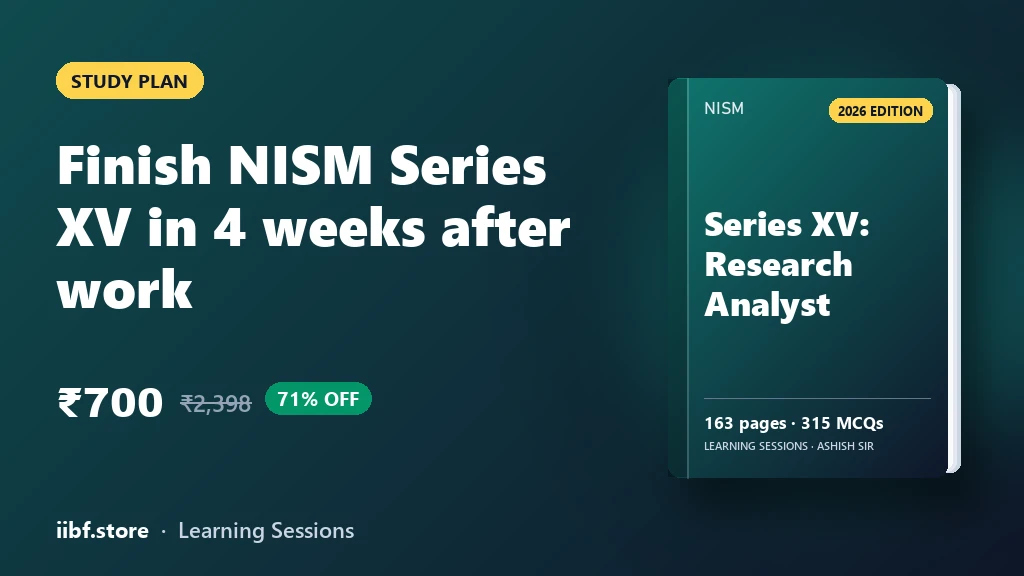
It is 9:40 pm. You reached home after a day of cash counters, audit queries and a customer who wanted "just one more" explanation. The Research Analyst syllabus is open on your phone, and it looks endless: securities markets, ratios, valuation, commodities, regulations, charts. You are not lazy and you are not weak. You simply have about ninety usable minutes a day, and you need a NISM Series XV study plan that fits those minutes instead of fighting them.
This article gives you exactly that: a four-week, day-wise plan, a table you can paste into your notes, and the habits that make tired-brain studying work. You can follow it with any decent material. If you want one printed book to anchor it, we explain how the plan maps onto the chapters of ours, and we are upfront about what a book cannot do for you.
Why a NISM Series XV study plan needs to start from your day, not the syllabus
Most people open the syllabus, feel overwhelmed and then either postpone or cram. A better start is to count your real hours. Take a normal week at the branch and mark the slots that survive: perhaps 60 to 90 minutes on weekday nights and three to four hours on a Sunday. That is roughly 10 to 14 hours a week, or 40 to 55 hours in a month. That is enough for this paper if you spend it in the right order.
Three rules for tired-brain study
- One chapter, one sitting. Do not leave a chapter half-read across three nights. You lose the thread each time.
- Questions the same night. Reading feels like progress; questions show whether it stuck. Attempt the chapter's MCQs before you sleep.
- Heavy chapters on weekends. Keep valuation and financial analysis for Saturday and Sunday, when your head is fresh. Use weekday nights for lighter, definition-heavy chapters.
If you have failed or postponed an attempt before, do not treat this as a punishment cycle. Treat it as a schedule problem. A schedule can be fixed in an evening.
Know the shape of the paper before you plan
The Research Analyst paper tests four broad areas, and the best way to plan is by module rather than by page. In the NISM Series XV Research Analyst book, the 21 chapters sit in four modules:
- Module A, Research Foundations and Securities Markets: the research analyst profession, securities market basics in two parts, terminology in equity and debt markets, and fundamentals of research.
- Module B, Economy, Industry and Company Analysis: economic analysis, industry analysis in two parts, company analysis on business and governance, and financial analysis in two parts.
- Module C, Corporate Actions, Valuation, Commodities and Risk: corporate actions, valuation principles in two parts, fundamental analysis of commodities, and risk and return.
- Module D, Research Reports, Regulation and Technical Analysis: qualities of a good research report, legal and regulatory environment in two parts, and technical analysis in two parts.
As a banker you already have an advantage in Module A, because much of the securities market vocabulary overlaps with what you handle daily. Module B and Module C are where numbers and reasoning appear, so they deserve your best hours. Module D mixes memory-heavy regulation with chart reading, which is why we put it last, when you have built confidence.
For the official syllabus and the exam schedule of the upcoming exam cycle, always check the official IIBF website. Do not rely on a forwarded message.
What the book gives you to work with
Since the plan is built around the printed book, here are its facts, with no decoration: 163 pages, 21 chapters, 315 practice questions, and a 2026 edition. In addition there are 30 case studies (120 questions) and 5 mega tests (500 questions). Spread across 21 chapters, the chapter questions come to about 15 per chapter on average, which fits a single evening: read first, then test yourself.
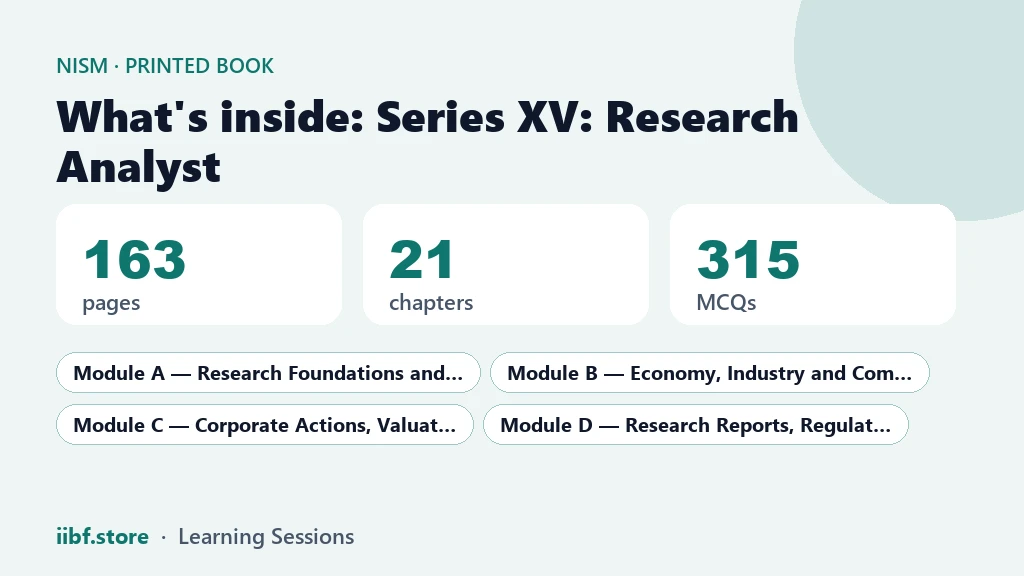
At 163 pages, the book is short enough to finish more than once. That matters. Most failed attempts we hear about are not because the candidate never studied; they are because the first pass ended too late for a second one.
The 4-week NISM Series XV study plan, day by day
The plan below assumes about 90 minutes on weekdays and 3 hours on weekends. It follows the book's module order, so you never have to hunt for what comes next. If a day goes wrong, which it will because a branch inspection does not respect your timetable, slide the plan by one day instead of abandoning it.
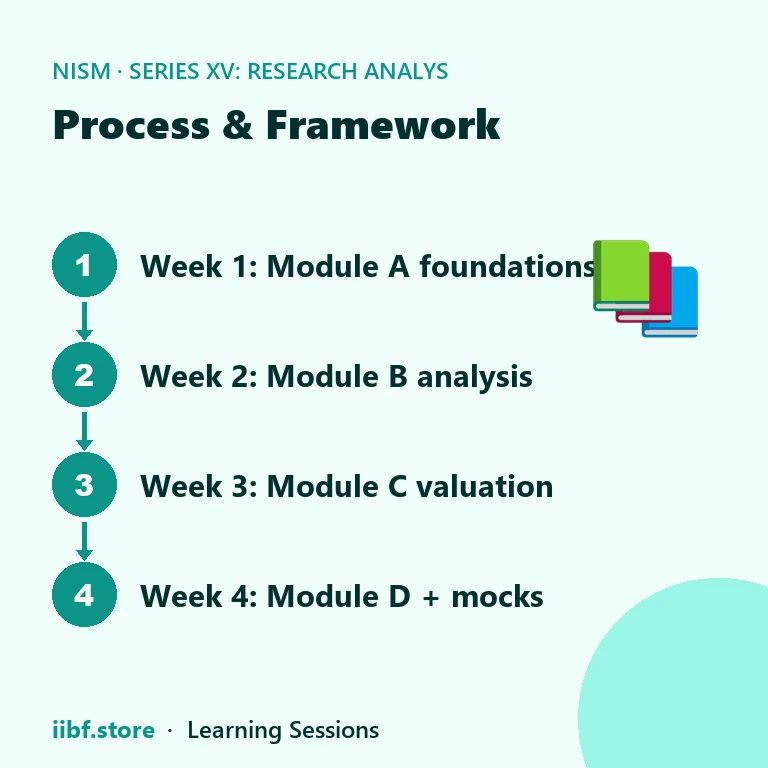
| Days | What to read | MCQ target |
|---|---|---|
| Days 1-2 | Module A: Research Analyst Profession; Securities Market Part 1 | Chapter MCQs for both, about 15 each |
| Days 3-4 | Module A: Securities Market Part 2; Terminology in Equity and Debt Markets | Chapter MCQs for both |
| Days 5-7 | Module A: Fundamentals of Research, then revise the module | Chapter MCQs, then redo every question you got wrong |
| Days 8-9 | Module B: Economic Analysis; Industry Analysis Part 1 | Chapter MCQs for both |
| Days 10-11 | Module B: Industry Analysis Part 2; Company Analysis, Business and Governance | Chapter MCQs for both |
| Days 12-14 | Module B: Financial Analysis Part 1 and Part 2 (weekend, slow pace) | Chapter MCQs, work every calculation by hand |
| Days 15-16 | Module C: Corporate Actions; Valuation Principles Part 1 | Chapter MCQs for both |
| Days 17-18 | Module C: Valuation Principles Part 2; Fundamental Analysis of Commodities | Chapter MCQs for both |
| Days 19-21 | Module C: Risk and Return, then revise the module | Chapter MCQs, then the wrong-answer notebook |
| Days 22-23 | Module D: Qualities of a Good Research Report; Legal and Regulatory Part 1 | Chapter MCQs for both |
| Days 24-25 | Module D: Legal and Regulatory Part 2; Technical Analysis Part 1 | Chapter MCQs for both |
| Days 26-28 | Module D: Technical Analysis Part 2; case studies; first mega test | Case-study questions, one full mega test under timed conditions |
How to use the MCQ column
Attempt the questions without looking at the answers, then check. Keep a small notebook titled "Wrong answers" and write the concept, not the option letter. When you finish each module, redo only that notebook. Fifteen minutes on your own mistakes beats an hour of rereading what you already know.
If you have only two weeks
Compress by doubling the daily load only if you are on leave. If you are not, keep the order but skip the second read of Module A and spend those hours on the case studies and mock tests. Exam-hall speed comes from practice, not from a longer first read.
Weekday versus weekend: matching chapters to your energy
Not every chapter needs the same brain. Definition and process chapters, such as the profession, market structure and regulation, are fine at 10 pm. Financial analysis, valuation and risk and return need a clear head and a pencil. Swap days freely, but always keep these heavier chapters for the weekend if you can.
For the calculation chapters, do not just read the worked example. Cover the solution, solve it on paper and compare. Bankers are usually good at this because you are used to ratios and interest arithmetic; the trick is simply to do it rather than to nod along.
The last three days before the exam
- Day minus 3: one mega test, timed, then review only the mistakes.
- Day minus 2: reread your wrong-answer notebook and the headings of all 21 chapters.
- Day minus 1: light revision of regulation and technical analysis, and an early night.
What a book will not do, and what to pair it with
We would rather be honest than sell you a miracle: a book alone will not give you exam-hall speed. Reading and chapter questions build understanding. Speed and nerve come from full-length timed practice. So pair the Series XV book with the free mock tests at iibf.store/tests and keep the sample pages, free PDFs at iibf.store/free-material, and the wider list of titles at iibf.store/books handy while you decide.
The price is mentioned on the book page, currently ₹700 against an MRP of ₹2,398, but prices may change, so treat the book page as the current source. Whatever you choose, the plan above works because of its structure, not because of any brand.
Making the NISM Series XV study plan stick for four weeks
A plan survives when it is small enough to be boring. Fix a start time, keep your phone in another room, and decide tomorrow's chapter before you close the book tonight. Tick the day on paper. If you miss one, do not double the next day; just move the whole schedule by a day.
Tell one colleague or family member the date you plan to finish Module A. Public promises are cheap and strangely effective. And remember that you are not racing anyone else; you only need to be ready by your own exam date, which you can confirm on the official site.
Follow this NISM Series XV study plan honestly for four weeks and you will have read every chapter, attempted the practice questions, and tested yourself under time pressure. That is what preparation looks like. For more study guides, browse the iibf.store blog.
Frequently asked questions
Can I really finish this in four weeks with a full-time job?
If you can give 90 minutes on weekdays and about three hours on weekends, yes, for a first pass plus mock practice. If your branch is in a heavy audit or closing period, stretch the plan to five or six weeks rather than skipping practice questions.
Which module should I never skip?
Module B and Module C carry the numerical and reasoning load, namely financial analysis, valuation and risk and return. Give them your fresh hours and attempt every question yourself.
Is there a sample before I buy?
Yes. The book page has a free sample you can read, and the free mock tests on iibf.store/tests let you check your level before deciding anything.
Where do I find the official exam date?
We do not quote dates here because they change. Check the official schedule for the upcoming exam cycle on www.iibf.org.in.
Prefer revising from a printed book?
Chapter-wise books with MCQs after every chapter — minimal pages, complete coverage, delivered anywhere in India. Every book has a free sample to read first.


























Practice this topic
Take a free mock test, download chapter PDFs, or watch a video class — all included on iibf.store.
Keep reading