NISM X-B Study Plan: Finish Investment Adviser Level 2 Alongside Your Bank Job
It is 8:40 pm. The branch shutters are down, the cash has tallied (finally), and you are on the train or at the dining table with a cup of tea going cold. The syllabus of an Investment Adviser paper looks endless: insurance, retirement, tax, wills, trusts, behavioural finance. You have postponed this once already. Sound familiar?
This article gives you a workable NISM X-B study plan for exactly that situation: a full-time bank job, perhaps 90 minutes on weekdays and a few hours on weekends. The plan works whether or not you ever buy a book. If you do want one tool to hang the plan on, we describe it further down, using only its facts.
Why a NISM X-B study plan must start from your day, not from the syllabus
Most people open the syllabus, feel the weight of it, and close it again. The fix is to turn the syllabus into small, nightly units. Series X-B (Investment Adviser, Level 2) is not a paper you can cram in a weekend. It spans four very different subject areas, and each rewards a different kind of study.
- Insurance and retirement reward understanding. Once you see how needs are estimated, the options follow.
- Tax rewards repetition. Rules and treatments blur unless you revisit them.
- Estate planning and behavioural finance reward reading with examples, because the questions are scenario-led.
- Advice and case studies reward practice, since you have to combine everything.
A good plan respects this. Put the heavy tax block in the middle of your schedule, when you are warmed up but not yet tired of the paper, and keep the lighter conceptual modules for the ends.
Three honest ground rules
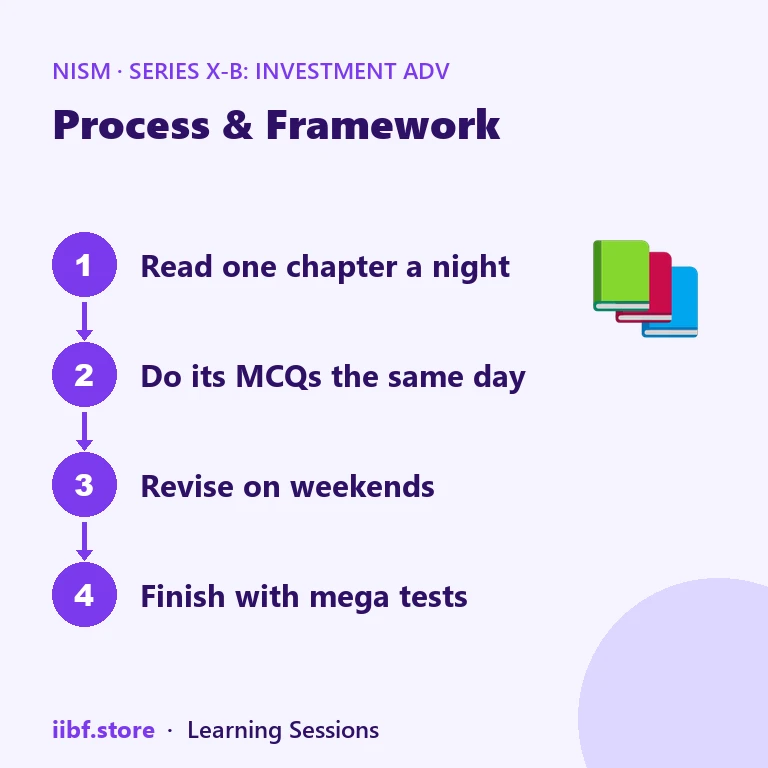
- One chapter per weekday night. If you are too tired, read half and do half the questions. Never skip a night entirely, because restarting is the hard part.
- Do the MCQs the same day you read. Questions you attempt within hours of reading are the ones that stick.
- Keep one weekend slot per week for revision only, with no new chapters.
What you actually have to cover
Before planning, count the work. The NISM X-B Investment Adviser Level 2 book from iibf.store runs to 157 pages across 24 chapters, with 360 practice questions, which works out to roughly 15 per chapter on average. The chapters sit in four modules:
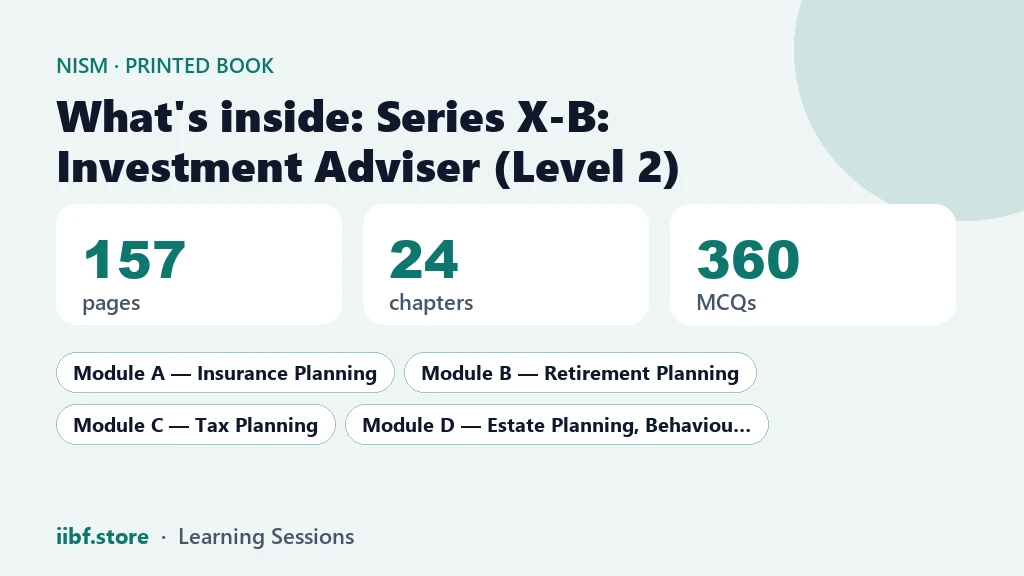
- Module A, Insurance Planning: 3 chapters (basics of insurance, life products, non-life products).
- Module B, Retirement Planning: 4 chapters (the planning process and estimating needs, retirement products and schemes in two parts, and miscellaneous aspects).
- Module C, Tax Planning: 9 chapters, from concepts in taxation through capital gains, debt, equity, mutual funds, derivatives, virtual digital assets and special cases.
- Module D, Estate Planning, Behavioural Finance and Advice: 8 chapters, covering succession laws, wills and probate, trusts, behavioural finance, risk profiling, product comparison and case studies in comprehensive advice.
That is 24 chapters in all. Tax is the biggest block, which is why any serious NISM X-B study plan gives it the most days.
The 28-day NISM X-B study plan, day by day
Four weeks, roughly one chapter per weekday night, with weekends used for catch-up and revision. If your exam is closer, compress it; if it is further, stretch it. The proportions matter more than the exact days.
| Days | What to read | MCQs to attempt |
|---|---|---|
| 1 to 3 | Module A: Basics of Insurance; Life Insurance Products; Non-Life Insurance Products | About 15 per night, 45 in all |
| 4 to 7 | Module B: Retirement process and needs; Products and Schemes Part 1 and Part 2; Miscellaneous aspects | About 15 per night, 60 in all |
| 8 (weekend) | Revision of Modules A and B, with no new chapters | Redo every question you got wrong |
| 9 to 13 | Module C, first half: Taxation concepts Part 1 and 2; Capital Gains; Income from Other Sources; Taxation of Debt Products | About 15 per night, 75 in all |
| 14 to 15 (weekend) | Catch-up and a light revision of Module C so far | Wrong-answer redo only |
| 16 to 19 | Module C, second half: Equity and Mutual Funds; Derivatives and Business Income; Other Products and Virtual Digital Assets; Special Cases | About 15 per night, 60 in all |
| 20 to 22 | Module D, first half: Estate Planning concepts; Wills and Probate; Trusts, Guardianship and Powers of Attorney | About 15 per night, 45 in all |
| 23 to 25 | Module D, second half: the two Behavioural Finance chapters; Risk Profiling; Product Comparison; Case Studies | About 15 per night, 75 in all for the five chapters |
| 26 to 28 | Full revision, case studies and mock practice | Case studies first, then a mega test |
Notice that the plan keeps all 24 chapters and still leaves your final three days for integration. That last stretch is where an Investment Adviser paper is won, because the questions combine insurance, tax and risk profile in a single client scenario.
How to use your 90 minutes on a weekday
- First 50 minutes: read the chapter with a pencil. Mark every number, limit, holding period and rate. Do not highlight whole paragraphs.
- Next 25 minutes: attempt that chapter's MCQs without looking back.
- Last 15 minutes: for each wrong answer, write one line on why you missed it. This notebook becomes your revision sheet.
Prices and offers on any book can change, so always check the current figure on the book page before you decide anything.
Where the book fits into this NISM X-B study plan
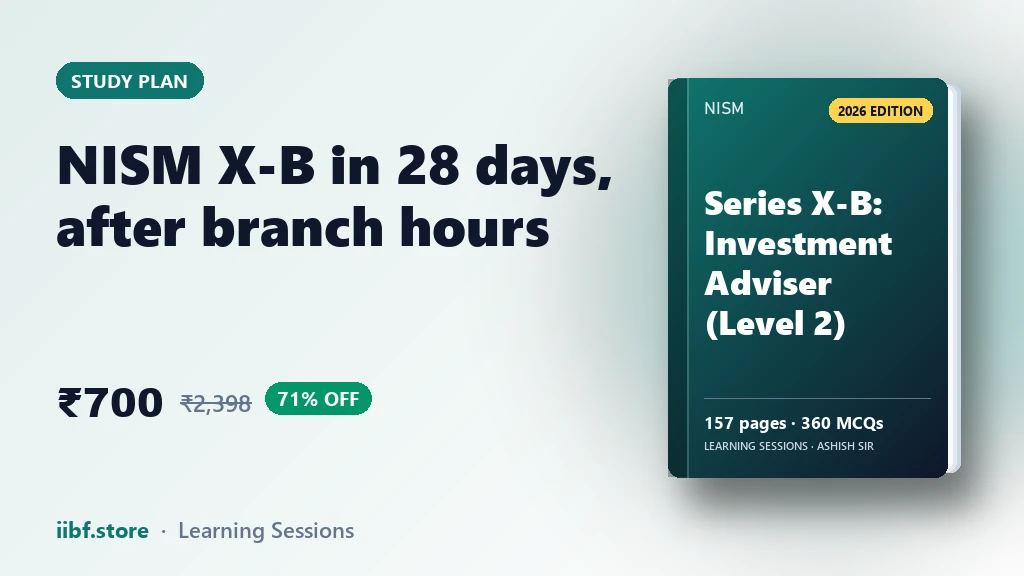
Any structured text can carry the plan above, including your own notes. What a compact book gives a tired reader is predictability: the same chapter order every night, the questions right behind the chapter, and nothing to hunt for. The Series X-B printed book is the 2026 edition, priced at ₹700 against an MRP of ₹2,398 (71 percent off), and it comes with two add-ons: 30 Case Studies carrying 120 questions, and 5 Mega Tests carrying 500 questions. A free sample is available on the book page if you want to see the layout before committing.
Those extras map neatly onto the last week of the table. The case studies suit days 26 and 27, when you need to practise combining modules. The mega tests are for the final run, when you want to feel the pace of a full paper.
Module-wise tips for the tired reader
Insurance and retirement (days 1 to 7)
Start with the needs-based view. In the retirement chapters, practise the estimation logic slowly, because the later product chapters assume you can follow it. Do not try to memorise product features in one pass; compare them in a small table in your notebook.
Tax (days 9 to 19)
This is the longest block and the one most likely to cause a drop in motivation. Split it by asset type, not by chapter number. Keep a running one-page sheet with one row per product: what is taxed, how it is classified, and any holding-period condition. Tax rules are revised often, so treat the book as your base and confirm anything you intend to use in real client advice against the latest official sources at the IIBF website and the relevant regulators.
Estate planning, behaviour and advice (days 20 to 28)
These chapters read like stories. Read them in the daytime if you can, such as a lunch break or a train ride, because they need less concentration than tax. Behavioural finance questions often hinge on recognising a bias from a short description, so after each chapter, write down two examples from clients or colleagues you have met. Risk profiling is where it all comes together: a profile, a goal, and a product that fits both.
Adding free practice around your NISM X-B study plan
You do not need to spend more to add variety. The free mock tests on iibf.store are useful for checking the pace of a timed attempt, and the free material library has PDFs you can use alongside your notes. You can also browse the full list of books if you are planning other certificates in the same year. For the official schedule of the upcoming exam cycle, always rely on the IIBF website rather than anyone's blog, including ours.
One honest limit
A book alone will not give you exam-hall speed. Reading and untimed questions build knowledge; timed full-length tests build speed and nerve. That is why the plan ends with mega tests, and why you should attempt at least one in a single sitting, phone away, exactly as you would in the exam.
If you fall behind: the recovery rules
You will miss days. A branch audit, a festival season rush or a sick child will break the pattern. Do not try to double up the next night. Instead:
- Drop the weekend revision, not the new chapter, once. The chapter is the foundation; the revision can be done in the final three days.
- If you are more than three days behind, cut days 26 to 28 from three to two by merging full revision and case studies. Never cut the mega test.
- If you are a week behind, move the exam attempt to the next window. A planned retry is better than a rushed fail.
Conclusion: a NISM X-B study plan you can actually keep
The best NISM X-B study plan is the one you are still following on day 20. Keep it small: one chapter, its questions, one line on every mistake. Protect the weekend revision. Treat the last three days as practice for the real thing. Whether you use the Series X-B book, your own notes, or a mix, the structure above gets 24 chapters done in four weeks of ordinary evenings. Start tonight with Module A, chapter one, and tick day 1.
Frequently asked questions
Can I really finish this paper in 28 days while working full time?
It is realistic if you can give about 90 minutes on weekdays and use weekends for revision. If your evenings are shorter, stretch the same plan to 5 or 6 weeks and keep the module order and the MCQ habit unchanged.
Which module should I study first?
Start with Module A (Insurance Planning). It is the lightest, builds the habit, and its needs-based thinking carries into retirement and advice later. Keep tax in the middle, when you are warmed up.
How many MCQs should I attempt each night?
Aim for the questions that belong to the chapter you read that day, which is about 15 on average across the 360 in the book. Redo your wrong answers on the weekend.
Is the book enough on its own?
It covers the chapter content and practice questions in a compact form, with case studies and mega tests as add-ons. For exam-hall speed, add timed mocks, such as the free ones on iibf.store, and check official exam details on the IIBF website.
Prefer revising from a printed book?
Chapter-wise books with MCQs after every chapter — minimal pages, complete coverage, delivered anywhere in India. Every book has a free sample to read first.



























Practice this topic
Take a free mock test, download chapter PDFs, or watch a video class — all included on iibf.store.