NPA Classification and Provisioning Norms in Indian Banks 2026
Understanding NPA classification and provisioning norms is one of the most important skills for any banker preparing for the CAIIB Advanced Bank Management paper. A Non-Performing Asset (NPA) is a loan or advance where the borrower has stopped paying interest or principal for a defined period, and the way a bank identifies, classifies and provisions for these assets directly affects its profitability and capital adequacy. The Reserve Bank of India lays down a detailed Income Recognition and Asset Classification (IRAC) framework that every scheduled commercial bank must follow. This article walks through the full journey of a loan from a healthy standard asset, through early stress signals, into the sub-standard, doubtful and loss categories, and explains exactly how much a bank must set aside as provisions at each stage. Mastering these NPA classification and provisioning norms will help you answer both the theory and numerical questions that regularly appear in the exam.
What Counts as an NPA Under RBI Norms
An asset becomes non-performing when it ceases to generate income for the bank. For a term loan, this happens when interest or an installment of principal remains overdue for more than 90 days. For a cash credit or overdraft account, the account is treated as NPA if it remains out of order continuously for 90 days, meaning the outstanding balance stays above the sanctioned limit or drawing power, or there are no credits sufficient to cover interest. In the case of bills purchased or discounted, the account turns NPA if the bill remains overdue for more than 90 days. For agricultural advances, a different yardstick applies: a loan for a short-duration crop is treated as NPA if the installment remains overdue for two crop seasons, while for long-duration crops the trigger is one crop season. The core principle behind all these rules is that classification is borrower-wise, not facility-wise, so if one account of a borrower becomes an NPA, all facilities extended to that borrower are generally treated as non-performing. This 90-day overdue norm is the foundation on which the entire IRAC framework rests, and examiners frequently test whether candidates know the exact overdue period for each type of facility.
SMA Categories: Early Warning Before an NPA
Before an account slips into NPA territory, RBI requires banks to flag it under the Special Mention Account (SMA) framework, which acts as an early warning system for incipient stress. For loans other than revolving credit, there are three sub-categories based on the number of days the principal or interest payment is overdue. An account is classified as SMA-0 when the payment is overdue between one and 30 days, SMA-1 when it is overdue between 31 and 60 days, and SMA-2 when it is overdue between 61 and 90 days. Once the overdue crosses 90 days, the account moves out of SMA and becomes an NPA. For revolving facilities like cash credit and overdraft, the SMA classification is based on the account remaining continuously out of order, with SMA-1 covering 31 to 60 days and SMA-2 covering 61 to 90 days. The SMA framework matters because banks must report large SMA accounts to the RBI's Central Repository of Information on Large Credits (CRILC), enabling the regulator to spot systemic stress early. For exam purposes, remember that SMA is not a provisioning category by itself; it is a monitoring and reporting stage that precedes NPA classification and gives the bank a window to take corrective action.
The Three NPA Sub-Categories and IRAC
Once an asset is classified as non-performing, the IRAC framework further sorts it into three categories that reflect the depth of the problem. A sub-standard asset is one that has remained an NPA for a period of up to 12 months. At this stage the RBI recognises that the credit weaknesses are well-defined and that there is a distinct possibility the bank will sustain some loss if deficiencies are not corrected. When the asset has remained in the sub-standard category for 12 months, it is downgraded to a doubtful asset. A doubtful asset carries all the weaknesses of a sub-standard asset with the added feature that full recovery is highly questionable and improbable. Doubtful assets are further aged into doubtful up to one year (D1), doubtful one to three years (D2) and doubtful more than three years (D3), because the provisioning requirement rises with the age of the doubtful asset. Finally, a loss asset is one where the loss has been identified by the bank, its internal or external auditors, or the RBI inspection, but the amount has not been fully written off. Such an asset is considered uncollectible and of such little value that its continuance as a bankable asset is not warranted, even though there may be some salvage or recovery value. Knowing this progression from sub-standard to doubtful to loss is essential for the numerical provisioning questions in the paper.
Provisioning Percentages You Must Memorise
Provisioning is the amount a bank charges to its profit and loss account to cover expected losses on non-performing assets, and the required percentages depend on the asset category and whether the loan is secured or unsecured. For a sub-standard asset, the general provision is 15 percent of the outstanding, with an additional 10 percent (taking it to 25 percent) on the unsecured portion where no security was available at the outset. For doubtful assets, the secured portion is provided for at 25 percent for D1, 40 percent for D2, and 100 percent for D3, while the unsecured portion of any doubtful asset always attracts a 100 percent provision regardless of age. A loss asset requires a full 100 percent provision, or the asset should be written off entirely. Standard assets are not provision-free either: banks must maintain a general provision on standard advances, typically 0.40 percent for most sectors, with higher rates for stressed sectors like commercial real estate. When a stressed loan is restructured, RBI's Prudential Framework for Resolution of Stressed Assets requires the bank to make an additional provision and, in most cases, to downgrade the account to NPA on restructuring, with an upgrade permitted only after a satisfactory performance period. Working through provisioning sums repeatedly, using both secured and unsecured splits, is the surest way to score full marks on this topic. You can reinforce these numbers using the practice sets on our mock test platform and by attempting quick daily drills through the concept matching game. For the authoritative source, always cross-check the Master Circular on Prudential Norms published by the Reserve Bank of India, which is updated periodically.
Conclusion: Turn NPA Norms Into Exam Marks
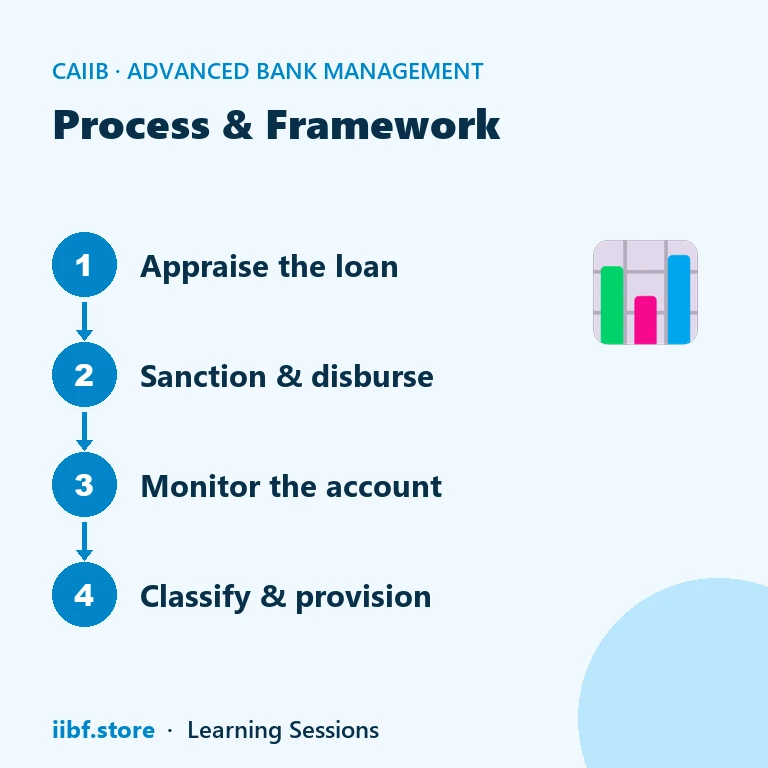
The topic of NPA classification and provisioning norms rewards candidates who can recall exact numbers under pressure: the 90-day overdue trigger, the SMA-0/1/2 buckets, the 12-month cut-offs between sub-standard and doubtful, and the ladder of provisioning percentages from 15 percent up to 100 percent. Rather than trying to memorise these in isolation, connect them into the single storyline of a loan going bad, and practise numerical questions until the calculations become automatic. Keep the latest RBI rates and circulars handy through our RBI rates reference, and read structured explainers on the wider syllabus on the iibf.store blog. When you are ready to convert this knowledge into a strong CAIIB score, enrol in the full CAIIB course, which covers Advanced Bank Management with detailed provisioning worksheets, video lessons and exam-focused revision.
What is the 90-day rule for NPA classification?
Under RBI norms, a term loan becomes a Non-Performing Asset when interest or principal remains overdue for more than 90 days. For cash credit or overdraft accounts the same 90-day out-of-order period applies, and for bills the bill must be overdue by more than 90 days.
How are SMA categories different from NPA categories?
SMA-0, SMA-1 and SMA-2 are early-warning stages covering overdue of 1-30, 31-60 and 61-90 days respectively. They are monitoring and reporting categories, not provisioning ones. An account becomes an NPA only after overdue crosses 90 days, at which point it is classified as sub-standard, doubtful or loss.
What is the provisioning percentage for a sub-standard asset?
A sub-standard asset attracts a general provision of 15 percent of the outstanding balance. Where the advance was unsecured from the beginning, an additional 10 percent is required, taking the provision on the unsecured portion to 25 percent.
When does a sub-standard asset become doubtful?
An asset that has remained in the sub-standard category for a continuous period of 12 months is downgraded to a doubtful asset. Doubtful assets are then aged as D1, D2 and D3, with rising provisioning requirements of 25, 40 and 100 percent on the secured portion.

Quick quiz on this topic
5 exam-style questions from our free test bank — check yourself before you move on.
Practice this topic
Take a free mock test, download chapter PDFs, or watch a video class — all included on iibf.store.
Keep reading