Packing Credit Explained: IIBF International Trade Finance Guide 2026
For every exporter, the hardest money to find is the money needed before a single container leaves the port. Raw materials must be bought, wages paid and goods packed long before the buyer overseas remits a rupee. This is exactly the gap that packing credit fills — a pre-shipment export finance facility that Indian banks extend against a confirmed order or a letter of credit. For candidates sitting the IIBF International Trade Finance (ITF) examination, packing credit is a high-yield topic: it links RBI export-credit regulation, foreign-exchange mechanics and risk cover into one practical product. This guide breaks down what it is, who qualifies, how the foreign-currency variant works, and how it differs from post-shipment finance, with exam-ready MCQs at the end.
📦 What Is Packing Credit?
Packing credit — also called pre-shipment credit or pre-shipment finance — is any loan or advance granted by a bank to an exporter for the purpose of purchasing, processing, manufacturing, warehousing or packing goods meant for export. The defining feature is purpose plus timing: the funds must be used to build up the export consignment, and they are released before the goods are shipped. Because the advance is need-based working capital, it is self-liquidating — it is expected to be repaid out of the eventual export proceeds rather than from the borrower's general cash flow.
The facility is normally sanctioned against evidence of a firm export order or an irrevocable letter of credit opened in the exporter's favour. In practice, banks look for a clear trail: the order or LC establishes that a genuine overseas buyer exists, and the drawings are then linked to the value of that order. RBI treats export credit as a priority activity, and historically pre-shipment rupee credit has attracted concessional treatment relative to ordinary commercial advances, though the actual interest rate is now deregulated and set by each bank's board. Understanding this product deeply also means understanding the wider ecosystem of trade finance instruments that surround it, from documentary credits to guarantees. Packing credit is where the exporter's working-capital cycle and the banking system's export-promotion mandate meet.
📝 Eligibility, Documents and the Running Account Facility
Any exporter with a valid Importer-Exporter Code (IEC) and a genuine export transaction can, in principle, access packing credit. The bank assesses the applicant much like any working-capital borrower — creditworthiness, track record and the commercial viability of the order — but the sanction is ring-fenced to export purposes. Support-manufacturers and back-to-back suppliers who feed the actual exporter can also be financed, so that the entire production chain is covered.
The core documents are the export order or letter of credit, the exporter's own stock and processing records, and, at the disbursement stage, evidence that the money is being deployed on the specific consignment. To reduce paperwork for regular exporters, RBI permits a Running Account facility: banks may extend pre-shipment credit without insisting that each drawing be tied to a specific LC or order upfront, provided the exporter has a good track record and the individual orders or LCs are produced within a reasonable period. This is a genuine operational relief — it lets seasoned exporters draw funds as soon as a season's raw-material buying begins, rather than waiting for each contract to be papered. Proper handling of the underlying trade transactions is essential, because the credit remains conditional on the goods actually being exported.
💡 Exam Tip: Under the Running Account facility, the export order or LC need not be produced at the moment of drawing, but it must be submitted within a reasonable period — the facility rewards track record, it does not waive the export obligation.
💱 PCFC: Packing Credit in Foreign Currency
Not every exporter wants to borrow in rupees. If the underlying inputs are themselves imported, or if the exporter wants to hedge the interest cost against the export currency, a rupee loan creates a currency mismatch. Packing Credit in Foreign Currency (PCFC) solves this by letting the bank disburse the pre-shipment advance directly in a foreign currency such as US dollars, euros or pounds. The exporter thus borrows and repays in the same currency the export will earn, and the interest is benchmarked to an international reference rate plus a spread, rather than to the domestic rupee cost of funds.
PCFC is particularly attractive when international interest rates are lower than domestic ones, because the all-in cost can be materially cheaper than rupee packing credit. The advance is liquidated out of the export proceeds when the bill is negotiated or purchased, and the same foreign-currency pool can flow seamlessly into post-shipment finance. Banks fund PCFC from their own foreign-currency resources, lines from correspondent banks, or the exchange earners' foreign currency balances they hold. Because PCFC introduces exchange-rate and interest-rate exposure for both the bank and the borrower, sound risk management — including matched funding and clear hedging norms — is central to running the product safely. For the exam, remember the essence: PCFC is packing credit denominated in foreign currency, chosen to align the currency of borrowing with the currency of earning.
📌 Remember: Rupee packing credit and PCFC serve the same pre-shipment purpose; PCFC simply switches the currency so the exporter borrows and repays in the export currency.
⏱️ Tenor, Liquidation and ECGC Cover
Packing credit is short-term by design. The advance is granted for the period reasonably required to procure, manufacture and ship the goods, and it must be liquidated once the goods are exported. Where shipment is delayed for genuine reasons, banks may allow extensions, but a pre-shipment advance that is not backed by an actual export loses its concessional character — if the goods are never shipped, the outstanding is treated as an ordinary commercial advance and repriced accordingly. The classic route of liquidation is conversion: pre-shipment credit is squared off by the proceeds of the export bill, either by transferring it into post-shipment finance or by direct receipt of the remittance.
Risk cover comes from two directions. The Export Credit Guarantee Corporation (ECGC) offers credit-insurance products — including packing-credit covers — that protect the lending bank against the exporter's insolvency or protracted default, encouraging banks to lend more freely. Separately, RBI's regulatory framework governs how export credit must be classified, reported and priced. Candidates should be able to connect packing credit to the broader regulatory framework that supervises trade finance in India. Government support schemes for export-credit interest have existed and been revised from time to time; the durable principle to carry into the exam is that packing credit is a self-liquidating, purpose-bound, short-term advance repaid from export earnings and commonly backstopped by ECGC cover.
⚠️ Common Mistake: Assuming packing credit stays concessional even if goods are never exported. If the export does not materialise, the advance is reclassified and loses its export-credit treatment.
📊 Pre-Shipment vs Post-Shipment Export Credit
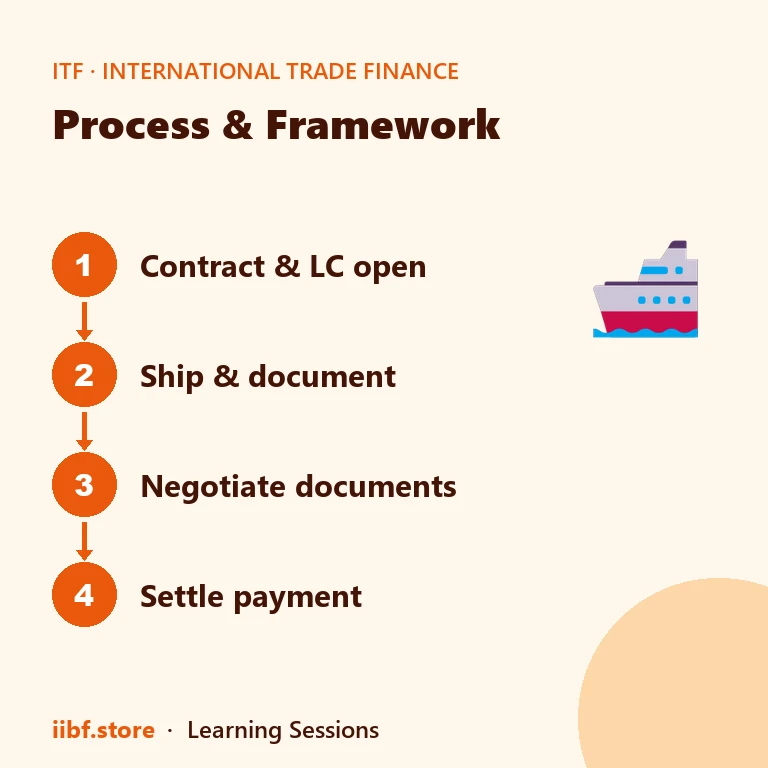
The single most tested distinction in this area is pre-shipment versus post-shipment finance. Both are export credit, but they sit at opposite ends of the shipment event.
| Feature | Pre-Shipment (Packing Credit) | Post-Shipment | Self-Liquidating? |
|---|---|---|---|
| Timing | Before goods are shipped | After goods are shipped | ✅ |
| Purpose | Procure, process, pack the consignment | Bridge the gap until buyer pays | ✅ |
| Typical security | Export order / LC + goods being built up | Export bills / shipping documents | ✅ |
| Foreign-currency variant | PCFC | Rediscounting of export bills (EBR) | ✅ |
| Liquidation source | Export proceeds / conversion to post-shipment | Receipt of overseas remittance | ✅ |
| Runs after non-export? | Reclassified as ordinary advance | Not applicable | ❌ |
Packing credit rarely lives alone. Exporters who need to remove the credit risk of the buyer entirely often pair it with forfaiting and factoring, while those relying on documentary payment terms should master Letters of Credit UCPDC 600 and, for performance obligations, bank guarantees. Because trade finance is a favourite conduit for illicit flows, exporters and banks must also run robust sanctions screening in banks on counterparties before any pre-shipment limit is drawn. Explore more on the International Trade Finance tag hub, and if you are building toward the broader banking qualifications, the JAIIB course lays the groundwork.
📚 Official reference: Always verify the latest rules, circulars and thresholds on the Reserve Bank of India (RBI) website before your exam — regulations change and only primary sources are authoritative.
🧠 Practice MCQs: Packing Credit
Q1. Packing credit is best described as which type of export finance? (a) Post-shipment finance (b) Pre-shipment finance (c) Buyer's credit (d) Term loan for machinery
Answer: (b) — Packing credit is pre-shipment finance granted to procure, process and pack goods before they are shipped.
Q2. Packing credit is normally granted against which of the following? (a) The exporter's personal savings (b) A firm export order or an irrevocable letter of credit (c) A domestic sales invoice (d) A fixed-deposit receipt only
Answer: (b) — A confirmed export order or an LC in the exporter's favour establishes the genuine export transaction the advance is tied to.
Q3. PCFC refers to which facility? (a) Post-shipment Credit in Foreign Currency (b) Packing Credit in Foreign Currency (c) Priority Credit for Farmers Cooperatives (d) Pre-shipment Cash Flow Cover
Answer: (b) — PCFC is packing credit disbursed in a foreign currency so the exporter borrows and repays in the export currency.
Q4. If goods against a packing-credit advance are never exported, the advance is generally: (a) Written off automatically (b) Converted into a fixed deposit (c) Reclassified and loses its concessional export-credit treatment (d) Converted into equity
Answer: (c) — Without an actual export, the advance is treated as an ordinary commercial advance and repriced.
Q5. The Running Account facility for packing credit primarily benefits exporters by: (a) Waiving the export obligation entirely (b) Allowing drawings without tying each one to a specific order upfront, subject to track record (c) Guaranteeing a fixed interest rate for life (d) Removing the need for an IEC
Answer: (b) — It lets good-track-record exporters draw funds without pre-linking each drawing to an order, with the LC/order produced within a reasonable period.
Want chapter-wise mock tests with 100+ MCQs? Start practising free →
❓ Frequently Asked Questions
Is packing credit the same as post-shipment credit?
No. Packing credit is pre-shipment finance used to buy, process and pack goods before shipment, while post-shipment credit bridges the gap between shipment and receipt of the buyer's payment. Packing credit is typically converted into post-shipment finance once the goods are shipped.
What documents does a bank need to sanction packing credit?
The core evidence is a firm export order or an irrevocable letter of credit in the exporter's favour, along with the exporter's IEC and processing records. Under the Running Account facility, the order or LC can be produced within a reasonable period rather than at each drawing.
How is a packing-credit advance repaid?
It is self-liquidating: it is squared off from the export proceeds, usually by converting the pre-shipment advance into post-shipment finance when the export bill is negotiated, or by direct receipt of the overseas remittance.
What is the role of ECGC in packing credit?
ECGC offers credit-insurance covers, including packing-credit covers, that protect the lending bank against the exporter's insolvency or protracted default. This risk cover encourages banks to extend export credit more readily.
🎯 Conclusion
Packing credit sits at the heart of export finance: a short-term, purpose-bound, self-liquidating advance that funds the exporter's working-capital cycle before shipment and is repaid from export earnings, often with ECGC cover behind it. Master the rupee-versus-PCFC choice, the Running Account facility and the pre- versus post-shipment distinction, and you have locked in a reliable cluster of ITF marks. Ready to test yourself under exam conditions? Take a free ITF mock test now → and review the full syllabus through the JAIIB course.
Practice this topic
Take a free mock test, download chapter PDFs, or watch a video class — all included on iibf.store.