Performance Management System in Banks: CAIIB HRM Guide

For bankers preparing for the CAIIB Human Resource Management elective, mastering the performance management system in banks is non-negotiable. The performance management system in banks is the structured process through which a bank sets goals, measures employee contribution, gives feedback, and links results to rewards and career growth. Far more than the once-a-year appraisal form, it is a continuous cycle that aligns individual effort with the bank's strategic objectives, drives accountability, and builds a high-performance culture. This article unpacks the concept, its core stages, the methods examiners love to test, and the modern shifts you must know for the exam.
What the Performance Management System in Banks Really Means
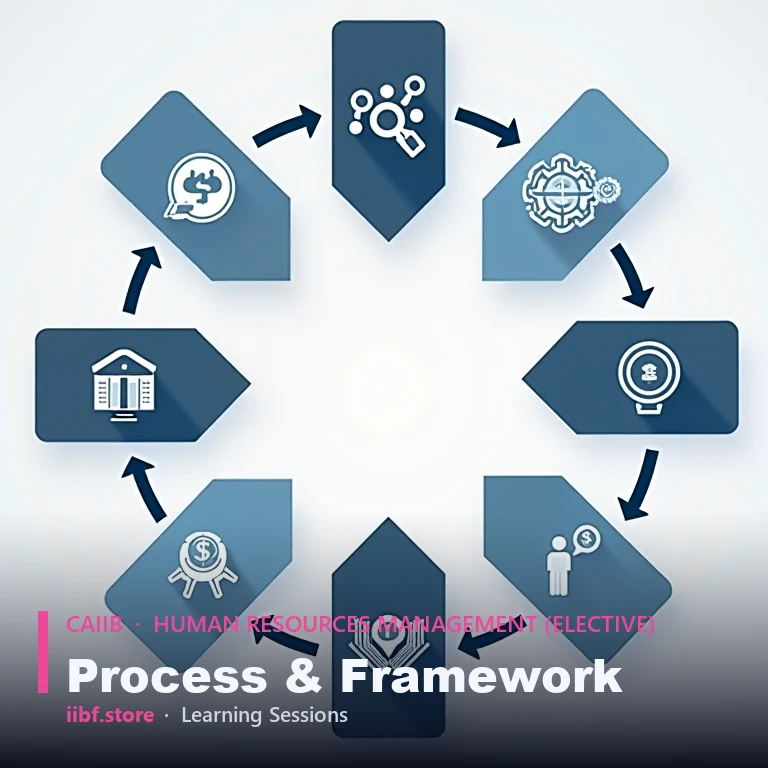
The performance management system in banks is best understood as a closed-loop cycle rather than an isolated event. It begins with planning, where the manager and employee jointly agree on Key Result Areas (KRAs) and measurable targets such as deposit mobilisation, advances growth, recovery, cross-sell, and customer service scores. The second stage is continuous monitoring, where progress is tracked and mid-year reviews keep the employee on course. The third stage is developing capability through coaching, training, and on-the-job guidance. The fourth stage is the formal appraisal, where actual achievement is rated against agreed standards. The final stage is rewarding and reviewing, where increments, promotions, and developmental plans flow from the rating.
What distinguishes a good system from a mere ritual is its forward-looking nature. A well-designed system in a bank does not simply judge the past; it identifies competency gaps, plans for the future, and motivates staff. It must satisfy three masters at once: the organisation, which needs productivity; the manager, who needs a fair basis for decisions; and the employee, who needs clarity, feedback, and growth. When these align, the bank gains a measurable edge in service quality and profitability.

The Performance Appraisal Cycle and Its Key Stages
The appraisal cycle is the operational heart of the framework, and exam questions frequently test the sequence and purpose of each stage. The cycle typically runs as follows:
- Goal setting: SMART objectives (Specific, Measurable, Achievable, Relevant, Time-bound) are framed collaboratively at the start of the financial year.
- Performance standards: Clear benchmarks define what "meets", "exceeds", or "falls short of" expectation looks like for each KRA.
- Continuous feedback: Periodic one-on-one reviews replace surprise judgements, allowing course correction.
- Appraisal and rating: The appraiser scores actual performance, often supported by a self-appraisal from the employee.
- Appraisal interview: A two-way discussion communicates the rating, recognises strengths, and agrees an action plan.
- Reward and development decisions: Increments, incentives, promotions, training nominations, or, where needed, a performance improvement plan.
A recurring exam theme is the difference between a trait-based approach (judging personality) and a results-based approach (judging outcomes). Modern banks lean heavily on results and behaviour because they are objective and defensible. Candidates revising this cycle alongside the structured material in the CAIIB course will find the stages easier to recall under exam pressure.
Common Methods of Performance Appraisal
Examiners expect you to distinguish the major appraisal methods, their strengths, and their limitations. The classical and modern techniques most relevant to banking include:
- Ranking method: Employees are ordered from best to worst. Simple but unsuitable for large branches and offers no developmental insight.
- Graphic rating scale: Traits and results are scored on a numeric scale. Easy to use but prone to central-tendency and halo errors.
- Management by Objectives (MBO): Performance is measured purely against jointly set, quantifiable goals — highly relevant to target-driven banking roles.
- Behaviourally Anchored Rating Scales (BARS): Combines numeric ratings with specific behavioural examples, improving objectivity.
- 360-degree feedback: Inputs are gathered from superiors, peers, subordinates, and sometimes customers, giving a rounded view of a manager's effectiveness.
- Assessment centres: Used mainly for promotion to higher grades, combining exercises, simulations, and interviews.
Equally testable are the rating errors that distort fairness: the halo effect, horn effect, central tendency, leniency or strictness bias, and the recency effect. A robust performance management system in banks builds in safeguards such as multiple raters, behavioural anchors, and normalisation to counter these biases. To drill these distinctions, candidates often use the rapid-recall format on the match game and benchmark themselves with the practice sets on the IIBF mock tests.

Linking Appraisal to Rewards, Development and Banking Outcomes
The ultimate test of any appraisal framework is what it triggers afterwards. In banks, ratings feed three outcomes: rewards (performance-linked increments and incentives), development (training, job rotation, mentoring), and decisions (promotion, placement, or improvement plans). The link to rewards must be transparent and merit-based to retain talent, yet calibrated so that it does not encourage mis-selling or reckless risk-taking — a concern the regulator watches closely. Indeed, the compensation guidelines issued by the Reserve Bank of India for whole-time directors and material risk-takers explicitly require that variable pay align with prudent risk management and be subject to malus and clawback. For the wider workforce, the appraisal also identifies high-potential employees for succession planning and flags skill gaps that shape the bank's training calendar. A system that connects fair measurement to genuine growth is what converts an HR formality into a strategic lever, and staying current via the latest IIBF news helps you track how these practices evolve.
Frequently Asked Questions
What is the difference between performance appraisal and performance management?
Performance appraisal is a single component — the periodic rating of an employee's results against standards. Performance management is the broader, continuous cycle that includes goal setting, ongoing feedback, development, appraisal, and rewards. Appraisal looks back at the past; management is forward-looking and developmental, aligning individual effort with the bank's strategy throughout the year.
Why is 360-degree feedback useful in banks?
360-degree feedback collects views from superiors, peers, subordinates, and sometimes customers, giving a rounded picture of an employee's behaviour and leadership. In banks, where teamwork and customer service are critical, it reduces the bias of a single appraiser, highlights interpersonal and service competencies, and is especially valuable for assessing branch managers and supervisory staff being considered for higher responsibility.
What are common rating errors examiners ask about?
The frequently tested errors are the halo effect (one good trait inflating the whole rating), the horn effect (its opposite), central tendency (rating everyone average), leniency or strictness bias, and the recency effect (recent events overshadowing the full period). Banks counter these with behavioural anchors, multiple raters, training of appraisers, and rating normalisation.
How does the RBI influence performance-linked pay in banks?
The RBI's compensation guidelines require that variable pay for senior staff and material risk-takers be aligned with prudent risk-taking. They mandate deferral of a portion of variable pay, and malus and clawback provisions so that rewards can be withheld or recovered if risks materialise later. This ensures the appraisal-to-reward link does not encourage short-term, reckless behaviour.
Conclusion and Next Steps
A well-run performance management system in banks turns measurement into motivation: it sets clear goals, gives honest feedback, develops people, and rewards genuine contribution while guarding against bias and undue risk. For the CAIIB HRM paper, focus on the cycle's stages, the major appraisal methods, the rating errors, and the regulatory link to compensation. Ready to test your command of these concepts? Attempt a focused mock on iibf.store practice tests and reinforce the wider syllabus with the structured CAIIB classes before exam day.
Quick quiz on this topic
5 exam-style questions from our free test bank — check yourself before you move on.
Practice this topic
Take a free mock test, download chapter PDFs, or watch a video class — all included on iibf.store.
Keep reading