Phishing Attacks in Banking: Prevention of Cyber Crime Guide
Of all the threats facing a modern bank, few are as persistent and as human as phishing attacks in banking. Behind almost every large financial fraud lies a moment when someone was tricked into clicking a link, revealing a password, or approving a transaction they should have questioned. For candidates preparing for the Prevention of Cyber Crime certification, understanding how phishing works — and how to defend against it — is foundational, because it connects technology, psychology and regulation in one topic.
Phishing attacks in banking are fraudulent attempts to obtain sensitive information — login credentials, card details, one-time passwords or account numbers — by masquerading as a trustworthy entity. Unlike attacks that break through firewalls, phishing exploits the weakest link in any security chain: the human being. This is why awareness, not just technology, is the strongest defence, and why regulators treat customer education as a core part of cyber-crime prevention.
How Phishing Works and Its Many Faces
At its core, a phishing attack is a confidence trick delivered through a digital channel. The classic form is a fraudulent email that appears to come from a bank, urging the recipient to "verify" their account by clicking a link that leads to a cloned website. But phishing attacks in banking have evolved into many variants. Spear phishing targets a specific individual with personalised detail; whaling goes after senior executives; smishing uses SMS; and vishing uses voice calls, often impersonating bank officials or the RBI itself.
What unites all these variants is social engineering — the manipulation of trust, urgency and fear. A message that warns your account "will be blocked in two hours" is engineered to override rational judgement and provoke an immediate, unthinking response. The Reserve Bank of India regularly cautions customers, through advisories published at rbi.org.in, that it never asks for passwords, OTPs or card details. Recognising the psychological levers — urgency, authority, scarcity and fear — is the first practical skill a cyber-crime professional must develop, and it recurs across our certification course.
Technical and Human Defences
Defending against phishing attacks in banking requires layers, because no single control is sufficient. On the technical side, banks deploy email authentication protocols such as SPF, DKIM and DMARC to make it harder to spoof their domains, alongside secure gateways that filter malicious links and attachments. Multi-factor authentication is perhaps the most powerful single control, because even a stolen password is useless without the second factor — though attackers now attempt real-time OTP interception, which is why customers must never share an OTP with anyone.
Yet technology alone cannot close the gap. The human layer is decisive: staff and customers must be trained to pause, inspect the sender's address, hover over links before clicking, and treat any unsolicited request for credentials as hostile until proven otherwise. Banks run simulated phishing campaigns to keep employees alert and measure their resilience. For customers, clear, repeated messaging — never share your OTP, never click links in unexpected messages, always type the bank's URL yourself — remains the highest-return investment in security. Test your grasp of these controls on our mock tests and reinforce the vocabulary with quick match games.
The Legal and Regulatory Response
When prevention fails, the law provides recourse, and phishing attacks in banking sit squarely within India's cyber-law framework. The Information Technology Act, 2000 criminalises identity theft, cheating by personation using a computer resource, and unauthorised access — the very acts that phishing entails. Sections dealing with dishonest receipt of stolen computer resources and fraudulent use of another's electronic signature give investigators the tools to prosecute offenders, while the RBI's cyber-security directions require banks to maintain robust fraud-detection and incident-response capabilities.
Equally important is the customer-protection dimension. RBI guidelines on limiting customer liability in unauthorised electronic transactions mean that a customer who reports fraud promptly and was not negligent may bear little or no loss, shifting the incentive firmly toward banks to prevent and detect phishing. Rapid incident reporting — to the bank, to the national cyber-crime portal, and where relevant to CERT-In — is essential to freeze funds and preserve evidence. For the exam, be ready to connect a phishing scenario to the relevant IT Act provisions and RBI expectations. Stay current through IIBF news updates and explore more explainers on the blog.
Frequently Asked Questions
What are phishing attacks in banking?
Phishing attacks in banking are fraudulent attempts to steal sensitive information such as passwords, OTPs or card details by impersonating a trusted entity like a bank. They exploit human trust through social engineering rather than breaking technical defences.
What is the difference between phishing, smishing and vishing?
Phishing typically uses email, smishing uses SMS text messages, and vishing uses voice phone calls. All three rely on social engineering to trick victims into revealing confidential banking information or approving fraudulent transactions.
How can customers protect themselves from phishing?
Customers should never share OTPs or passwords, avoid clicking links in unexpected messages, type the bank's URL manually, enable multi-factor authentication, and treat any urgent request for credentials as suspicious. The RBI never asks for such details.
Which law covers phishing in India?
The Information Technology Act, 2000 covers phishing through provisions on identity theft, cheating by personation using a computer resource, and unauthorised access. RBI cyber-security directions and customer-liability guidelines further govern banks' prevention and response duties.
Conclusion and Next Steps
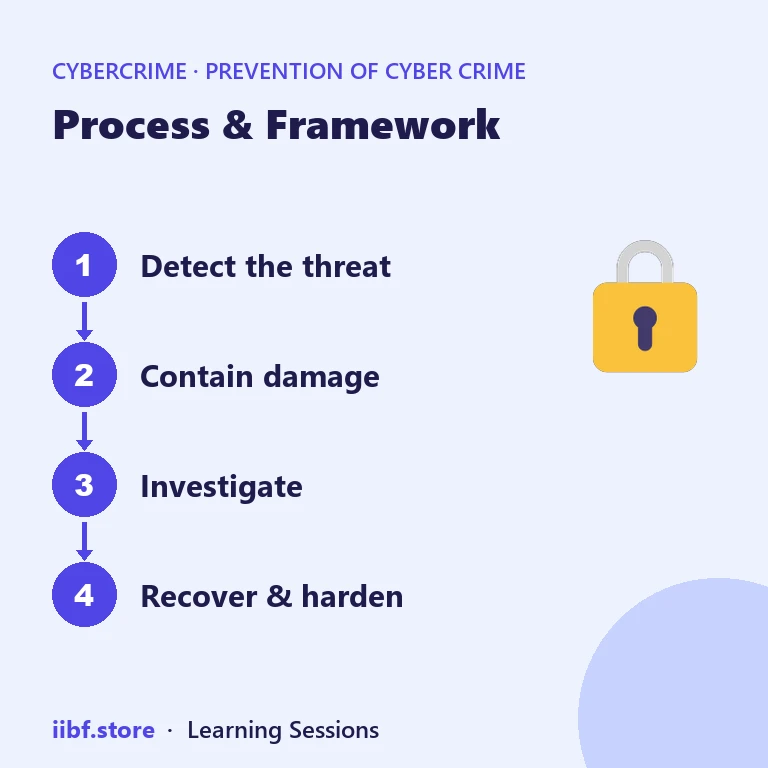
Phishing attacks in banking remain the most common gateway to financial fraud precisely because they target people, not just systems. Mastering the variants, the layered defences, and the legal framework under the IT Act equips you to prevent, detect and respond effectively — and to answer the scenario-based questions the Prevention of Cyber Crime exam favours. Remember that awareness is the strongest firewall a bank owns. Ready to test yourself? Attempt a focused mock on our practice tests and dive into the full cyber-crime prevention course.
Practice this topic
Take a free mock test, download chapter PDFs, or watch a video class — all included on iibf.store.