Avoidance Transactions Under IBC 2016: Preferential, Undervalued & Fraudulent Deals
Not every transaction that drains value from a failing company is an honest loss — some are deliberate. Avoidance transactions under IBC are the legal tool the Code uses to claw back that value for creditors. For JAIIB and CAIIB candidates, it's a compact, high-yield topic: four sections, four transaction types, and look-back periods examiners love to mix up.
🔍 What Are Avoidance Transactions Under IBC 2016?
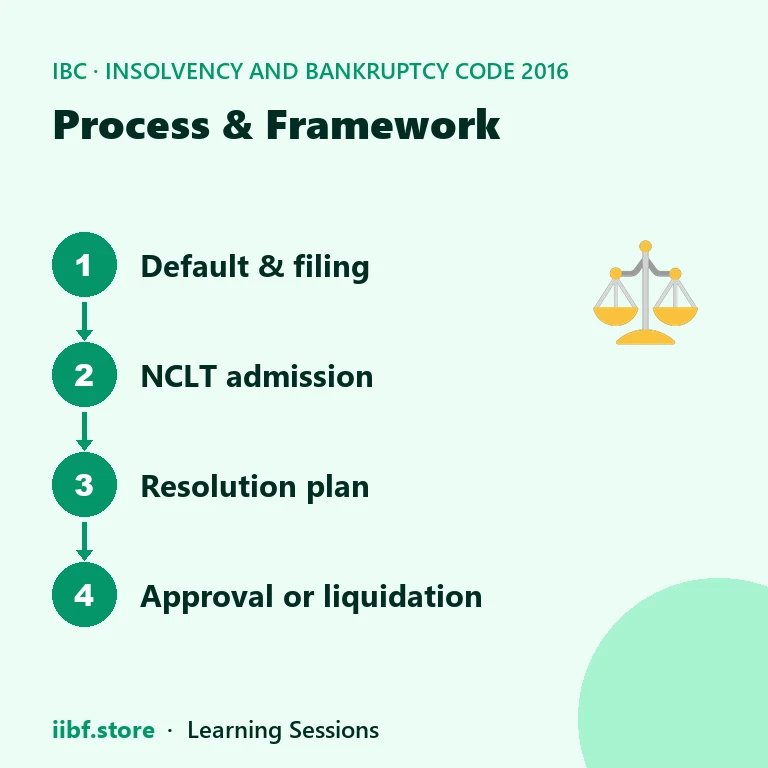
Once Corporate Insolvency Resolution Process (CIRP) begins, the resolution professional (RP) must look backward, not just forward. Directors and promoters of a distressed company sometimes move assets to related parties, repay favoured creditors, or strike deals at unfair value ahead of insolvency, to keep those assets out of reach of the creditor pool. The Code calls these "avoidance transactions" and empowers the RP or liquidator to apply to the NCLT to reverse them. Chapter IV of Part II (Sections 43 to 51, plus Section 66) sets out four categories: preferential, undervalued, extortionate credit, and fraudulent or wrongful trading — each with its own trigger and look-back window measured backward from the insolvency commencement date (ICD), the date the NCLT admits the CIRP application. Getting these timelines straight builds on the broader CIRP under IBC 2016 process candidates already know.
📉 Preferential Transactions — Section 43
A preferential transaction happens when the corporate debtor transfers property or pays a debt to a creditor, surety or guarantor that puts that party in a better position than it would have got in a normal liquidation waterfall. Section 43 checks the transaction against a look-back period counted backward from the ICD: one year for an unrelated party, extended to two years where the counterparty is related to the debtor. This asymmetry exists because related-party dealings carry a higher collusion risk, so the Code gives the RP a longer window to catch them. Ordinary transactions in the normal course of business, or those made to a new value creditor without security, are generally excluded. On finding one, the RP applies to the NCLT, which can order the property returned, the security released, or the payment reversed.
💡 Exam Tip: Whenever a question gives you a transaction date and asks whether it's "preferential," the first thing to check is whether the counterparty is related or unrelated — that single fact decides whether the look-back is 1 year or 2 years.
⚖️ Undervalued and Extortionate Credit Transactions
Section 45 covers undervalued transactions — where the corporate debtor makes a gift or sells an asset for far less than its market value, with no legitimate business justification. The look-back mirrors Section 43: one year for unrelated parties, two years for related parties. Section 50 is narrower and sharper — extortionate credit transactions, where the debtor received credit on exorbitant or unconscionably harsh terms. Here the look-back is a flat two years regardless of relationship, since the harm lies in the credit terms themselves. In both cases the RP files an application, and the adjudicating authority can restore the original position, set aside the transaction, or vary the credit terms — a doctrine candidates revising the evolution of the Insolvency and Bankruptcy Code will recognise from UK and US avoidance law.
⚠️ Common Mistake: Students often merge Section 43 and Section 45 into one rule. Preferential transactions are about who got paid and when; undervalued transactions are about what the debtor received in return. A transaction can be both — but they are tested as separate concepts.
🚨 Fraudulent Trading and Wrongful Trading — Section 66
Section 66 is the sharpest tool in the avoidance chapter and stands apart from the other three. If the RP or liquidator finds the business was carried on with intent to defraud creditors, they can apply to the NCLT to make directors or partners personally liable to contribute to the company's assets — piercing the usual limited-liability shield. Unlike Sections 43, 45 and 50, Section 66 carries no fixed look-back tied to the ICD; liability can attach to conduct at any point before insolvency where fraudulent intent is shown. A wrongful-trading limb also lets the NCLT hold a director liable if they knew, or ought to have known, there was no reasonable prospect of avoiding insolvency and failed to minimise creditor loss. This is why the roles and duties of the IRP and RP chapter treats forensic scrutiny of past transactions as a core obligation, not an optional add-on.
| Section | Transaction Type | Look-back Period (before ICD) | Related-Party Window Extended? |
|---|---|---|---|
| 43 | Preferential transactions | 1 year (unrelated party) | ✅ Yes — 2 years for related party |
| 45 | Undervalued transactions | 1 year (unrelated party) | Yes — 2 years for related party |
| 50 | Extortionate credit transactions | 2 years (flat) | No — same for all parties |
| 66 | Fraudulent / wrongful trading | No fixed period | ❌ Not applicable |
🏛️ How the Resolution Professional Investigates These Deals
In practice, avoidance-transaction scrutiny is one of the RP's earliest jobs after taking charge, running alongside claim verification and forming the Committee of Creditors. The RP reviews books of account, bank statements and related-party registers through the applicable look-back windows, flags suspicious entries, and files a Section 43/45/50/66 application with the NCLT before the resolution plan is finalised, since recoveries add to the value distributable to creditors. This diligence begins right from commencement of CIRP. If the company moves to liquidation instead of a resolution plan, clawed-back amounts feed into the priority order under Section 53 liquidation waterfall.
📌 Remember: Avoidance applications don't pause the resolution process — CIRP and the NCLT proceeding on a Section 43/45/50/66 application can run side by side, and any recovery is added to the estate available for distribution.
📚 Why This Topic Matters for JAIIB and CAIIB
Avoidance transactions sit at the intersection of insolvency law and everyday credit monitoring — the same red flags an RP hunts for (related-party sales below market value, sudden repayments to one lender, unusually generous credit terms) are what credit officers are trained to catch earlier. That overlap is also why this topic pairs naturally with NPA classification and provisioning, since accounts showing these signs are usually already slipping down the asset-classification ladder. IIBF papers typically test this chapter with short scenarios: given a transaction date, a counterparty type and a look-back period, identify the correct section. Mastering the four-way distinction above beats memorising sections in isolation.
Official sources: cross-check the latest syllabus, circulars and rates on the IIBF official website and the Reserve Bank of India.
🧠 Practice MCQs: Avoidance Transactions Under IBC 2016
Q1. Under Section 43 of the IBC, what is the look-back period for a preferential transaction with a related party of the corporate debtor? (a) 6 months (b) 1 year (c) 2 years (d) 3 years
Answer: (c) — For related parties, Section 43's look-back is extended to two years before the insolvency commencement date.
Q2. Which section of the IBC deals specifically with extortionate credit transactions? (a) Section 43 (b) Section 45 (c) Section 50 (d) Section 66
Answer: (c) — Section 50 covers extortionate credit transactions, with a flat two-year look-back for all parties.
Q3. What primarily distinguishes an undervalued transaction under Section 45 from a preferential transaction under Section 43? (a) The look-back period is always shorter (b) It focuses on inadequate consideration received by the debtor, not on which creditor was favoured (c) It only applies to related parties (d) It cannot be challenged before the NCLT
Answer: (b) — Section 45 targets transactions where the debtor received far less value than it gave; Section 43 targets favouring one creditor over others.
Q4. Under Section 66 of the IBC, personal liability for fraudulent trading can be imposed on directors: (a) Only for conduct within 1 year before the ICD (b) Only for conduct within 2 years before the ICD (c) With no fixed look-back period tied to the ICD (d) Only after liquidation is complete
Answer: (c) — Section 66 has no fixed look-back window; liability attaches whenever the fraudulent conduct occurred, once proved.
Q5. Who has the authority to apply to the NCLT to reverse an avoidance transaction during CIRP? (a) Any unsecured creditor directly (b) The resolution professional or liquidator (c) The corporate debtor's auditor (d) The Committee of Creditors' chairperson only
Answer: (b) — The RP during CIRP, or the liquidator during liquidation, applies to the NCLT to reverse avoidance transactions.
Want chapter-wise mock tests with 100+ MCQs? Start practising free →
What are avoidance transactions under IBC 2016?
Transactions entered into by a corporate debtor before insolvency that unfairly reduce the value available to creditors — covering preferential (Section 43), undervalued (Section 45), extortionate credit (Section 50), and fraudulent or wrongful trading (Section 66).
Who can challenge an avoidance transaction before the NCLT?
Only the resolution professional during CIRP, or the liquidator during liquidation, can file an application to have it reversed or set aside.
Why is the look-back period longer for related-party transactions?
Related-party dealings carry a higher risk of collusion, so Sections 43 and 45 extend the look-back from one year to two years when the counterparty is related to the debtor.
Does Section 66 fraudulent trading have a fixed look-back period like Section 43?
No. Section 66 does not tie liability to a fixed period before the insolvency commencement date — a director can be liable for fraudulent conduct whenever it occurred, once proved.
Keep This Chapter Exam-Ready
Avoidance transactions are a small chapter with an outsized share of scenario questions in JAIIB and CAIIB papers. Lock in the four sections, their look-back periods, and who can apply — then pressure-test yourself with full-length mocks on iibf.store's CAIIB course or browse more IBC 2016 articles to round out the rest of the Code before exam day.
Quick quiz on this topic
5 exam-style questions from our free test bank — check yourself before you move on.
Practice this topic
Take a free mock test, download chapter PDFs, or watch a video class — all included on iibf.store.