Retail Banking Customer Segmentation: A JAIIB RBWM Guide

For JAIIB candidates preparing the Retail Banking and Wealth Management (RBWM) paper, understanding retail banking customer segmentation is one of the highest-yield topics you can master. Segmentation is the discipline of grouping a bank's individual customers by needs, income, life-stage and behaviour so that products, service levels and pricing can be tailored to each group. It sits at the heart of how modern retail banks earn fee income, improve branch profitability and cross-sell wealth products. This guide walks you through the concept, the standard customer tiers Indian banks use, the products mapped to each tier, and the exam angles most likely to appear in your JAIIB RBWM question paper. Whether you are revising from the IIBF courseware or a coaching module, treat this as a structured refresher you can revisit before test day.
What Retail Banking Customer Segmentation Means
Retail banking is the mass-market business of serving individuals and small households rather than large corporates. Because a single branch may serve tens of thousands of customers with very different needs, banks cannot offer a one-size-fits-all relationship. Segmentation solves this by dividing the customer base into manageable groups that share common characteristics. The most common bases are demographic (age, income, occupation), geographic (metro, urban, semi-urban, rural), behavioural (transaction frequency, channel preference, product holding) and psychographic (risk appetite, lifestyle). A young salaried professional in a metro needs a salary account, a credit card and a small SIP; a retired pensioner in a semi-urban town needs a monthly-income scheme, health insurance and a simple fixed deposit. By recognising these differences, the bank can design targeted offers, set appropriate service standards, and price relationships to reflect the value each segment brings.
For the JAIIB exam, remember that segmentation is not merely a marketing exercise — it directly supports the profitability and role of the retail branch. A well-segmented base lets relationship managers focus effort where returns are highest while automating service for low-value, high-volume customers. This links tightly to the courseware chapters on introduction of retail banking and retail banking concepts, which frame segmentation as a core operational strategy rather than an afterthought.
The Standard Customer Tiers Indian Banks Use
Most Indian banks organise their retail base into a pyramid of value tiers. At the base sits the mass-market or "regular" customer — the largest group by number, served mainly through digital channels, ATMs and the branch counter. Above this is the mass-affluent or "preferred" segment, typically customers who maintain a higher average balance or hold a salary relationship, and who receive priority service and a dedicated helpline. Near the apex sits the High Net-worth Individual (HNI) segment, often defined by banks internally as those with substantial investable surplus, who are served by a named relationship manager and offered privileged banking, portfolio advisory and lifestyle privileges. Some banks add an "ultra-HNI" or private-banking layer at the very top for the wealthiest families.
There is no single regulatory definition of "HNI" — the thresholds are set by each bank commercially, so in the exam speak qualitatively rather than quoting a fixed rupee figure. What matters is the logic: as you move up the pyramid, customer numbers fall but per-customer profitability and product complexity rise. The mass segment drives volume and low-cost CASA deposits; the affluent and HNI segments drive fee income from wealth products, insurance and advisory. This tiering directly shapes branch staffing and cost, a theme explored in the courseware unit on branch profitability. Understanding which products attach to which tier is a frequent source of exam questions.
Products and Service Levels Mapped to Each Segment
The practical payoff of segmentation is matching the right product bundle and service level to each tier. The table below summarises how a typical Indian retail bank aligns offerings across the value pyramid. Note that exact features vary by bank; use this as a conceptual map, not a rate card.
| Segment | Typical Profile | Core Products | Service Model |
|---|---|---|---|
| Mass-market (Regular) | Large base, modest balances, digital-first | Savings account, debit card, UPI, small FD/RD, micro-insurance | Self-service: app, ATM, branch counter |
| Mass-affluent (Preferred) | Salaried/professional, higher balances | Salary account, credit card, personal & home loans, SIP/mutual funds | Priority queue, dedicated phone banking |
| HNI (Privilege) | High investable surplus | Portfolio advisory, PMS referral, insurance, tax-planning, locker | Named relationship manager |
| Ultra-HNI (Private) | Wealthiest families/business owners | Bespoke wealth solutions, estate & succession planning | Private-banking team |
Reading the table, notice how the product mix shifts from simple deposit and payment products at the base toward advisory and wealth-management solutions at the top. For the mass segment, the bank's goal is low-cost service and gathering stable CASA deposits. For affluent and HNI customers, the goal shifts to cross-selling fee-earning products — mutual funds distributed under SEBI rules, insurance sold through the bancassurance channel, and investment advisory. This is where retail banking meets wealth management, and why the RBWM syllabus treats the two together. Sound segmentation ensures a relationship manager is not spending scarce time on customers whose needs the app can meet, while genuinely high-value clients receive the personal attention that retains their deposits and fees.
Why Segmentation Drives Branch Profitability and Exam Marks
Segmentation is ultimately a profitability tool. Every customer relationship carries a cost to serve — the branch space, staff time, technology and compliance overhead — and generates revenue through net interest margin on deposits and loans plus fee income. When a bank serves all customers identically, it over-invests in low-value relationships and under-serves the high-value ones. By segmenting, it can push routine transactions to low-cost digital channels while reserving expensive human advisory capacity for customers who generate enough revenue to justify it. This is the direct mechanism linking segmentation to branch profitability, and it is worth revising alongside the applicability chapter in your courseware.
For the JAIIB RBWM paper, expect questions that test whether you can connect a customer profile to the right segment, product and channel — for example, identifying that a first-job salaried customer belongs in the affluent-building segment and should be offered a salary account plus a starter SIP. You may also see questions on the rationale for tiering and its effect on cost-to-serve. Reinforce this with the deep-dive on applicability of retail banking concepts and branch profitability, and browse the full Retail Banking and Wealth Management article hub for more topic-wise revision notes. You can verify regulatory context on distribution of investment products from the SEBI official website, since mutual fund and advisory rules underpin how banks serve affluent segments.
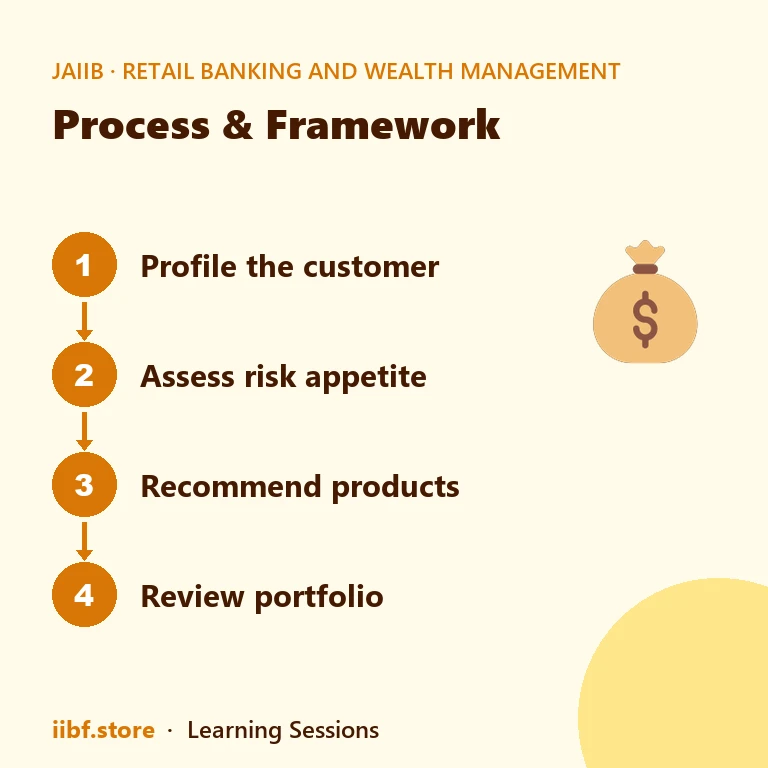
To lock in these concepts, practice applying them to realistic scenarios rather than memorising definitions. Build a mental checklist: identify the segment, match the product bundle, choose the channel, and note the profitability logic. Combine this with regular mock testing so that the pattern becomes automatic under exam pressure.
Frequently Asked Questions
Is there a fixed regulatory definition of an HNI in Indian retail banking?
No. Unlike some prudential terms, "High Net-worth Individual" has no single statutory or RBI-mandated threshold for retail-banking segmentation. Each bank sets its own commercial cut-off based on investable surplus or relationship value. For the JAIIB exam, describe HNI qualitatively as a top-tier customer served by a dedicated relationship manager rather than quoting a specific rupee figure.
How is customer segmentation different from KYC classification?
They serve different purposes. KYC (Know Your Customer) is a mandatory regulatory process to verify identity and assess money-laundering risk. Segmentation is a voluntary commercial strategy to group customers by value and needs so products and service levels can be tailored. A customer can be low-risk under KYC yet high-value under segmentation, or vice versa.
Why does segmentation matter for branch profitability?
Because it lets a bank align its cost-to-serve with the revenue each customer generates. Routine, low-value transactions are pushed to low-cost digital channels, while expensive human advisory capacity is reserved for affluent and HNI customers whose fee income and deposits justify it. This improves the branch's overall return without raising costs uniformly.
Which products are typically cross-sold to affluent and HNI segments?
Beyond core deposits, banks cross-sell mutual funds (distributed under SEBI regulations), life and health insurance through the bancassurance channel, portfolio and investment advisory, tax-planning solutions, and lockers. Ultra-HNI clients may additionally receive estate and succession-planning services through a private-banking team.
Conclusion and Next Step
Retail banking customer segmentation is the connective tissue between retail banking operations and wealth management — the topic that explains why banks build product pyramids, deploy relationship managers selectively, and chase fee income from affluent tiers. Master the segment-to-product-to-profitability logic and you will comfortably handle the application-style questions this area attracts in the JAIIB RBWM paper. Now put it to the test: attempt a timed RBWM mock test to check your recall under exam conditions, or enrol in the structured JAIIB course to work through the full Retail Banking and Wealth Management syllabus with guided practice.
Quick quiz on this topic
5 exam-style questions from our free test bank — check yourself before you move on.
Practice this topic
Take a free mock test, download chapter PDFs, or watch a video class — all included on iibf.store.
Keep reading