Ransomware Attacks on Banks: Prevention, Response and Reporting
Ransomware attacks on banks have moved from a theoretical IT risk to a live operational threat that IIBF candidates must understand in exam-ready detail. A single infected endpoint can lock core banking screens within hours, and the attacker's real goal is rarely just encryption — it is leverage over the bank's continuity and its customers' trust. This article walks through how ransomware attacks on banks actually happen, what separates a clean recovery from a costly capitulation, and the reporting duties that kick in the moment an attack is confirmed.
🎣 How Ransomware Gets In
Most ransomware attacks on banks do not start with a dramatic technical exploit. They start with a staff member clicking a convincing phishing email, or an attacker walking in through a remote access channel that was left open a little too generously. Weak or reused passwords on VPN gateways and RDP (remote desktop protocol) ports are a favourite entry point, especially where multi-factor authentication was skipped for "convenience".
The third channel is the supply chain: a vendor's software update, a branch printer's management tool, or a third-party API integration that quietly carries malicious code into the bank's environment. Because the bank trusts the vendor's credentials and patches by default, this route often bypasses the controls built for direct attacks. Candidates should connect this to the broader pattern covered under computer insecurity in the syllabus, and to how attackers profile a target before striking, discussed under computer hackers.
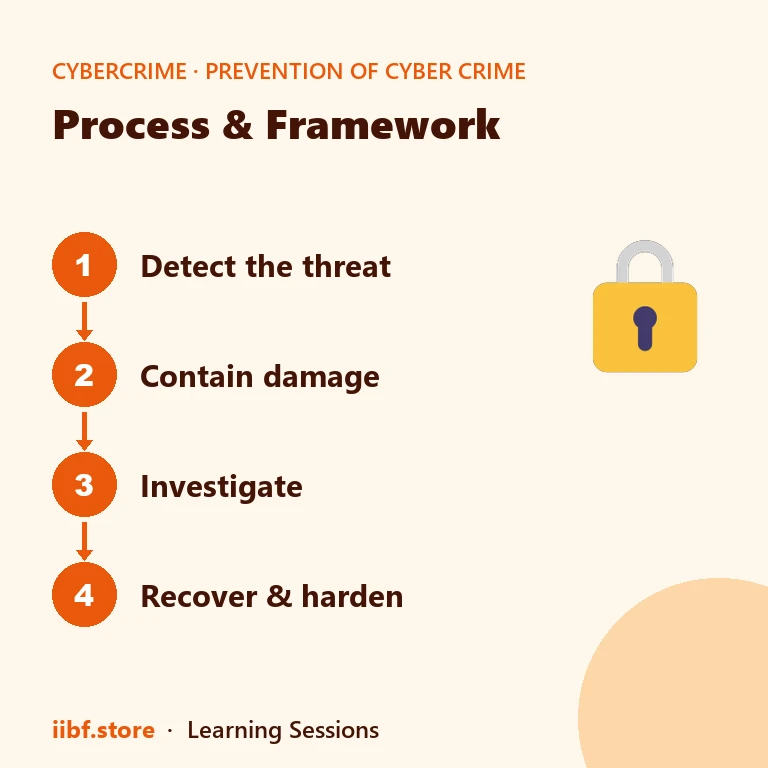
Once inside, the attacker rarely encrypts immediately. There is usually a "dwell time" of days or weeks where the intruder maps the network, identifies the domain controller and backup servers, and escalates privileges quietly before triggering the payload.
🔓 Double Extortion: Encryption Plus Data Theft
Modern ransomware attacks on banks are almost never a simple lock-and-demand. Attackers now practise double extortion: they quietly exfiltrate customer data, loan files, and internal correspondence before triggering encryption. Even if the bank restores every system from backup, the attacker still holds a second lever — the threat to leak or sell stolen data on the dark web.
This changes the incident calculus completely. A bank that can restore operations in six hours through clean backups still has to treat the incident as a full data breach, because customer PII and financial records may already be outside its perimeter. That triggers customer notification obligations, credit-bureau considerations, and reputational exposure that a restore-from-backup alone cannot fix.
⚠️ Common Mistake: Treating "we restored from backup, so we are fine" as the end of the incident. Double extortion means data theft and encryption are two separate harms that both need separate containment and disclosure decisions.
Some ransomware groups now skip encryption altogether and threaten exposure only, because banks have become faster at restoring systems but are still slow at detecting silent data exfiltration. This is why monitoring outbound traffic volumes matters as much as endpoint protection — a subject that overlaps with third-party risk, covered from a governance angle under supply chain security risk in banks.
💾 Backup Restore vs Paying the Ransom
The practical difference between restoring from backup and paying the ransom is not just cost — it is control. A clean, tested backup restore puts the bank back in charge of its own timeline. Paying the ransom hands control to a criminal group that has no contractual obligation to actually deliver a working decryption key, and case data across the industry shows a meaningful share of victims who pay still lose some data or get incomplete decryptors.
Backups only work as a defence if they are immutable and offline (or air-gapped). If backup servers sit on the same network as production systems with standing write access, attackers who gain domain admin rights will encrypt or delete the backups first — precisely to remove the bank's ability to say no. Immutable storage (write-once, cannot-be-altered snapshots) and offline tape or disconnected replicas are what make "just restore from backup" a realistic option rather than wishful thinking.
💡 Exam Tip: If a question asks why backups failed to help during a ransomware incident, the expected answer is almost always that the backups were reachable from the compromised network and were encrypted along with production data.
This is the practical heart of the topic, and it links directly to computer fraud protection concepts on preventive controls, since backup design is a preventive control decided long before any attack begins.
🛡️ Containment: Segmentation, Privilege Limits and Rehearsal
Network segmentation is what stops a single compromised branch laptop from becoming a bank-wide outage. By splitting the network into isolated zones — branch systems, core banking servers, treasury, HR — a single infection is contained to one segment while the rest of the bank keeps functioning. Least-privilege access limits work the same way: if a teller's credentials cannot reach the domain controller, a phished teller account cannot hand the attacker the keys to everything.
Privilege limits also mean routinely removing standing admin rights and using just-in-time elevation only when needed, so that a compromised account has a narrow blast radius rather than persistent high-level access.
Tabletop rehearsal of an outage is the piece banks skip most often, and it is also the piece examiners favour testing. A tabletop exercise walks the incident response team, business continuity owners, and senior management through a simulated ransomware scenario — who isolates which segment, who decides on customer communication, who has authority to engage law enforcement — without the pressure of a live incident. Banks that rehearse recover measurably faster because roles and escalation paths are already muscle memory. This containment discipline sits alongside broader incident handling covered under incident management.
📢 Reporting Duties: CERT-In and RBI
Once ransomware attacks on banks are confirmed, reporting is not optional and is not slow. Under the CERT-In directions on cyber security incident reporting, banks (as regulated entities and critical information infrastructure participants) must report qualifying cyber incidents, including ransomware, to the Computer Emergency Response Team - India within the mandated timeline from detection, not from confirmation of impact.
Separately, the Reserve Bank of India requires regulated entities to report cyber security incidents, including ransomware, to RBI's supervisory channels under its cyber security framework for banks, in addition to (not instead of) the CERT-In report. Missing either channel, or reporting late while the bank quietly negotiates with the attacker, is itself a compliance failure independent of how the technical incident is resolved. Read the RBI's public guidance directly at rbi.org.in for the current framework.
This dual-reporting duty is a frequent exam distinction — one channel is the national cyber security coordinator, the other is the sector regulator, and both expect prompt, factual disclosure rather than a sanitised summary after recovery.
⚖️ Why Paying Creates Fresh Legal Exposure
Paying a ransom does not close the legal exposure — it can open a new one. If the ransom payment, directly or through an intermediary, ends up reaching an entity or group under international or domestic sanctions, the paying bank can face its own regulatory and legal consequences for facilitating that payment, separate from the original cyber incident.
There is also the matter of encouraging the criminal business model itself: paying confirms that the target is willing to pay, which invites repeat targeting of the same bank or its customers. Boards are increasingly advised to treat "do we ever pay" as a pre-decided policy question settled during tabletop rehearsal, not a live decision made under pressure during the actual attack, when panic and downtime cost are at their peak.
📌 Remember: A ransom payment does not guarantee data deletion by the attacker, does not remove the reporting obligation to CERT-In and RBI, and can add its own legal risk on top of the original breach.
| Response Path | Restores Access | Data Confidentiality Fixed | Reporting Obligation | Legal/Sanctions Risk |
|---|---|---|---|---|
| Immutable/offline backup restore | ✅ Yes, on bank's timeline | ❌ No, if data was stolen | ✅ Still required | ✅ Low |
| Paying the ransom | ❌ Not guaranteed | ❌ No guarantee of deletion | ✅ Still required | ❌ High |
| No backup, no payment | ❌ Prolonged outage | ❌ No | ✅ Still required | ❌ Regulatory action likely |
The pattern across every row is the same: reporting to CERT-In and RBI is never optional, whichever recovery path the bank takes. For context on how banks are also evaluated on human-factor entry points like manipulated calls and messages, see deepfake fraud in banking, and for the forensic aftermath of a confirmed breach, see electronic evidence in banking fraud cases.
🎯 Building an Exam-Ready Response Checklist
For IIBF exam purposes, structure your answer on ransomware attacks on banks around four pillars: prevention (patching, MFA, segmentation, vendor controls), containment (isolate, limit privilege, activate the incident response plan), recovery (immutable backups over payment), and reporting (CERT-In and RBI, on time, every time). Examiners commonly frame scenario questions around which pillar failed, so practise identifying the gap rather than memorising definitions alone.
It also helps to study the topic alongside related chapters such as channels of cyber crimes, since ransomware delivery draws on the same phishing and remote-access channels used in other banking cyber crimes, and browse the full Prevention of Cyber Crime tag for more scenario-style coverage.
🧠 Practice MCQs: Ransomware Attacks on Banks
Q1. Ransomware most commonly gains its first foothold in a bank's network through which route? (a) A zero-day flaw in the core banking software (b) Phishing emails and unsecured remote access (c) Physical theft of a server (d) A satellite communication failure
Answer: (b) — Phishing and poorly secured remote access (VPN/RDP) are the most common initial access routes for ransomware, ahead of rare zero-day exploits.
Q2. What does "double extortion" mean in a ransomware attack on a bank? (a) The attacker demands payment twice from two branches (b) Data is encrypted and separately exfiltrated for a second leak threat (c) Two ransomware groups attack together (d) The bank is charged twice by its cyber insurer
Answer: (b) — Double extortion combines encryption with prior data theft, so the attacker can threaten to leak stolen data even after systems are restored.
Q3. Why do offline or immutable backups matter more than backups kept on the live network? (a) They are cheaper to maintain (b) They cannot be reached or altered by an attacker who compromises the production network (c) They restore data faster in all cases (d) They are required only for foreign bank branches
Answer: (b) — If backups are reachable from the compromised network, attackers encrypt or delete them too; immutable/offline backups remove that dependency.
Q4. Network segmentation helps contain a ransomware attack primarily by: (a) Encrypting all files automatically (b) Limiting the spread of infection to an isolated zone (c) Replacing the need for backups (d) Eliminating the need for incident reporting
Answer: (b) — Segmentation confines a compromised zone, preventing lateral movement into core banking, treasury, or HR systems.
Q5. A bank confirms a ransomware incident. What is required regarding reporting? (a) Report only to RBI if data was stolen (b) Report only if the ransom is paid (c) Report to CERT-In within the mandated timeline and separately to RBI under its cyber security framework (d) No reporting is required if systems are restored quickly
Answer: (c) — Both CERT-In and RBI reporting obligations apply to a confirmed cyber incident, independent of how fast recovery happens or whether ransom is paid.
Want chapter-wise mock tests with 100+ MCQs? Start practising free →
❓ Frequently Asked Questions
Do banks have to report a ransomware attack even if they restore from backup without paying?
Yes. Reporting to CERT-In and to RBI under its cyber security framework is a separate obligation from recovery, and applies regardless of whether the bank restores cleanly, negotiates, or pays.
Is paying the ransom illegal for an Indian bank?
Payment is not automatically illegal, but it carries fresh legal exposure if the payment reaches a sanctioned entity, and it does not remove the bank's CERT-In and RBI reporting duties. Boards typically treat payment as a last-resort, pre-decided policy rather than a case-by-case call.
What is the difference between encryption-only ransomware and double extortion?
Encryption-only ransomware locks files and demands payment for a decryption key. Double extortion adds data theft before encryption, so the attacker can threaten to leak stolen data even after the bank restores systems from backup.
Why is tabletop rehearsal important for ransomware preparedness?
A tabletop exercise tests the incident response plan under simulated pressure, clarifying who isolates network segments, who authorises communication, and who reports to CERT-In and RBI, so the real response is faster and less error-prone.
🚀 Practise This Topic Before Your Next Exam
Ransomware attacks on banks combine technical prevention, disciplined containment, and strict regulatory reporting into one exam-heavy topic. Revise the chapters above, then test yourself with a timed set on iibf.store/tests to lock in the CERT-In and RBI reporting distinctions before exam day.
Practice this topic
Take a free mock test, download chapter PDFs, or watch a video class — all included on iibf.store.