RBI Cyber Security Framework: Cyber Crime Exam Guide
For candidates pursuing the IIBF Prevention of Cyber Crime certificate, the RBI cyber security framework is a cornerstone topic that appears in many forms. The RBI cyber security framework sets the baseline controls every bank must implement to defend against phishing, ransomware, and data breaches, and it links directly to incident reporting through CERT-In. As digital banking expands, examiners want professionals who understand both the regulatory architecture and the practical defences. This guide explains the framework, the supporting laws, and the exam-relevant detail in a clear, structured way.
What the RBI Cyber Security Framework Covers
The RBI cyber security framework, introduced through the central bank's 2016 circular on cyber security in banks, requires every bank to put in place a board-approved cyber security policy distinct from its broader IT policy. It mandates a baseline set of controls, continuous surveillance, and a clear escalation path for incidents. The aim is to make cyber resilience a board-level priority rather than a back-office IT chore.
Banks are classified by their digital footprint, and the depth of controls scales with that complexity. The framework insists on network segmentation, secure configuration, access control, and an arrangement to detect and respond to intrusions in near real time. These principles echo the operational-risk themes you will also study in the CAIIB programme, where technology risk is a recurring concern.
For the exam, remember that the framework is preventive, detective, and responsive all at once. It does not merely list controls; it demands a Cyber Security Operations Centre (C-SOC) for larger banks and a culture of continuous monitoring. Grasping this layered intent helps you answer conceptual questions confidently.

Incident Reporting and CERT-In Coordination
A defining feature of the RBI cyber security framework is mandatory, time-bound incident reporting. Banks must report unusual cyber incidents to the Reserve Bank promptly, regardless of whether customer data or money was lost. This early-warning discipline lets the regulator spot systemic threats and coordinate a sector-wide response.
Parallel to RBI reporting, the Indian Computer Emergency Response Team (CERT-In) is the national nodal agency for cyber incidents. Under its directions, certain incidents must be reported within a tight window, and organisations must retain logs for a prescribed period. Authoritative guidance is published by the Indian Computer Emergency Response Team, the body that issues advisories and vulnerability alerts.
Examiners often test the dual reporting obligation — to RBI and to CERT-In — so keep the two channels distinct in your notes. Knowing who reports what, and how quickly, is a frequent question. Drilling these specifics through the IIBF practice tests is an efficient way to commit the timelines and authorities to memory.
Common Cyber Threats the Framework Defends Against
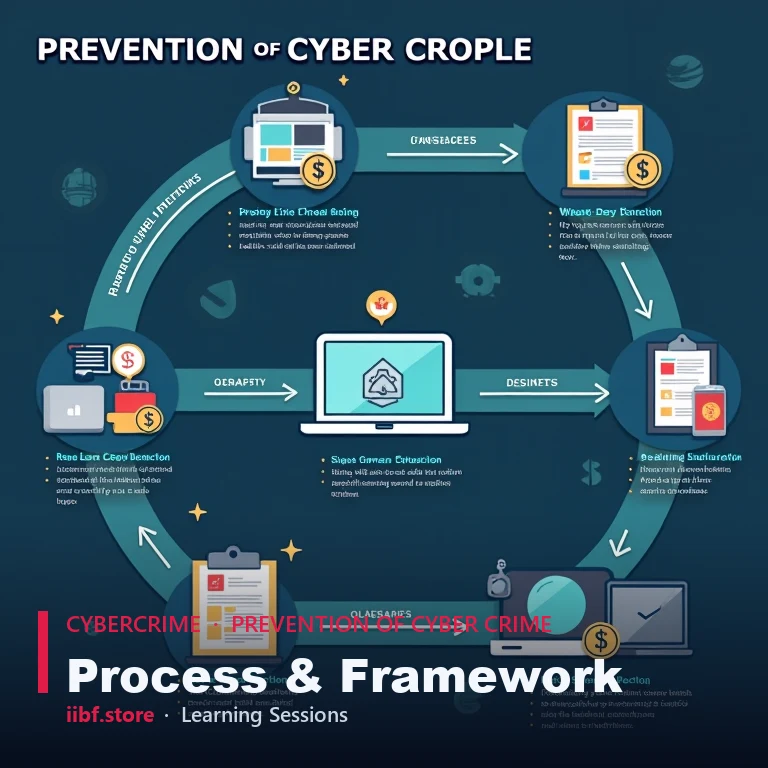
The RBI cyber security framework is designed to counter a familiar set of threats. Phishing tricks customers or staff into revealing credentials through fake messages and websites. Ransomware encrypts a bank's systems and demands payment, threatening operational continuity. Other vectors include malware, distributed denial-of-service attacks, insider misuse, and social-engineering frauds targeting customers directly.
Defences mandated or encouraged by the framework include multi-factor authentication, encryption of data in transit and at rest, regular patching, anti-phishing measures, employee awareness training, and tested incident-response and business-continuity plans. Customer-facing controls such as transaction alerts and cooling-off periods for new payees add further protection.
- Phishing and vishing aimed at credential theft.
- Ransomware and malware threatening system availability.
- DDoS attacks degrading digital banking channels.
- Insider threats and social-engineering frauds.
Mapping each threat to its control is a high-yield exam skill. To keep these pairings fresh between sessions, the quick-recall activity on the match-the-concept game is a handy revision aid.

Legal Backing and Exam Tips
The RBI cyber security framework operates alongside the Information Technology Act, 2000, which criminalises hacking, identity theft, and data tampering and provides for adjudication and penalties. Sections on unauthorised access, dishonest receipt of stolen computer resources, and cheating by personation are commonly examined. The Act, together with the framework, forms the legal-plus-regulatory backbone of cyber-crime prevention in banking.
For the paper, link controls to consequences: a weak control plus a specific threat leads to a defined breach and a reportable incident. Be ready to distinguish the IT Act (law), the RBI framework (banking regulation), and CERT-In directions (national operational mandate). A common trap is treating cyber security as purely technical; the framework stresses governance, board accountability, and customer awareness too.
Answer around prevent, detect, respond, and report, and you will cover most questions. For grounding in the digital-banking basics that first appear earlier in your journey, revise alongside the JAIIB course before returning to certificate-level depth.
Frequently Asked Questions
What is the purpose of the RBI cyber security framework?
The RBI cyber security framework, issued in 2016, requires every bank to adopt a board-approved cyber security policy with baseline controls, continuous monitoring, and incident response. Its purpose is to make cyber resilience a board-level priority, protect customers and systems, and enable coordinated, time-bound reporting of incidents to the regulator.
How does CERT-In relate to bank cyber incident reporting?
CERT-In is India's national nodal agency for cyber incidents. Banks must report qualifying incidents to CERT-In within prescribed timelines and retain logs as directed, in addition to reporting to the RBI. CERT-In issues advisories and alerts, helping institutions defend against emerging threats and coordinate a national response.
Which law criminalises cyber crime in India?
The Information Technology Act, 2000, is the primary law criminalising cyber offences such as hacking, identity theft, data tampering, and cheating by personation. It works alongside the RBI cyber security framework and CERT-In directions, providing penalties, adjudication mechanisms, and the legal foundation for prosecuting cyber crime in banking.
What controls help banks defend against ransomware?
Key defences include regular patching, network segmentation, least-privilege access, tested offline backups, endpoint protection, and staff awareness training to resist phishing entry points. The RBI cyber security framework also requires incident-response and business-continuity plans so a bank can isolate, recover, and report quickly if ransomware strikes its systems.
Conclusion: Build Your Cyber Crime Prevention Edge
The RBI cyber security framework ties together regulation, law, and practical defence, making it a high-value topic for the IIBF Prevention of Cyber Crime certificate. By understanding its scope, the dual reporting to RBI and CERT-In, the threats it counters, and the supporting IT Act, you can tackle both conceptual and scenario questions with authority. Reinforce this knowledge through focused practice. Begin your targeted preparation today on the IIBF mock test series and build the confidence to clear the cyber-crime paper.
Practice this topic
Take a free mock test, download chapter PDFs, or watch a video class — all included on iibf.store.