RBI Ombudsman 2026: New Limits, 90-Day Window and Appeal Rules
Your bank sat on a complaint for six weeks and then sent a one-line reply that settled nothing. Until this summer you had a comfortable twelve months to escalate that grievance to the Reserve Bank. That cushion is gone. RBI Ombudsman 2026 — formally the Reserve Bank – Integrated Ombudsman Scheme, 2026 — came into force on 1 July 2026, and it cuts the filing window down to just 90 days while raising the compensation an Ombudsman can award you to ₹30 lakh. Ashish Jain walks through the revised scheme end to end in the session below. This article is the written companion, with the clause-level detail an examiner actually asks about.
RBI Ombudsman 2026: New Limits, New Timeline, New Rules · Watch on YouTube
What the Ombudsman is, and why "integrated" is not the new part
Strip away the legalese and the Ombudsman is a free complaints referee. If a bank, an eligible NBFC, a non-bank prepaid instrument issuer or a credit information company gives you deficient service, and the institution itself will not fix it, you get a cost-free, non-adversarial forum that is far quicker than a consumer court. You pay nothing. You do not need an agent. You do not need a lawyer.
A lot of candidates get the history wrong in the exam hall, so fix it now: the integration did not happen in 2026. It happened in 2021, when the Banking Ombudsman Scheme 2006, the Ombudsman Scheme for NBFCs 2018 and the Ombudsman Scheme for Digital Transactions 2019 were folded into one umbrella. What 2026 did was revise that umbrella. RB-IOS 2026 replaces RB-IOS 2021, but complaints received before 1 July 2026, appeals arising out of decisions under the old scheme, and execution of awards already issued continue to be governed by the 2021 framework. Both schemes therefore run side by side for a while, which is exactly the kind of transitional detail a paper-setter enjoys.
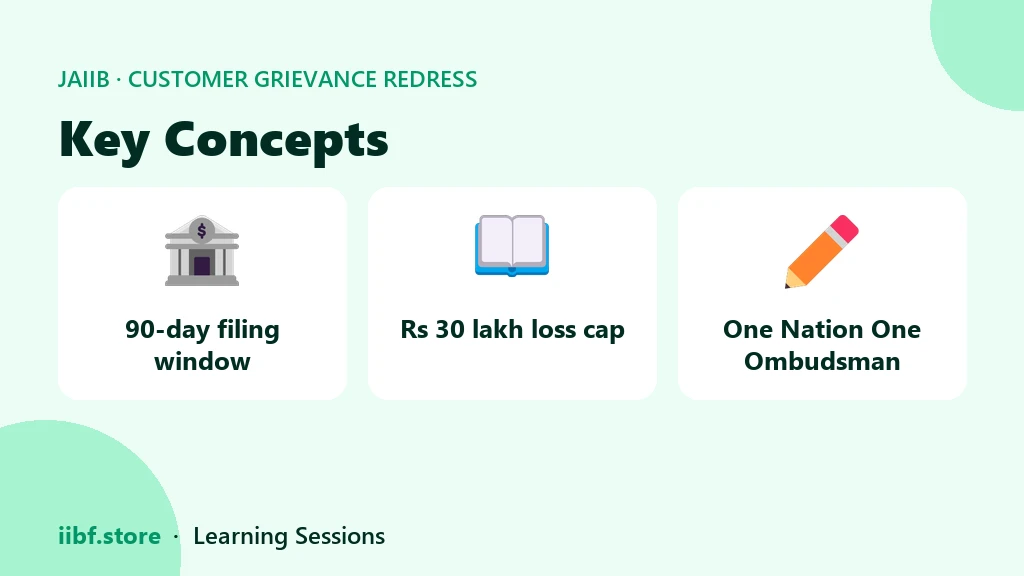
The other thing that carried over untouched is "One Nation One Ombudsman". You do not hunt for the office with jurisdiction over your branch. You lodge centrally and the Reserve Bank assigns the case internally.
The five changes that actually matter
Most of the scheme reads the same as before. Five things moved, and every one of them is a plausible one-mark question.
| Parameter | RB-IOS 2021 | RB-IOS 2026 (from 1 July 2026) |
|---|---|---|
| Window to file with the Ombudsman | One year | 90 days |
| Compensation for consequential loss | ₹20 lakh | ₹30 lakh |
| Compensation for time, expenses, harassment or mental anguish | ₹1 lakh | ₹3 lakh |
| Co-operative bank coverage | Urban co-operative banks | State Co-operative Banks and Central Co-operative Banks expressly added |
| Appeal lies against | Award and certain rejections | Award only |
| Waiting period before escalating | 30 days | 30 days or the RBI / NPCI / card-network timeline, whichever is higher |
| Limit on the disputed amount | None | None (unchanged) |
Who is covered, and who quietly is not
Coverage is defined by category, not by goodwill. On the banking side the scheme takes in all commercial banks, regional rural banks, State Co-operative Banks, Central Co-operative Banks and Scheduled Primary (Urban) Co-operative Banks. Non-Scheduled Primary (Urban) Co-operative Banks come in only if their deposit size is ₹50 crore or more as on the date of the audited balance sheet of the previous financial year. That ₹50 crore threshold is worth memorising verbatim.
On the non-bank side, an NBFC registered with the Reserve Bank is covered if it is either authorised to accept deposits, or has a customer interface with asset size of ₹100 crore or more as on the date of the previous year's audited balance sheet. Several categories are carved out even if they clear that bar: housing finance companies, core investment companies, IDF-NBFCs, NBFC-IFCs, NOFHCs, primary dealers and mortgage guarantee companies. Non-bank prepaid payment instrument issuers and credit information companies are in.
The trigger for a complaint is "deficiency in service", and the definition is deliberately generous. It means a shortcoming or inadequacy in any service the regulated entity was required to provide statutorily or otherwise, which may or may not result in financial loss or damage. You do not have to prove you lost money. That single clause is the most under-appreciated line in the whole document.
The complaint journey: first 30 days, then 90
The sequence is rigid, and getting it out of order is the commonest reason complaints are thrown out at the door.
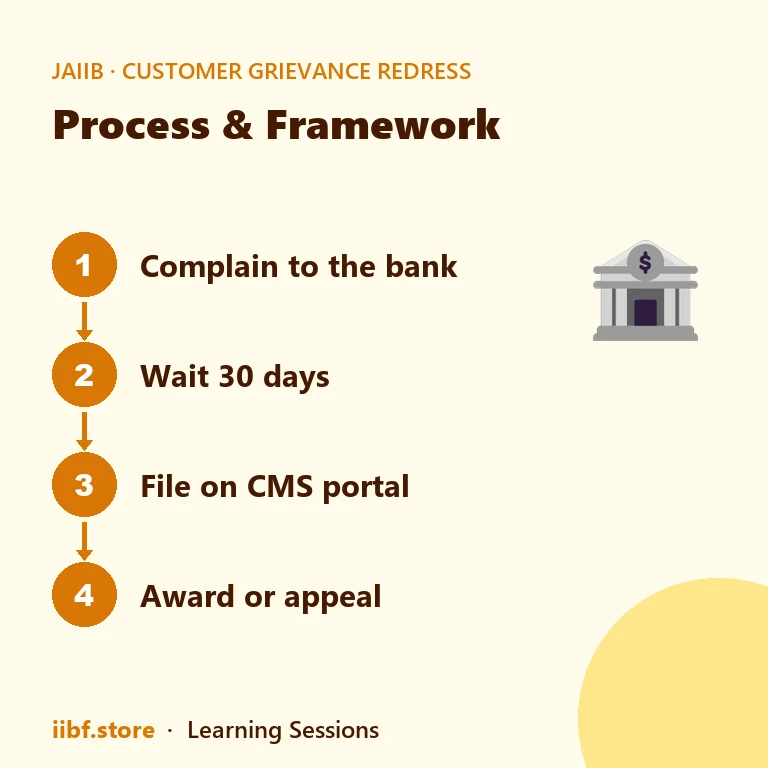
You complain to the regulated entity first, and you keep proof of having done so. Going straight to the Ombudsman gets you rejected without examination. From there, two roads. If the entity replies and you are dissatisfied, you may escalate immediately. If it does not reply, you wait — and here is the 2026 refinement — 30 days, or the timeline specified in RBI, NPCI or card-network guidelines if any, whichever is higher. If a particular transaction type carries a 45-day resolution norm, 45 days is your clock, not 30.
Then the headline change. You have 90 days from the date the applicable timeline expires, or from the date of the last communication from the regulated entity, whichever is later. Miss it and the complaint is non-maintainable. There is a second, easily forgotten condition attached: your original complaint to the entity must itself have been made before the limitation period under the Limitation Act, 1963 expired.
Filing is free and comes in three flavours: online through the RBI Complaint Management System at cms.rbi.org.in, by e-mail to the Centralised Receipt and Processing Centre, or physically to the CRPC at Reserve Bank of India, Central Vista, Sector 17, Chandigarh – 160017. The RBI Contact Centre on toll-free 14448 runs a 24x7 IVRS and staffed support from 8:00 AM to 10:00 PM, Monday to Saturday, in English, Hindi and ten regional languages — but it cannot lodge the complaint for you. It only guides and gives status.
Compensation, and the 30 + 30 appeal clock
Separate two ideas that students routinely merge. The disputed amount has no ceiling — a ₹1.5 crore transaction can absolutely be brought before the Ombudsman. The compensation the Ombudsman may award is capped: up to ₹30 lakh for consequential loss, plus up to ₹3 lakh separately for loss of your time, expenses incurred, and harassment or mental anguish. So "no monetary limit on the complaint, capped award" is the correct formulation.
Three outcomes are possible once a complaint is admitted: settlement through facilitation, advisory or conciliation; an Award directing remedial action and compensation; or rejection. The RBI Deputy Ombudsman now has a wider operational role and may consider deficiency-in-service complaints and close or reject them on the grounds specified in Clause 16(1) of the scheme.
Appeals narrowed sharply under RBI Ombudsman 2026. An appeal lies only against an Award — not against a rejection. A complainant may appeal to the Appellate Authority within 30 days of receiving the Award, and the Appellate Authority may allow a further period of up to 30 days for sufficient cause. That extension is discretionary, never automatic. Meanwhile the complainant must furnish a letter of acceptance in full and final settlement to the regulated entity within 30 days of receiving the Award unless an appeal has been filed, and the entity then has 30 days from receipt of that letter to comply or to file its own permitted appeal.
How this gets asked in JAIIB and CAIIB
Customer grievance redress sits squarely in JAIIB Principles and Practices of Banking, and it leaks into Retail Banking and the customer-protection questions in Bank Financial Management too. Examiners rarely ask "what is an Ombudsman". They ask for the number. Which threshold applies to a non-scheduled urban co-operative bank. How many days to appeal. Whether an appeal lies against a rejection. Whether a ₹60 lakh dispute is admissible at all.
Learn seven figures as a single block and you have covered most of what RBI Ombudsman 2026 can throw at you: 1 July 2026, 30 days, 90 days, ₹30 lakh, ₹3 lakh, ₹50 crore, ₹100 crore. Then drill them under time pressure — our JAIIB and CAIIB mock tests mix these updated numbers into full-length papers, and the JAIIB course keeps the PPB notes synced whenever the Reserve Bank revises a scheme. If you are still building a revision schedule, the study planner will slot regulatory updates into your final fortnight, and current policy figures live on the RBI rates page. The full text and FAQs sit on the Reserve Bank's own site — read the primary source at least once before the exam.
When did the Reserve Bank – Integrated Ombudsman Scheme, 2026 come into force?
It came into force on 1 July 2026 and replaced RB-IOS 2021. Complaints received before that date, appeals from decisions under the 2021 scheme, and execution of awards already issued continue to be governed by RB-IOS 2021.
How many days do I now get to file with the RBI Ombudsman?
Ninety days, counted from the date the applicable resolution timeline expires or from the date of the last communication from the regulated entity, whichever is later. The earlier scheme allowed one year.
Is there a limit on the amount involved in the dispute?
No. There is no ceiling on the disputed amount. The cap applies only to compensation — up to ₹30 lakh for consequential loss and up to ₹3 lakh for time, expenses, harassment or mental anguish.
Can I appeal if the Ombudsman rejects my complaint?
No. Under the 2026 scheme an appeal lies only against an Award passed by the RBI Ombudsman. A complainant has 30 days from receipt of the Award, extendable by up to another 30 days by the Appellate Authority for sufficient cause.
Quick quiz on this topic
5 exam-style questions from our free test bank — check yourself before you move on.
Practice this topic
Take a free mock test, download chapter PDFs, or watch a video class — all included on iibf.store.
Keep reading