Retail Banking Products and Wealth Management 2026: JAIIB Guide

For any banker preparing for JAIIB, a firm grasp of retail banking products and the wealth-management services built around them is non-negotiable. The Retail Banking and Wealth Management paper rewards candidates who can connect everyday counter products — savings accounts, fixed deposits, home loans, credit cards — with the regulatory framework and customer-advisory layer that sits on top of them. This guide walks through the full product suite as it stands in 2026, the RBI and SEBI rules that govern it, and the practical selling points an exam wants you to articulate.
Retail banking is the mass-market, high-volume, low-ticket side of a bank's business. Unlike corporate banking, where a handful of large exposures dominate, retail spreads risk across millions of individual customers. That diversification, combined with the cross-selling potential of wealth products, is why retail has become the growth engine for Indian banks. Understanding how these products are designed, priced and regulated is exactly what the JAIIB syllabus tests.
Below we move from liability products (deposits) to asset products (loans), then to cards, digital channels and finally the wealth-management overlay — mutual funds, insurance and portfolio advisory — that turns a transactional relationship into a lifelong one.
Deposit Products: The Liability Side of Retail Banking
Deposits are the foundation of retail banking and the cheapest source of funds for a bank. The core retail banking products on the liability side are the savings account, the current account, the fixed (term) deposit and the recurring deposit. Savings and current balances together form a bank's CASA (Current Account Savings Account) ratio — a high CASA lowers cost of funds and lifts net interest margin, a metric examiners love to probe.
- Savings account: interest-bearing, with no RBI-mandated minimum interest rate since deregulation in 2011. Banks set their own rate and may slab it by balance.
- Current account: non-interest-bearing, meant for businesses, with unlimited transactions.
- Fixed deposit: a lump sum locked for a chosen tenor (7 days to 10 years) at a contracted rate; premature withdrawal usually attracts a penalty.
- Recurring deposit: fixed monthly instalments earning FD-equivalent rates — a disciplined savings tool.
Every deposit is covered by the Deposit Insurance and Credit Guarantee Corporation (DICGC) up to ₹5 lakh per depositor per bank, a figure raised from ₹1 lakh in 2020. Banks must also flag deposits inactive for two years as dormant accounts and transfer balances unclaimed for ten years to the RBI's Depositor Education and Awareness (DEA) Fund. Knowing these thresholds cold will win you easy marks. Strengthen the fundamentals with the structured modules in the JAIIB course.
Retail Asset Products: Loans That Drive Growth
The asset side is where banks earn their spread. Retail loans are typically standardised, scored through credit-bureau data, and secured or unsecured depending on purpose. The headline products are home loans, auto loans, personal loans, education loans, loans against property (LAP) and gold loans.
Home loans are the largest retail category and are governed by RBI's loan-to-value (LTV) norms — up to 90% for loans up to ₹30 lakh, 80% for ₹30–75 lakh and 75% above ₹75 lakh. Most home and many other retail loans are now linked to an external benchmark — usually the RBI repo rate — under the External Benchmark Lending Rate (EBLR) regime mandated in 2019, replacing the older MCLR for fresh retail floating-rate loans. This means EMIs move directly with monetary policy, which you can track against the live RBI policy rates.
Education loans up to ₹7.5 lakh are eligible under the Credit Guarantee Fund Scheme for Education Loans (CGFSEL), and priority-sector classification applies to several retail categories including small home loans and education. Personal loans, being unsecured, carry the highest rates and are priced almost entirely on credit score and income. For recovery on secured retail loans above ₹20 lakh, banks can invoke the SARFAESI Act, 2002, a recurring exam favourite.

Cards, Digital Channels and Payment Products
Cards and digital rails are the most visible face of modern retail banking. Debit cards draw directly on the customer's account, while credit cards extend a revolving, unsecured line with an interest-free grace period followed by finance charges that can exceed 40% annualised. Prepaid instruments (PPIs) — wallets and gift cards — sit between the two and are regulated under RBI's PPI Master Directions.
India's payment ecosystem, built largely by the National Payments Corporation of India (NPCI), underpins these products: UPI for real-time account-to-account transfers, IMPS for 24x7 mobile remittance, RuPay as the domestic card network, and NEFT/RTGS for higher-value transfers (both now available round the clock). The RBI's tokenisation mandate, fully effective since 2022, replaces stored card numbers with device-specific tokens to cut fraud — a control candidates should be able to explain.
Every card and digital onboarding must satisfy KYC norms under the PMLA, 2002 and RBI's Master Direction on KYC, with risk-based customer due diligence. Two-factor authentication, the ₹5,000 small-value UPI auto-pay limit and the customer-liability framework for unauthorised electronic transactions are all testable. Reinforce these concepts with timed practice on the JAIIB mock tests, and lighten revision with the quick-recall matching game.
Wealth Management: Mutual Funds, Insurance and Advisory
Wealth management is the value-added layer that converts a deposit-and-loan customer into a long-term, fee-generating relationship. Banks distribute three pillars of wealth products: mutual funds, insurance and government/market-linked investments, supported by goal-based financial-planning advisory.
Mutual funds — equity, debt, hybrid and the popular Systematic Investment Plan (SIP) route — are regulated by SEBI, while banks act as AMFI-registered distributors earning trail commission. Insurance is sold under the bancassurance model and supervised by the IRDAI; products span term life, ULIPs, health and general cover. Government avenues such as the Public Provident Fund (PPF), Sukanya Samriddhi, Senior Citizens Savings Scheme, Sovereign Gold Bonds and the National Pension System (NPS) round out a balanced portfolio.
Effective wealth management rests on asset allocation, risk profiling and diversification matched to a client's age, goals and risk appetite — the classic life-cycle approach where equity weight falls as the investor ages. Bankers must distinguish a distributor (commission-led) from a SEBI-registered investment adviser (fee-only, fiduciary), a separation SEBI has sharpened in recent years to curb mis-selling. You can read the source rules at the regulator's own site, SEBI. For ongoing developments, keep an eye on the curated IIBF news feed.
Why Retail and Wealth Converge in 2026
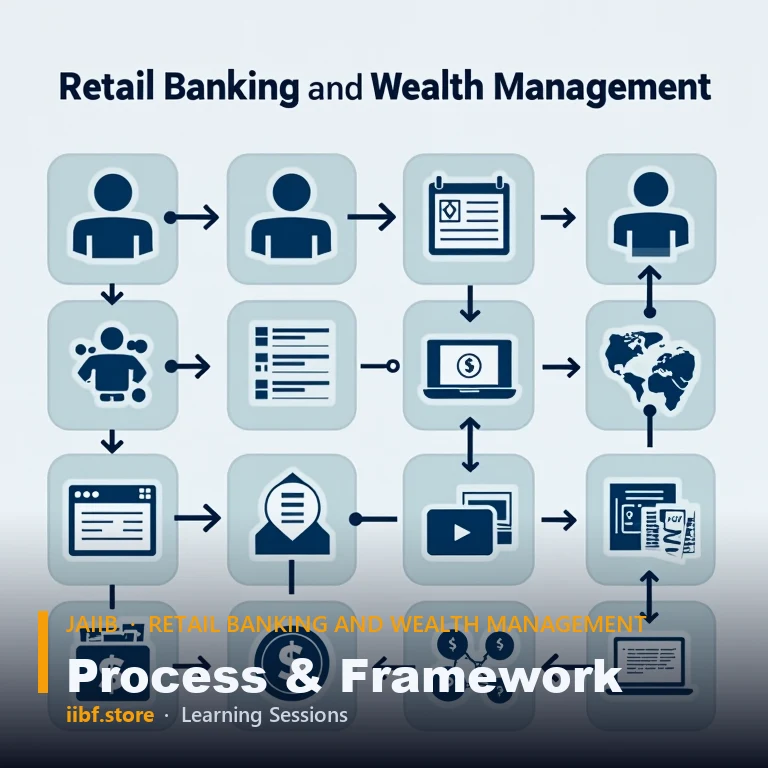
The 2026 exam emphasises the convergence of retail and wealth. Data analytics now lets banks cross-sell a SIP to a salary-account holder, a term plan to a home-loan borrower, or an NPS to a current-account proprietor — all from a single 360-degree customer view. Digital lending guidelines, account aggregator (AA) consent frameworks and the rise of neo-banking partnerships have made the retail customer the centre of the bank's universe. Candidates should be able to argue, with regulatory grounding, why a customer-lifetime-value mindset beats a product-push one, and how suitability and appropriateness obligations protect the customer in that journey.
Frequently Asked Questions
What are the main categories of retail banking products?
Retail banking products fall into three buckets: liability products (savings, current, fixed and recurring deposits), asset products (home, auto, personal, education and gold loans) and transaction products (debit/credit cards, UPI, wallets). Wealth-management offerings such as mutual funds and insurance are layered on top of these core products.
How much deposit insurance does DICGC provide in 2026?
The DICGC insures bank deposits up to ₹5 lakh per depositor per bank, covering principal and interest combined. This limit was raised from ₹1 lakh in 2020. It applies to savings, current, fixed and recurring deposits across all commercial banks and most cooperative banks operating in India.
What benchmark governs retail loan interest rates today?
Since October 2019, fresh floating-rate retail loans must be tied to an external benchmark under the EBLR regime — most banks use the RBI repo rate. This replaced MCLR for new retail loans, making EMIs respond directly and transparently to RBI monetary-policy changes.
What is the difference between a distributor and an investment adviser?
A mutual-fund distributor is AMFI-registered, earns commission from product manufacturers and sells products. A SEBI-registered investment adviser charges the client a fee, owes a fiduciary duty and must recommend suitable products. SEBI separates the two roles to reduce mis-selling and conflicts of interest.
Final Takeaways
Mastering retail banking products and the wealth-management overlay means linking each product to its regulator, its pricing logic and its place in a customer's life cycle — exactly the integrated thinking JAIIB rewards. Lock in deposit insurance limits, LTV norms, EBLR, SARFAESI thresholds and the SEBI/IRDAI/AMFI distribution rules, then test yourself under exam conditions. Start your structured prep with the JAIIB course, sharpen recall on our free mock tests, and explore more concept guides on the iibf.store blog. Consistent practice turns this dense syllabus into guaranteed marks.
Quick quiz on this topic
5 exam-style questions from our free test bank — check yourself before you move on.
Practice this topic
Take a free mock test, download chapter PDFs, or watch a video class — all included on iibf.store.
Keep reading