Small Finance Bank Licensing: On-Tap Norms and Eligibility (IIBF SFB)
For an aspirant appearing in the IIBF Small Finance Bank paper, small finance bank licensing is the single most exam-heavy topic in the regulatory module. RBI moved away from one-time licensing windows in 2019 and now accepts SFB applications throughout the year under its "on tap" framework. This article walks through who can apply, how much capital they must bring, what the business plan must promise, and what conditions must be met before the bank can actually open its doors.
📜 Why On-Tap Licensing Replaced One-Time Windows
Until 2015, RBI licensed small finance banks only through episodic application cycles — apply within a fixed window, wait for a committee to shortlist names, then wait again for in-principle approval. Ten SFBs emerged from the 2015 round, but the process gave no route for a fresh applicant who missed the window or for an NBFC that matured into eligibility a year later.
On 5 December 2019, RBI released the Guidelines for "on tap" Licensing of Small Finance Banks in the Private Sector. Under this regime an eligible applicant can file at any time; RBI's Standing External Advisory Committee screens applications continuously instead of in batches. The shift mirrors the on-tap route already open for universal banks and was meant to widen financial inclusion without candidates having to time a narrow application calendar.
For exam purposes, remember that on-tap licensing did not relax eligibility — it only removed the fixed window. The underlying capital, promoter, and business-plan conditions stayed largely intact, with a few tightened norms carried over from the earlier framework. Candidates preparing chapters on Operations Of Banks should read this history alongside the licensing conditions, since the two topics are frequently cross-tested in the same case-study question.
💰 Capital, Promoter Eligibility and Shareholding Norms
The on-tap guidelines set the minimum paid-up voting equity capital for a new small finance bank at Rs 200 crore. An existing Urban Co-operative Bank that voluntarily transitions into an SFB gets a lower entry threshold with a glide path up to the standard Rs 200 crore requirement over time, recognising that co-operative banks rarely hold that much capital upfront.
Eligible promoters include resident individuals or professionals with at least ten years of experience in banking and finance, along with existing NBFCs, Micro Finance Institutions and Local Area Banks that meet the fit-and-proper criteria. Large industrial or business houses are not eligible promoters, though they may hold a non-controlling stake as investors, consistent with RBI's general caution on connected lending.
Promoters must contribute a minimum of 40% of the paid-up voting equity capital at inception, and this stake stays locked in for five years from the date the bank commences business. Beyond that, promoter shareholding must be brought down to 30% within ten years and to 15% within fifteen years of commencement — a dilution path candidates should be able to reproduce from memory in the exam.
💡 Exam Tip: Pair the promoter dilution schedule (40% locked for 5 years, then down to 30% by year 10 and 15% by year 15) with the capital figure of Rs 200 crore — these two numbers together account for a large share of SFB licensing questions.
🎯 Business Plan and Priority Sector Mandate
A viable, realistic business plan for serving the unserved and underserved is central to small finance bank licensing. The applicant must show how it will reach small business units, marginal and small farmers, micro and small industries, and other unorganised-sector entities through a high-technology, low-cost operating model rather than a conventional branch-heavy approach.
Once operational, the SFB must direct at least 75% of Adjusted Net Bank Credit to priority sector lending, well above the 40% norm for universal banks. At least 50% of its loan portfolio must consist of loans and advances of up to Rs 25 lakh, keeping the book genuinely skewed toward small-ticket, financially excluded borrowers rather than large corporate exposures. Candidates revising the Priority Sector Advances chapter will recognise these thresholds as an extension of the general PSL framework, adapted specifically for SFBs.
The plan is also assessed on its rural and agricultural lending intent — many licensed SFBs originated from MFIs already active in this space, and their business plans typically extend to schemes such as the Kisan Credit Card scheme for farm credit. RBI evaluates whether the projected branch network, staffing, and technology stack can realistically deliver on these commitments, not merely whether the numbers look good on paper.
⚠️ Common Mistake: Candidates often confuse the SFB priority sector target (75% of ANBC) with the standard scheduled commercial bank target (40%). The two figures test differently in MCQs, so anchor them to "small finance bank" versus "universal bank" explicitly.
🏦 Commencement Conditions and Post-Licensing Compliance
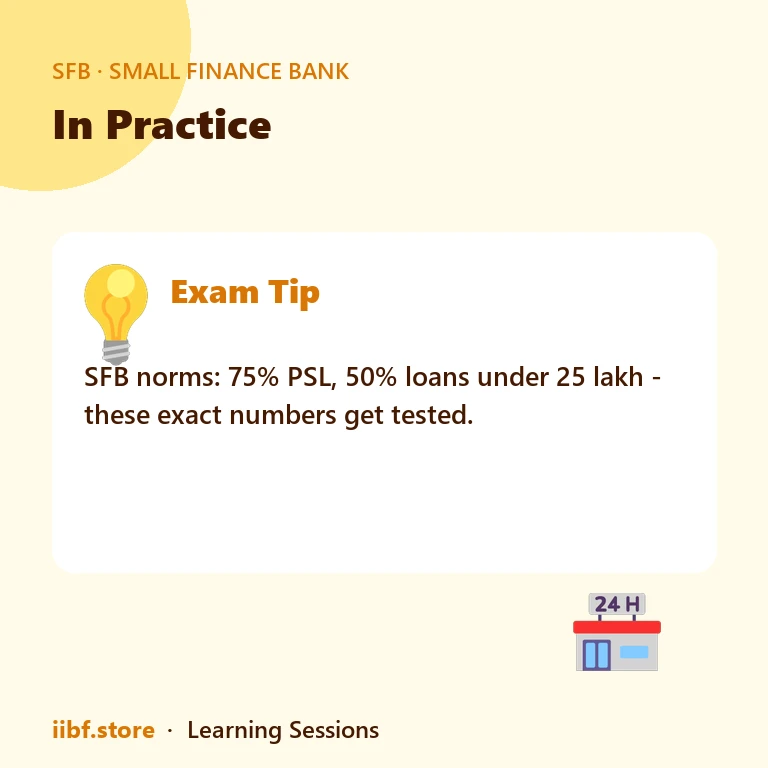
An in-principle approval is not a licence to open for business. RBI typically allows around 18 months for the applicant to complete all preparatory steps — incorporating as a public limited company under the Companies Act, setting up governance structures, and obtaining the actual banking licence under Section 22 of the Banking Regulation Act, 1949, before commencing operations.
During this window, RBI monitors whether the promoter group is progressing on capital infusion, board composition, technology readiness, and branch rollout exactly as represented in the business plan. Any material deviation can delay or jeopardise the final licence. Once commenced, the bank must maintain minimum capital adequacy of 15% of risk-weighted assets, higher than the regulatory floor for universal banks, reflecting the relatively thinner risk buffers of a young, small-ticket lender.
Post-commencement, the SFB operates under the same core statutes as any scheduled bank — the Banking Regulation Act, the RBI Act, 1934, and the Reserve Bank of India's ongoing supervisory directions — with additional SFB-specific caps such as the 75% PSL floor described earlier. Candidates linking licensing conditions to daily operations should revisit Maintenance Of Accounts and account-opening documentation practice, since examiners frequently combine a licensing-eligibility question with a follow-up on day-one compliance obligations such as Documentation requirements for new customer accounts.
📌 Remember: The banking licence itself is granted under Section 22 of the Banking Regulation Act, 1949 — the on-tap guidelines govern who may apply and on what terms, but the statutory licence is a separate, later step.
| Parameter | On-Tap SFB Requirement | Applies Uniformly to UCB Conversion Route? |
|---|---|---|
| Minimum paid-up capital | Rs 200 crore | ❌ Lower entry level with a glide path to Rs 200 crore |
| Promoter minimum initial stake | 40%, locked in for 5 years | ✅ Same principle applies |
| Promoter dilution milestone | Down to 30% within 10 years | ✅ Same principle applies |
| Promoter dilution milestone | Down to 15% within 15 years | ✅ Same principle applies |
| Minimum capital adequacy (CRAR) | 15% of risk-weighted assets | ✅ Same principle applies |
| Priority sector lending target | 75% of Adjusted Net Bank Credit | ✅ Same principle applies |
🧠 Practice MCQs: Small Finance Bank Licensing
Q1. Under RBI's on-tap licensing framework, small finance bank applications may be filed: (a) only during a fixed annual window (b) at any time during the year (c) only once every five years (d) only by existing universal banks
Answer: (b) — The 2019 on-tap guidelines removed the fixed application window that applied to the 2015 batch licensing round.
Q2. The minimum paid-up voting equity capital required for a new small finance bank is: (a) Rs 100 crore (b) Rs 200 crore (c) Rs 500 crore (d) Rs 1,000 crore
Answer: (b) — Rs 200 crore is the standard minimum capital requirement under the on-tap SFB guidelines.
Q3. Promoters of a small finance bank must retain at least what minimum stake, locked in for five years from commencement of business? (a) 26% (b) 40% (c) 51% (d) 74%
Answer: (b) — Promoters must hold a minimum 40% stake, locked in for five years from the date the bank commences business.
Q4. What percentage of Adjusted Net Bank Credit must a small finance bank direct to priority sector lending? (a) 40% (b) 50% (c) 60% (d) 75%
Answer: (d) — SFBs must lend at least 75% of Adjusted Net Bank Credit to priority sector activities, well above the universal bank norm.
Q5. The statutory banking licence for a small finance bank is granted under which provision? (a) Section 22 of the Banking Regulation Act, 1949 (b) Section 35A of the Banking Regulation Act, 1949 (c) Section 45 of the RBI Act, 1934 (d) Companies Act, 2013 registration alone
Answer: (a) — Section 22 of the Banking Regulation Act, 1949 is the statutory basis for granting a banking licence, distinct from RBI's in-principle on-tap approval.
Want chapter-wise mock tests with 100+ MCQs? Start practising free →
What is on-tap licensing for small finance banks?
It is RBI's continuous licensing window, introduced in December 2019, that lets eligible applicants apply for a small finance bank licence at any time instead of waiting for a periodic batch application cycle.
What is the minimum capital needed for small finance bank licensing?
A new small finance bank needs a minimum paid-up voting equity capital of Rs 200 crore, except for Urban Co-operative Banks converting into SFBs, which follow a lower entry level with a glide path to that figure.
Who is eligible to be a promoter of a small finance bank?
Resident individuals or professionals with at least ten years of banking and finance experience, and existing NBFCs, Micro Finance Institutions or Local Area Banks that satisfy RBI's fit-and-proper norms, are eligible promoters; large industrial houses cannot promote an SFB.
How long does promoter shareholding stay locked in after licensing?
The promoters' minimum 40% initial stake is locked in for five years from commencement of business, after which it must be diluted to 30% within ten years and to 15% within fifteen years.
✅ Conclusion: Master the Licensing Framework Before the Exam
Small finance bank licensing questions reward candidates who can recall exact figures — the Rs 200 crore capital floor, the 40% promoter lock-in, the 75% priority sector target, and the 15%/30-year dilution path — rather than vague descriptions. Revisit the on-tap guidelines on the small finance bank tag hub for related chapters, and cross-check every number against RBI's own published guidelines at rbi.org.in before your exam.
Once licensing conditions are commencement-compliant, banks move into day-to-day operating requirements — deposit strategy, cash reserves and financial-inclusion mandates are covered separately in our notes on deposit mobilisation for small finance banks, cash reserve ratio for small finance banks, and the financial inclusion role of small finance banks. Read these alongside the Bankers Special Relationship chapter to connect licensing eligibility with the bank's ongoing legal obligations toward customers.
Ready to test your grasp of small finance bank licensing? Attempt a full mock paper on IIBF CAIIB topics and track your accuracy chapter by chapter before exam day.
Practice this topic
Take a free mock test, download chapter PDFs, or watch a video class — all included on iibf.store.
Keep reading