Special Rupee Vostro Account: Rupee Trade Settlement (IIBF ITF)
When the Reserve Bank opened a rupee channel for cross-border trade, it did not invent a new currency market — it created an account. The special rupee vostro account (SRVA) is the plumbing that lets an Indian importer pay in rupees and an Indian exporter be paid in rupees, with no hard-currency leg in between. For IIBF International Trade Finance candidates this is a high-yield topic, because it sits exactly where FEMA, correspondent banking and the Foreign Trade Policy meet, and it has a clean, testable structure that examiners love.
This guide walks through the mechanism the way the exam actually tests it: who approves the account, what due diligence the Indian bank must complete before opening it, how money moves in and out, what can be done with the surplus balance, how the transactions are reported, and where the arrangement runs into real-world friction.
🏦 What a Special Rupee Vostro Account Is and Why RBI Built It
Start with the vocabulary, because half the marks in this area are vocabulary marks. A nostro account is "our account with you" — an Indian bank's foreign currency account held with an overseas correspondent. A vostro account is "your account with us" — an account maintained in India, in Indian rupees, for an overseas bank. The SRVA is a specialised version of the second: an Authorised Dealer Category-I bank in India opens and maintains a designated rupee account for the correspondent bank of a partner country.
The enabling framework is RBI's A.P. (DIR Series) Circular No. 10 dated 11 July 2022 on International Trade Settlement in Indian Rupees, issued under the Foreign Exchange Management Act, 1999, and read with the extant Master Directions on export of goods and services and on import of goods and services. You can trace the statutory chain in the regulatory framework chapter of the ITF syllabus.
The stated objectives are worth memorising verbatim in substance: to promote the growth of global trade with emphasis on exports from India, and to support the increasing interest of the global trading community in the Indian rupee. The practical driver is narrower — it keeps trade alive with counterparties whose access to hard currency is constrained, whether by a shortage of foreign exchange reserves or by sanctions-related payment friction in the dollar clearing system. That macro logic is developed further in the macro perspective chapter.
🧐 Opening the Account: RBI Approval, FATF Status and Sanctions Screening
An AD Category-I bank cannot open a special rupee vostro account on its own commercial judgement. Prior approval must be obtained from the Foreign Exchange Department of the Reserve Bank, Central Office, Mumbai. That approval requirement is the single most frequently examined fact in this topic, and candidates routinely answer "the bank's own board" or "DGFT" instead.
Before seeking approval, the Indian bank must complete a hard-edged due diligence file on the proposed correspondent. Three limbs matter. First, the financial soundness of the partner bank — capital, asset quality, and its own regulatory standing in its home jurisdiction. Second, the Financial Action Task Force status of that bank's jurisdiction: the Indian bank must satisfy itself that the correspondent is not from a country or jurisdiction named in the FATF public statement on high-risk jurisdictions subject to a call for action. Third, the sanctions position — screening against United Nations Security Council lists and any other applicable restrictions, plus the bank's own group sanctions policy.
Layered on top is ordinary correspondent-banking discipline under the KYC Master Direction: customer due diligence on the respondent bank, understanding of its own AML controls, wire-transfer information requirements, and an explicit prohibition on payable-through arrangements that let unknown third parties operate the account. The same discipline you study for URR 725 reimbursement rules in a conventional letter of credit applies here — the difference is the currency, not the diligence.
⚠️ Common Mistake: Do not confuse this account with a Special Non-Resident Rupee (SNRR) account or with the rupee vostro accounts of non-resident exchange houses. Different purpose, different approval route, different permissible debits and credits.
🔁 The Payment Flow: Importer Pays In, Exporter Is Paid Out
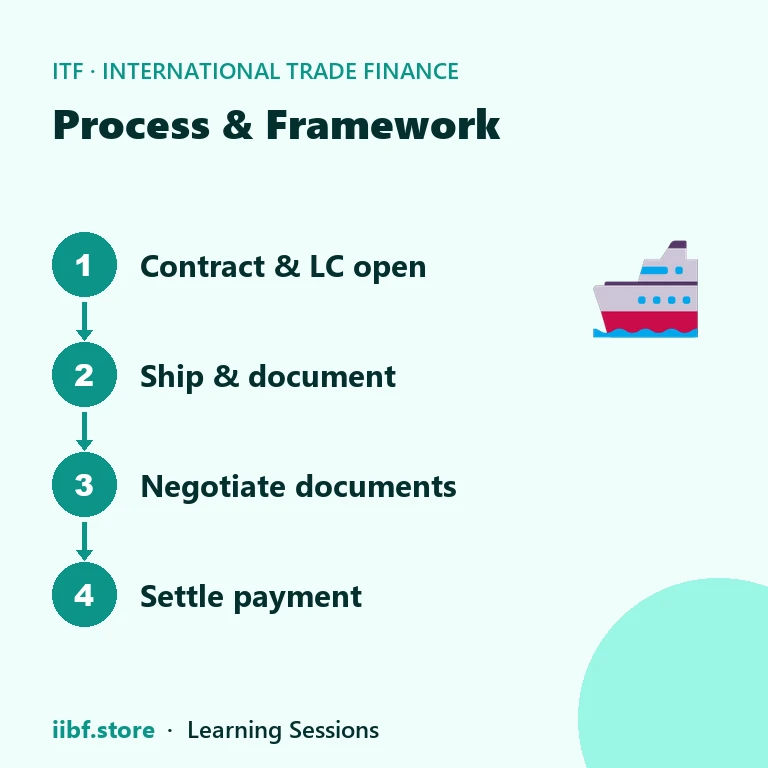
The flow through a special rupee vostro account is deliberately symmetrical, and if you can draw it you can answer almost any question on it. On the import side, the Indian importer pays Indian rupees into the designated account of the correspondent bank, against the invoice raised by the overseas supplier for the supply of goods or services. On the export side, the Indian exporter is paid export proceeds in Indian rupees out of the balances standing in that same designated account.
Notice what this means operationally: the account is a shared pool. Import payments credit it; export payments debit it. Invoicing, payment and settlement are all in rupees, so the commercial invoice, the shipping documents and the bank's advice all carry INR. The mechanics of the underlying trade cycle do not change — read the trade transactions chapter for the documentary sequence that still applies.
Three refinements are commonly tested. Advance payment against exports is permitted, but the AD bank must first ensure that the funds available in the account are used towards payment obligations arising out of already executed export orders and export payments in the pipeline — the pipeline has priority over the advance. Set-off of export receivables against import payables is permitted within the arrangement, subject to the extant set-off conditions. And bank guarantees for trade transactions routed through this mechanism are permitted, subject to the guarantee provisions under FEMA and the Master Direction on Guarantees and Co-acceptances.
💡 Exam Tip: Remember the direction of travel — rupees flow in from the Indian importer and out to the Indian exporter. The overseas party never remits or receives foreign currency into or from this account.
Financing structures sit alongside the settlement rail rather than replacing it. A borrower still weighs buyers credit for imports on the funding side, and an exporter can still consider export factoring and receivables finance to convert a rupee receivable into cash.
💰 Surplus Balances, the Exchange Rate and Permitted Investments
The exchange rate between the currencies of the two trading partner countries is market determined. There is no administered rate, no RBI reference fixing and no FEDAI-declared rate for this purpose — the two banks agree a rate on commercial terms. Candidates who track policy rates through the RBI rates resource should note that this is a price discovered bilaterally, not published centrally.
Because import payments and export payments rarely match, a surplus rupee balance builds up. RBI permits that surplus to be deployed in defined ways: payments for projects and investments, export and import advance flow management, and investment in Government Treasury Bills and Government dated securities, in each case subject to FEMA provisions and the applicable extant guidelines and limits. That last permission is why an ITF candidate needs some fixed-income literacy — if you are shaky on how a G-sec is priced, work through bond pricing and yield to maturity before the exam.
The table below contrasts the special rupee vostro account route with conventional foreign currency settlement, which is the comparison most often set as a short-note question.
| Parameter | Rupee vostro (SRVA) route | Conventional FCY route |
|---|---|---|
| Invoicing and settlement currency | Indian rupees | Hard currency (USD, EUR, etc.) |
| Where the account sits | In India, with the AD Category-I bank | Abroad, as the Indian bank's nostro |
| Prior RBI approval to open | ✅ Required, from FED, Central Office | ❌ Not required |
| Exchange rate | Market determined between the two currencies | Market determined against the hard currency |
| Use of surplus balance | T-bills, dated G-secs, project and investment payments, advance flow management | Governed by nostro and overseas investment norms |
| Workable in sanctions-constrained corridors | ✅ Yes, no dollar clearing leg | ❌ Frequently blocked |
📋 Reporting, EDPMS, IDPMS and the Imbalance Problem
Rupee settlement does not create a reporting holiday. Export transactions continue to be reported and closed through the Export Data Processing and Monitoring System, and import transactions through the Import Data Processing and Monitoring System, exactly as they would be under a foreign currency settlement. The shipping bill still has to be matched and closed against realisation; the bill of entry still has to be evidenced against the outward payment. AD banks additionally report under the extant returns applicable to the arrangement.
The Foreign Trade Policy was aligned with this framework as well. DGFT amended the FTP in September 2022 so that invoicing, payment and settlement of exports and imports in Indian rupees through the rupee vostro mechanism is recognised for the purposes of export realisation and the related export benefits. Without that amendment, exporters would have faced the absurd position of shipping goods, being paid in full, and losing scheme entitlements because the receipt was not in free foreign exchange. More on the institutional plumbing sits in the facilitation bodies chapter.
The honest limitation is arithmetic. Where India imports far more from a partner than it exports to that partner, rupees pile up in the account faster than the partner's side can spend them. The permitted investment avenues absorb some of that surplus, but a partner central bank or exporter community that ends up holding a large, slowly deployable rupee balance will start pricing that inconvenience into the invoice. Trade imbalance, not regulation, is the binding constraint on how far a special rupee vostro account arrangement can scale. Related risk themes across the syllabus are collected under the International Trade Finance article hub.
📌 Remember: The rupee route removes settlement-currency risk for the Indian party and removes dependence on dollar clearing — it does not remove credit risk, country risk or documentary risk. Those are assessed exactly as before.
For the original text of the circular and the Master Directions it interacts with, go to the Reserve Bank of India website rather than to any secondary summary.
🧠 Practice MCQs: Rupee Trade Settlement
Q1. Before an AD Category-I bank in India opens an SRVA for a correspondent bank of a partner country, prior approval must be obtained from: (a) the Directorate General of Foreign Trade (b) the Foreign Exchange Department, RBI, Central Office, Mumbai (c) the bank's own board of directors (d) FEDAI
Answer: (b) — RBI's July 2022 circular requires prior approval from the Foreign Exchange Department, Central Office, Mumbai; board sanction alone is not enough.
Q2. As part of due diligence on the proposed correspondent bank, the Indian bank must specifically obtain: (a) only a domestic credit rating (b) financial soundness details together with the FATF status of the jurisdiction and the sanctions position (c) a DGFT importer-exporter code (d) an ECGC policy in favour of the correspondent
Answer: (b) — financial soundness, FATF status and sanctions screening form the mandatory pre-approval diligence set.
Q3. Under the rupee settlement mechanism, the exchange rate between the currencies of the two trading partner countries is: (a) fixed daily by an RBI reference rate (b) declared by FEDAI (c) market determined (d) notified by DGFT with the Foreign Trade Policy
Answer: (c) — the circular expressly provides that the rate may be market determined between the two currencies.
Q4. In an import transaction settled through this mechanism, the Indian importer: (a) remits foreign currency into the Indian bank's nostro account (b) pays Indian rupees into the SRVA of the correspondent bank against the supplier's invoice (c) pays rupees directly to the overseas supplier outside the banking channel (d) must first open an EEFC account
Answer: (b) — imports are settled by the importer crediting rupees to the designated account against the invoice for supply of goods or services.
Q5. Surplus rupee balances lying in the account may be invested in: (a) listed equity shares of Indian companies (b) Government Treasury Bills and Government dated securities, subject to extant guidelines (c) foreign currency deposits held abroad (d) unrated corporate commercial paper only
Answer: (b) — permitted deployment includes Treasury Bills and dated Government securities, alongside project and investment payments and advance flow management.
Want chapter-wise mock tests with 100+ MCQs? Start practising free →
❓ Frequently Asked Questions
Is an SRVA the same as an SNRR account?
No. An SNRR account is opened for a non-resident person or entity for specified rupee-denominated business purposes. The SRVA is opened for a correspondent bank of a partner country, specifically to settle bilateral trade in rupees, and needs prior RBI approval.
Do exporters still get export incentives if they are paid in rupees?
Yes. DGFT amended the Foreign Trade Policy in September 2022 so that invoicing, payment and settlement in Indian rupees through the vostro mechanism is recognised for export realisation and related benefits.
Does EDPMS and IDPMS reporting still apply?
Yes. Export documents continue to be reported and closed through EDPMS and import transactions through IDPMS. The settlement currency changes; the monitoring obligation does not.
Can advance payment be received against exports under this arrangement?
It is permitted, but the AD bank must first ensure that funds available in the account are used towards payment obligations from already executed export orders and export payments in the pipeline before releasing an advance.
🎯 Key Takeaways and Your Next Step
Reduce the topic to five anchors and you will not lose a mark: prior RBI approval from the Foreign Exchange Department; mandatory financial soundness, FATF and sanctions diligence on the correspondent bank; importer pays rupees in and exporter is paid rupees out of the same balance; a market-determined exchange rate; and surplus deployment into Treasury Bills, dated Government securities, project payments and advance flow management. Layer on EDPMS and IDPMS reporting plus the Foreign Trade Policy alignment, and you have covered every angle the paper has historically taken on the special rupee vostro account.
Now convert reading into recall. Work the ITF chapters end to end and then test yourself under time pressure — attempt a free chapter-wise mock test and see how many of these five anchors you can reproduce cold.
Practice this topic
Take a free mock test, download chapter PDFs, or watch a video class — all included on iibf.store.