Bond Pricing and Yield to Maturity: CAIIB BFM Guide
Bond pricing and yield to maturity sit at the heart of every bank's investment portfolio decision, and CAIIB BFM candidates are expected to move fluently between the arithmetic and the treasury logic behind it. Whether a bank is marking its AFS book to market, deciding whether to add a security to its held-to-maturity bucket, or simply comparing two G-Secs on offer, the question that decides the trade is the same: what price makes sense for the yield the market is demanding today? This article builds that intuition from the ground up — present value, coupon cash flows, the price-yield seesaw, and the accrued-interest mechanics that turn a quoted price into a settlement amount — with worked logic you can carry straight into the exam hall.
📈 What Bond Pricing Means for a Bank's Investment Book
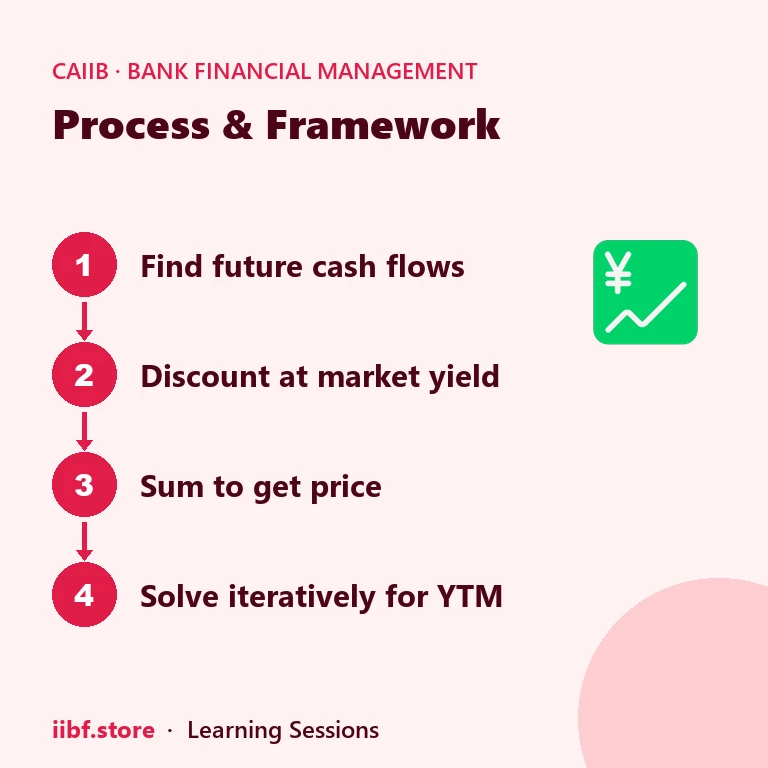
A bond is simply a promise: a fixed coupon on specified dates and the face value back at maturity. Bond pricing and yield to maturity work together to convert that stream of future cash flows into a single number a treasury desk can trade on today. The price of a bond is the present value of every future coupon plus the present value of the redemption amount, each discounted at the yield the market currently expects for a security of that tenor and credit quality. Raise the discount rate and every future cash flow is worth less today, so the price falls; lower it and the price rises. This inverse relationship is the single most tested idea in this part of the CAIIB BFM syllabus, and it explains why a bank's investment book can show a mark-to-market loss even when the issuer has not missed a single coupon payment — market yields simply moved up.
For a bank, this is not academic. Investments booked under Available for Sale and Held for Trading are revalued using current market yields, so a rise in benchmark yields hits the profit and loss account through provisioning even without a credit event. Treasury desks watch bond pricing constantly because it directly drives investment depreciation reserves, capital charges under the trading book framework, and the timing of profit booking on securities sales. Understanding how a small yield move translates into a price move — and why that sensitivity differs across tenors — is the foundation for every more advanced ALM and risk topic that follows in the CAIIB BFM curriculum, including how banks handle correspondent exposures and cross-border settlement risk covered under Correspondent Banking and NRI Accounts.
🧮 Calculating Yield to Maturity Step by Step
Yield to maturity is the single discount rate that, when applied to every remaining coupon and the final redemption, produces exactly the bond's current market price. Unlike the coupon rate, which is fixed at issuance, or current yield, which only compares annual coupon to price, YTM captures the full picture: it embeds reinvestment of coupons at the same rate, the time remaining to maturity, and any gain or loss the holder will realise if the bond is bought at a discount or premium to face value. There is no clean algebraic formula to solve for YTM directly from price — it is found by iteration, trial and error, or approximation formulas, which is exactly why exam questions test the approximate YTM formula rather than expecting a full iterative solve.
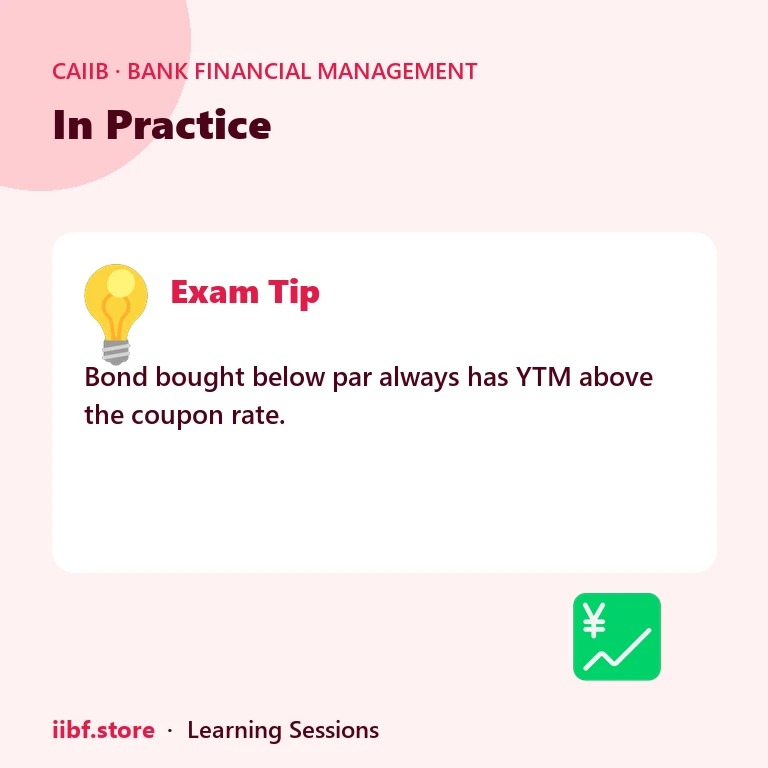
A commonly tested approximation is: YTM ≈ [Annual Coupon + (Face Value − Price) / Years to Maturity] / [(Face Value + Price) / 2]. Notice the numerator captures the coupon income plus the amortised capital gain or loss per year, while the denominator averages the price paid and the value redeemed. A bond bought below par will always show a YTM higher than its coupon rate, because the buyer earns the coupon plus a capital gain at redemption; a bond bought above par shows a YTM below the coupon rate for the mirror-image reason. CAIIB BFM numericals frequently combine this with day-count and accrued-interest adjustments, so candidates should practise the approximation formula until the arithmetic is second nature rather than something to derive under exam pressure.
⚖️ Price-Yield Relationship and Why It Matters for CAIIB BFM
Plot bond price against yield and the curve is not a straight line — it is convex, bowing away from the origin. That convexity means a given fall in yield raises the price by more than the equivalent rise in yield lowers it, an asymmetry that becomes especially important once candidates study duration and convexity as separate, deeper topics later in the syllabus. For now, the exam-relevant takeaway on bond pricing and yield to maturity is simpler: longer-tenor and lower-coupon bonds are more price-sensitive to a given yield change than short-tenor, high-coupon bonds, because more of their value sits further out in time and is discounted more heavily by any yield shift.
💡 Exam Tip: If a question asks which of two bonds will lose more value for the same rise in yield, pick the one with the longer residual maturity and the lower coupon — it has the higher price sensitivity, full stop.
This relationship also explains a recurring pattern in treasury desks: when the market expects rates to fall, desks extend duration by buying longer bonds to capture bigger price gains; when a rate hike cycle is expected, they shorten tenor to protect the book. The same yield-curve logic underpins how banks price forward cash flows in other treasury products, which is why it pairs naturally with the mechanics covered in CAIIB BFM Treasury Products 2026 and the hedging instruments discussed in CAIIB BFM Derivative Products. A bank that ignores this sensitivity risks understating the capital and provisioning impact of a rate cycle turning against its investment book.
⚠️ Common Mistake: Students often assume price and yield move together because "higher yield sounds like a better bond." Remember: yield up always means price down for an existing bond — the two move in strictly opposite directions.
| Yield Measure | What It Considers | Accounts for Time Value of Money | Best Used For |
|---|---|---|---|
| Coupon Rate | Fixed % of face value at issuance | ❌ | Stating the bond's contractual income only |
| Current Yield | Annual coupon ÷ market price | ❌ | Quick, rough income comparison |
| Yield to Maturity | All future coupons + capital gain/loss to redemption | ✅ | Comparing bonds of different price, coupon or tenor |
| Yield to Call | Cash flows only up to the earliest call date | ✅ | Callable bonds trading above par |
🏦 Accrued Interest, Day-Count Conventions and Clean vs Dirty Price
Bonds rarely settle exactly on a coupon date, so the price quoted in the market — the clean price — is not what the buyer actually pays. The buyer also owes the seller accrued interest, the coupon earned from the last payment date up to settlement, which produces the dirty price (clean price plus accrued interest) that actually changes hands. Getting this right matters for CAIIB BFM numericals because accrued interest is calculated using a specific day-count convention, and Indian G-Sec and corporate bond markets do not all use the same one — some use actual/actual, others 30/360, and the choice changes the accrued figure by a few basis points that examiners like to test.
Failing to separate clean and dirty price is one of the most common errors in bond-pricing numericals: a candidate who forgets accrued interest will misstate the settlement amount and, in a portfolio-valuation question, misstate the day's profit or loss on the book. Banks manage this precisely because investment desks report clean prices for market comparison but settle trades — and compute funding requirements — on dirty prices. The same settlement discipline that governs domestic bond trades extends into cross-border instruments; readers building out their forex and settlement portfolio can cross-check the underlying documentation flow in Documentry letters of credit and the rate mechanics in Exchange rates and Forex Business, both tested alongside bond and money-market pricing in the BFM paper.
📌 Remember: Clean price is what's quoted; dirty price (clean price + accrued interest) is what's actually paid on settlement. Exam questions that ask for the "purchase consideration" almost always want the dirty price.
🔗 Where Bond Pricing Fits in a Bank's Treasury Toolkit
Bond pricing and yield to maturity never sit in isolation on a bank's balance sheet — they connect directly into deposit and liability planning, hedging decisions, and even how a bank manages its correspondent and cross-border banking relationships. A treasury desk that has priced its bond book accurately can then decide whether the resulting duration gap needs to be hedged, which is the same judgement call examined in CAIIB BFM Treasury Management: Chapter 18. Because bond yields and forex forward premiums are both driven by interest-rate differentials, candidates preparing this topic often find it efficient to revise it alongside international-facing modules such as External Commercial Borrowings And Foreign Investments In India and remittance rules under Lrs And Other Remittance Facilities For Residents.
The underlying valuation framework for how Indian banks classify and value their investment portfolios — including when securities move between AFS, HFT and HTM and how mark-to-market gains or losses are recognised — is set out by the regulator; serious candidates should read the source rules directly at the Reserve Bank of India website rather than relying only on secondary notes. On the digital-banking side of the CAIIB syllabus, the same treasury desks increasingly rely on API-driven data feeds for real-time pricing, a theme covered in API banking and open banking. For a structured walk through every BFM topic in this cluster, browse the full Bank Financial Management archive before your next revision session.
🧠 Practice MCQs: Bond Pricing and Yield to Maturity
Q1. A bond is trading below its face value. Which statement is correct? (a) Its YTM is lower than its coupon rate (b) Its YTM equals its coupon rate (c) Its YTM is higher than its coupon rate (d) YTM cannot be determined without the credit rating
Answer: (c) — A bond priced below par gives the holder both the coupon and a capital gain at redemption, so YTM exceeds the coupon rate.
Q2. If market yields rise, the price of an existing fixed-coupon bond will: (a) Rise (b) Fall (c) Stay unchanged (d) Move only if the issuer is downgraded
Answer: (b) — Bond price and yield move inversely; a rise in required yield discounts future cash flows more heavily, lowering price.
Q3. Between two bonds with the same coupon, the one with the longer residual maturity will: (a) Be less sensitive to yield changes (b) Be more sensitive to yield changes (c) Have identical sensitivity (d) Only differ in credit risk, not price sensitivity
Answer: (b) — Longer-tenor bonds have more distant cash flows, which are discounted more heavily for a given yield change, making them more price-sensitive.
Q4. The "dirty price" of a bond is: (a) The quoted market price only (b) Face value minus accrued interest (c) Clean price plus accrued interest (d) The price after adjusting for credit rating
Answer: (c) — The dirty price is the actual settlement amount: the quoted clean price plus interest accrued since the last coupon date.
Q5. In the approximate YTM formula, the numerator represents: (a) Coupon income only (b) Coupon income plus amortised capital gain or loss per year (c) Face value divided by years to maturity (d) Market price minus coupon
Answer: (b) — The approximate YTM formula's numerator adds the annual coupon to the yearly amortised gain or loss between price and face value.
Want chapter-wise mock tests with 100+ MCQs? Start practising free →
❓ Frequently Asked Questions
What is the difference between coupon rate and yield to maturity?
Coupon rate is the fixed percentage of face value paid annually and never changes after issuance. Yield to maturity is the actual return an investor earns if the bond is held to maturity, factoring in the price paid, coupon income and capital gain or loss at redemption — so it changes every time the market price changes.
Why does bond price fall when interest rates rise?
A bond's price is the present value of its future coupons and redemption amount. When market interest rates rise, those future cash flows are discounted at a higher rate, which reduces their present value today — so the price falls even though the coupon itself is unchanged.
Is yield to maturity the same as current yield?
No. Current yield only divides the annual coupon by the current market price, ignoring the time value of money and any capital gain or loss at redemption. Yield to maturity accounts for the entire cash flow stream and is therefore the more complete and more heavily tested measure in CAIIB BFM.
Why do banks need to distinguish clean price from dirty price?
Banks quote and compare bonds using the clean price, but they settle trades and compute funding requirements using the dirty price, which includes accrued interest since the last coupon date. Mixing the two up misstates both the settlement amount and the day's reported profit or loss on the investment book.
Bond pricing and yield to maturity are not a one-time exam topic — they are the working vocabulary a bank's treasury desk uses every trading day to value its investment book, decide when to hedge, and judge whether a security is cheap or expensive relative to its risk. Master the present-value logic, the approximate YTM formula, and the clean-versus-dirty price distinction covered here, and the more advanced duration, convexity and IRRBB topics later in the CAIIB BFM syllabus will build on a foundation you already understand cold. Put the concepts to work now with full-length CAIIB BFM practice tests and structured chapters before your next attempt.
Quick quiz on this topic
5 exam-style questions from our free test bank — check yourself before you move on.
Practice this topic
Take a free mock test, download chapter PDFs, or watch a video class — all included on iibf.store.
Keep reading