Strategic Risk in Financial Services: Drivers, Measurement and Oversight (IIBF RFS)
Strategic risk in financial services is the risk that a bank's chosen business model, its response to competitive and regulatory change, or the execution of its stated strategy fails to deliver — and quietly destroys shareholder value over a multi-year horizon. Unlike credit or market risk, it rarely shows up as a clean number on a single day's risk report. For CAIIB Risk in Financial Services (RFS) candidates, this is exactly what makes strategic risk one of the hardest topics to answer precisely: examiners test whether you can define it, name its drivers, and explain why it cannot be squeezed into a VaR model the way market risk can.
📊 What Is Strategic Risk and Why It Resists Quantification
Strategic risk arises from adverse business decisions, poor implementation of decisions, or a failure to respond to changes in the competitive, regulatory, technological, or customer environment. It is forward-looking and existential in nature — it asks whether the bank's business model remains viable five to ten years out, not whether today's loan book is adequately provisioned.
This is the core reason strategic risk resists quantification. Credit risk has decades of default data feeding PD/LGD/EAD models; market risk has price series feeding Value-at-Risk. Strategic risk has neither a stable underlying distribution nor a large enough sample of comparable "business model failures" to build a statistically robust model. A bank cannot backtest a decision to exit a product line the way it backtests a VaR model. As a result, strategic risk is assessed qualitatively — through scorecards, peer benchmarking, and structured judgment — rather than measured in capital-equivalent terms.
That does not mean it is unmanaged. Boards and senior management are expected to identify strategic risk exposures, document the assumptions behind the strategy, and monitor leading indicators such as market share erosion, margin compression, or customer attrition that signal the strategy is drifting off course.
💡 Exam Tip: If a question asks why strategic risk is harder to quantify than credit or market risk, the answer hinges on the absence of a stable statistical model and reliable historical loss data — not on the risk being "less important."
🎯 Business Model Risk: The Core Driver of Strategic Risk
Business model risk is the single largest driver of strategic risk in financial services today. It is the risk that a bank's revenue model — how it earns, from whom, and through which channels — becomes unsustainable because of structural shifts in the industry rather than a one-off operational lapse.
In the Indian context, three forces dominate business model risk. First, digital disruption: fintechs and payment banks have unbundled traditional banking services, compressing fee income on payments and remittances. Second, margin pressure from rising cost of funds and intensified deposit competition, which squeezes net interest margin for banks over-reliant on a narrow liability franchise. Third, concentration risk in the business mix itself — a bank overly dependent on a single segment, such as unsecured retail lending or a narrow corporate relationship base, carries elevated strategic risk if that segment turns.
These drivers differ sharply from the drivers behind quantifiable risks. A portfolio manager assessing portfolio credit risk can point to concentration limits and correlation assumptions with numeric thresholds. A strategic risk assessment, by contrast, relies on management's judgment about where the industry is heading and whether the bank's current model can survive the transition — a judgment call, not a calculation.
Boards evaluating business model risk increasingly look at the same quantifiable disciplines used for credit risk models purely as a benchmark for what "measurable" risk management looks like, then accept that strategic risk assessment must stay qualitative, judgment-driven, and scenario-based instead.
🔮 Scenario Planning and Strategy Execution Risk
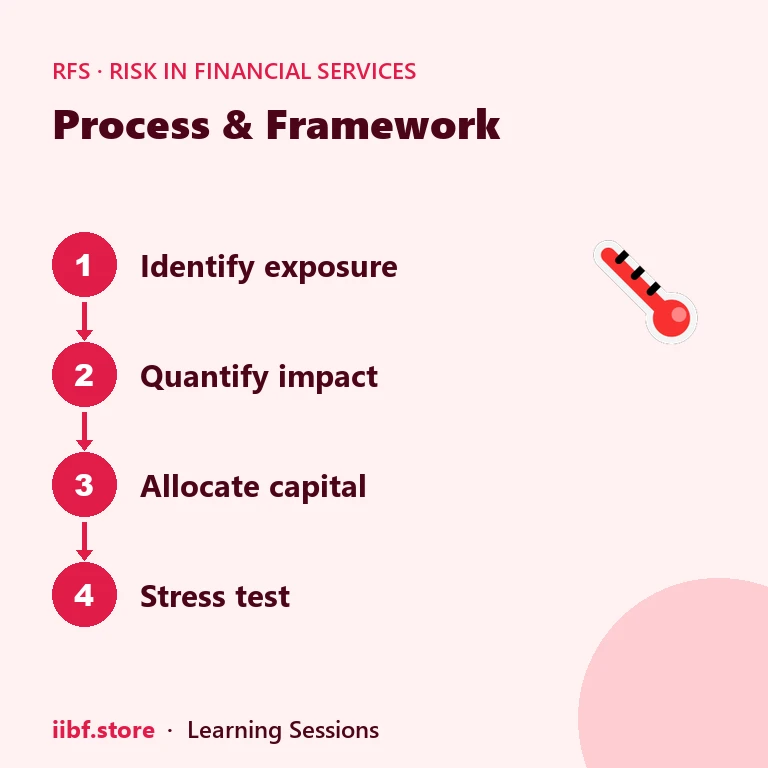
Because strategic risk cannot be modelled statistically, scenario planning becomes the board's primary tool. Scenario planning involves constructing a small number of plausible, internally consistent futures — for example, an aggressive digital-disruption scenario, a rate-shock scenario, and a regulatory-tightening scenario — and stress-testing the bank's current strategy against each one. The output is not a capital number; it is a set of triggers and contingency actions the bank commits to if a scenario starts to materialise.
Strategy execution risk is the second, closely related dimension examiners expect you to distinguish from business model risk. Even a sound strategy can fail purely because of poor implementation: inadequate resourcing, unclear accountability, technology delivery delays, or a failure to align incentives with the new strategic direction. A bank can have exactly the right diagnosis of where the market is going and still destroy value by executing badly.
Good practice separates the two explicitly in board papers — one section assessing whether the strategy itself remains sound given the external environment, and a second tracking execution milestones, budget variance, and key project risks against the approved strategic plan.
⚠️ Common Mistake: Candidates often conflate business model risk (is the strategy right?) with strategy execution risk (is the strategy being implemented well?). IIBF RFS questions frequently test this exact distinction.
🏛️ Board Oversight of Strategic Risk
Strategic risk sits squarely with the board, not with a risk model owned by the second line. The board approves the strategic plan, questions the assumptions underlying it, and is expected to revisit those assumptions at least annually — more often if the operating environment shifts materially. This is a deliberate design choice: because strategic risk cannot be reduced to a limit or a capital charge, the only credible control is informed, challenging board-level judgment.
In practice, effective board oversight of strategic risk includes reviewing competitor and market intelligence independent of management's own narrative, commissioning external scenario analysis, setting early-warning indicators tied to the strategic plan, and ensuring the Chief Risk Officer has a direct line into strategic and business planning discussions rather than being consulted only after decisions are made. This overlaps closely with the broader risk governance framework in banks, which sets out how the board, CRO, and risk committees divide responsibility across all risk categories, strategic risk included.
Where a bank does attempt to formalise strategic risk assessment — through scorecards, heat maps, or expert-judgment models — the same governance discipline applied to model risk management in banks should apply: assumptions must be documented, validated independently, and revisited when outcomes diverge from expectations, even though the underlying "model" here is largely qualitative.
📌 Remember: The RBI's corporate governance expectations place ultimate accountability for strategy and business model soundness with the board of directors, not with a single risk function.
For the regulatory backdrop on governance expectations, see the Reserve Bank of India's guidance on bank governance at rbi.org.in, which frames board responsibility for the overall risk and strategy of the institution.
| Risk Type | Primary Driver | Standard Quantification Approach | Quantifiable via Capital Models? |
|---|---|---|---|
| Credit Risk | Borrower default | PD / LGD / EAD, internal ratings | ✅ Yes |
| Market Risk | Price and rate movements | Value-at-Risk, stress testing | ✅ Yes |
| Operational Risk | Process, people, system failure | Loss data, Standardised Measurement Approach | ✅ Yes (Basel SMA) |
| Strategic Risk | Business model / competitive shift | Scenario planning, qualitative scorecards | ❌ No standard capital model |
This contrast is worth internalising for the exam: the drivers behind credit risk models PD LGD EAD are backward-looking and statistically estimable, while strategic risk drivers are forward-looking, judgment-based, and specific to each institution's competitive position. A bank that is well outsourced-dependent for digital delivery also inherits an additional layer of strategic exposure, which is why examiners often link this topic to the broader outsourcing risk in financial services chapter.
🧠 Practice MCQs: Strategic Risk in Financial Services
Q1. Strategic risk in financial services is best defined as the risk arising from: (a) borrower default on a loan (b) adverse business decisions, poor implementation, or failure to respond to a changing environment (c) an unauthorised trading position (d) a system outage in core banking
Answer: (b) — Strategic risk relates to business decisions, execution, and the bank's ability to adapt its model, not to a specific credit, market, or operational event.
Q2. Why does strategic risk resist quantification in the way credit or market risk does not? (a) it is not a real risk (b) regulators exempt it from measurement (c) it lacks stable historical data and a robust statistical model (d) it only affects small banks
Answer: (c) — There is no large, comparable dataset of business model failures to build a statistical model, so assessment stays qualitative.
Q3. A bank has the right strategic diagnosis of its market but fails to deliver because of delayed technology rollout and unclear accountability. This is best described as: (a) business model risk (b) strategy execution risk (c) credit concentration risk (d) settlement risk
Answer: (b) — Execution risk concerns implementation failure, distinct from the soundness of the strategy itself, which is business model risk.
Q4. Which tool is most commonly used by boards to assess strategic risk in the absence of a statistical model? (a) Value-at-Risk (b) scenario planning (c) internal ratings-based approach (d) standardised measurement approach
Answer: (b) — Scenario planning builds plausible futures and stress-tests the current strategy against each, since no capital model exists for strategic risk.
Q5. Primary accountability for oversight of strategic risk in a bank rests with: (a) the compliance officer (b) the internal audit function alone (c) the board of directors (d) the branch manager
Answer: (c) — Because strategic risk cannot be reduced to a limit or capital charge, the board retains direct accountability for approving and challenging the strategy.
Want chapter-wise mock tests with 100+ MCQs? Start practising free →
What is the difference between strategic risk and business risk?
In IIBF RFS usage, business risk and strategic risk are often used interchangeably to mean the risk that the bank's business model or strategy fails to generate expected returns; some texts treat business risk as the broader category and strategic risk as the sub-component tied specifically to strategic decisions and their execution.
Can strategic risk be assigned a capital charge under Basel norms?
No. Unlike credit, market, and operational risk, strategic risk does not have a dedicated Pillar 1 capital charge under the Basel framework; it is addressed through Pillar 2 supervisory review and board-level governance rather than a formula-driven capital requirement.
How does scenario planning help manage strategic risk?
Scenario planning builds a small set of plausible future environments and tests whether the bank's current strategy remains viable under each one, giving the board early-warning triggers and contingency actions rather than a single point estimate of loss.
Who is primarily responsible for strategic risk oversight in a bank?
The board of directors holds primary responsibility, since strategic risk decisions concern the overall direction and business model of the institution and cannot be delegated to a single risk model or risk owner.
✅ Conclusion: Making Strategic Risk Exam-Ready
Strategic risk in financial services is unlike every other risk category on the CAIIB RFS syllabus precisely because it cannot be modelled the way credit, market, or operational risk can. Master the vocabulary — business model risk, strategy execution risk, scenario planning, board oversight — and you will be able to answer both direct definition questions and applied case-study questions with confidence. Explore more coverage on this theme at the risk in financial services tag hub, and revise the related market and systemic dimensions through the market risk measurement in banks and systemic risk and macroprudential policy articles. When you are ready to test yourself, take a full CAIIB chapter-wise mock and lock in the distinction between strategic risk drivers and quantifiable risk models before exam day.
Practice this topic
Take a free mock test, download chapter PDFs, or watch a video class — all included on iibf.store.
Keep reading