Training and Development in Banks: CAIIB HRM Guide

For CAIIB aspirants tackling the Human Resources Management elective, training and development in banks is one of the most examinable and practically relevant topics you will encounter. Indian banks operate in a fast-changing environment shaped by digitalisation, new regulatory expectations, and generational shifts in the workforce, which means the way employees are re-skilled and up-skilled directly affects service quality, compliance, and profitability. This guide breaks down the concepts, institutions, and frameworks the IIBF expects you to know, links them to the core chapters of the CAIIB HRM syllabus, and gives you a compact revision table plus FAQs so you can convert reading time into marks.
Why training and development matters in the banking sector
Banking is a knowledge-intensive, trust-driven service industry, so the competence of frontline and back-office staff is a genuine business asset rather than an overhead. Training and development in banks aims to close the gap between the skills an employee currently has and the skills the role demands today and in the near future. In a public sector bank with lakhs of employees spread across rural and urban branches, this gap can be significant, especially when new products such as digital lending, co-lending, or unified payments are rolled out faster than staff can absorb them.
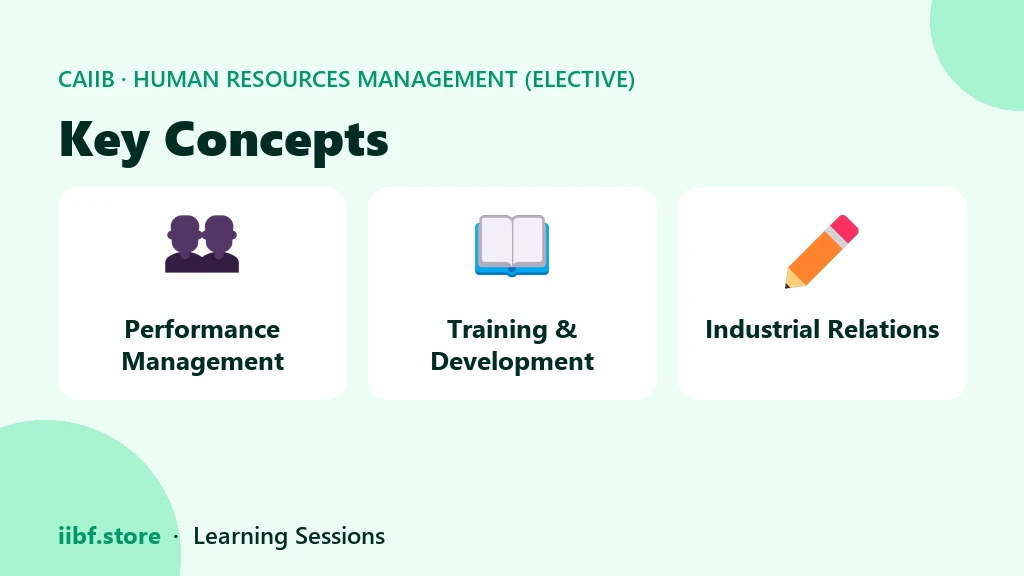
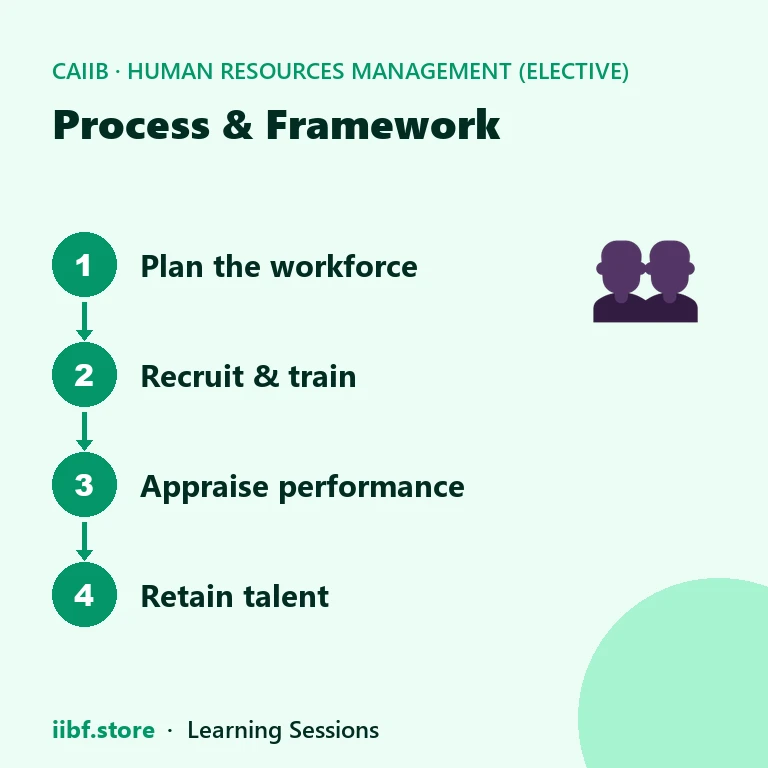
Development goes a step beyond training. Where training targets a specific current job skill, such as operating a new core banking module or handling KYC re-verification, development builds broader managerial and behavioural competencies for future roles. This distinction maps directly onto the HRD philosophy the CAIIB elective teaches: people are capable of continuous growth, and the organisation's job is to create an enabling climate. A strong learning culture also reduces attrition, improves customer retention, and supports succession pipelines. To ground these ideas in the syllabus, revise the fundamentals of HRM, which set out how training fits within the wider human resource function of recruitment, appraisal, and reward.
The training cycle: from needs assessment to evaluation
The IIBF favours a systematic, four-stage training cycle, and questions frequently test whether you can place activities in the correct stage. The first stage is training needs assessment (TNA), where the bank identifies gaps at the organisational, task, and individual levels, often using performance data, audit findings, and appraisal outputs. The second stage is design, where learning objectives, content, and delivery methods are chosen. The third is delivery or implementation, and the fourth is evaluation, where the bank measures whether the training actually changed behaviour and results.
Evaluation is where the well-known Kirkpatrick model appears: reaction, learning, behaviour, and results. Many banks only measure the first two levels through feedback forms and post-tests, but IIBF material stresses that true return on training is proven at the behaviour and results levels, for example fewer compliance breaches or faster loan turnaround. Modern delivery methods have shifted heavily toward blended learning, e-learning modules, and on-the-job coaching, reducing the cost and downtime of residential programmes. Understanding how training integrates with wider people-development strategy is covered well in the chapter on HRD strategies and systems, which you should read alongside this cycle.
Key training institutions for Indian banks
A distinctive feature of Indian banking is its dense network of apex training institutions, and CAIIB frequently asks candidates to match an institution to its role. At the top sits the Reserve Bank of India's own training ecosystem, including the College of Agricultural Banking (CAB) in Pune and the Reserve Bank Staff College in Chennai, which build capacity on supervision, rural credit, and central banking functions. The Institute for Development and Research in Banking Technology (IDRBT) in Hyderabad, established by the RBI, focuses on banking technology and cyber-security skills that are now central to every bank's training agenda.
For the wider industry, the National Institute of Bank Management (NIBM) in Pune, the Indian Institute of Banking and Finance (IIBF) itself, and the Bankers Institute of Rural Development (BIRD) in Lucknow deliver certifications, research, and role-based programmes. Individual banks also run their own apex staff colleges and regional training centres. You can verify the mandate of these RBI-promoted institutions directly on the regulator's site at rbi.org.in. Because this institutional map is examined in the banking-specific context, revise it together with the general subject material via the Human Resources Management elective tag hub, where related notes are collected.
Comparing training approaches and delivery modes
Choosing the right delivery mode is a recurring theme in HRM case-style questions. On-the-job methods such as job rotation, coaching, and mentoring are inexpensive and highly transferable but can disrupt live operations and depend on the quality of the supervisor. Off-the-job methods such as classroom sessions, simulations, and residential programmes allow deeper conceptual learning without operational pressure but are costlier and can suffer from a transfer-of-learning gap once the employee returns to the branch. E-learning and blended formats now dominate large-bank rollouts because they scale cheaply, standardise content, and allow self-paced completion, though they demand learner discipline and reliable connectivity in rural branches.
The table below summarises how these approaches compare on the dimensions IIBF examiners care about, so you can answer side-by-side questions quickly.
| Training mode | Typical cost | Skill transfer to job | Best suited for |
|---|---|---|---|
| On-the-job (coaching, rotation) | Low | High | Operational and process skills |
| Off-the-job (classroom, residential) | High | Moderate | Conceptual and managerial development |
| E-learning / self-paced | Very low per head | Moderate | Compliance, product, and refresher training |
| Blended learning | Moderate | High | Large-scale re-skilling programmes |
| Simulation / role-play | Moderate to high | High | Sales, negotiation, crisis handling |
Linking training to knowledge management and performance
Training does not operate in isolation; it feeds and is fed by the bank's knowledge management system. As experienced officers retire, capturing their tacit knowledge through documentation, communities of practice, and structured mentoring becomes as important as formal courses. This is why the CAIIB elective pairs training with the broader HRD strategy and treats learning as a continuous organisational capability rather than a one-off event. A well-run learning function also supplies the raw material for performance conversations, career pathing, and internal mobility.
For exam purposes, remember that training effectiveness should ultimately show up in business results and behaviour change, not just attendance. Tie your revision of this topic to practice questions and mock tests so the concepts stick under time pressure. You can build speed on the full elective through the CAIIB question bank on iibf.store tests, and reinforce recall with the quick-recall match game. Keeping current with regulator communications on skilling and staff capacity, tracked on the IIBF news page, also helps you answer contemporary application questions.
Frequently asked questions
What is the difference between training and development in banks?
Training targets a specific skill an employee needs for their current job, such as operating a new core banking module. Development is broader and future-oriented, building managerial and behavioural competencies for roles the employee may take on later. Training tends to be short and task-focused, while development is continuous and career-focused.
Which institutions provide training to Indian banks?
Key apex bodies include the RBI's College of Agricultural Banking (Pune) and Reserve Bank Staff College (Chennai), the RBI-established IDRBT (Hyderabad) for banking technology, the National Institute of Bank Management (Pune), the Indian Institute of Banking and Finance, and BIRD (Lucknow) for rural development. Individual banks also run their own staff colleges and regional training centres.
How is training effectiveness evaluated in the CAIIB HRM syllabus?
The syllabus commonly uses the Kirkpatrick model with four levels: reaction (participant feedback), learning (knowledge gained), behaviour (on-the-job application), and results (business impact such as fewer errors or faster processing). IIBF stresses that genuine return on training is demonstrated at the behaviour and results levels, not just feedback forms.
Is training and development an important topic for the CAIIB HRM exam?
Yes. It is a high-yield, evergreen topic that connects to HRD strategy, knowledge management, and performance. Expect questions on the training cycle stages, evaluation models, delivery methods, and matching training institutions to their roles, so it rewards focused revision.
Conclusion and next steps
Mastering training and development in banks means understanding the training cycle, the evaluation models, the trade-offs between delivery modes, and the map of India's apex training institutions. Because the topic links naturally to HRD strategy, knowledge management, and performance, it repays study with strong exam returns and real workplace relevance. Anchor your revision in the core chapters, drill the concepts with timed mock tests, and keep an eye on regulator updates so your answers stay current. Ready to test yourself? Head to the CAIIB course to structure your HRM preparation and take a full-length practice test today.
Quick quiz on this topic
5 exam-style questions from our free test bank — check yourself before you move on.
Practice this topic
Take a free mock test, download chapter PDFs, or watch a video class — all included on iibf.store.
Keep reading