Succession Planning in Banks: CAIIB HRM 2026 Guide

Succession planning is the discipline of identifying and preparing future leaders so that critical roles in a bank are never left vulnerable to a sudden vacancy. In the CAIIB Human Resources Management (HRM) elective it is a high-value topic because banking is a people-intensive, regulated industry where the departure of a branch head, a chief risk officer or a board-level executive can create real operational and compliance risk. This 2026 guide explains what succession planning means, how it differs from mere replacement, the process banks follow, the RBI expectations around key managerial personnel, and the modern tools such as competency mapping and talent pipelines that make it work.
What succession planning means and why banks need it
Succession planning is a proactive, ongoing process of identifying key positions, assessing the talent available, and systematically developing internal candidates to fill those positions when they fall vacant. It is not the same as replacement planning, which is reactive and merely names a stand-in. Succession planning looks years ahead and builds capability, not just a name on a list.
- Business continuity — critical roles remain covered despite retirement, resignation or attrition.
- Regulatory expectation — RBI expects banks to have orderly succession for board and senior management.
- Talent retention — visible growth paths motivate high performers to stay.
- Reduced hiring cost and risk — internal readiness cuts dependence on external recruitment.
For banks the stakes are heightened by "fit and proper" and key-managerial-personnel norms. A well-run programme also protects institutional knowledge: when a veteran credit head or treasury dealer retires, years of judgement about clients, markets and risk appetite can walk out of the door unless a successor has been shadowing and absorbing that expertise. Succession planning therefore has a strong knowledge-management dimension, capturing tacit know-how through mentoring, documentation and structured handovers so that continuity of judgement, not merely continuity of headcount, is preserved. Candidates studying the broader HR syllabus should map this to the wider CAIIB elective content and reinforce recall through structured practice tests.
The succession planning process step by step
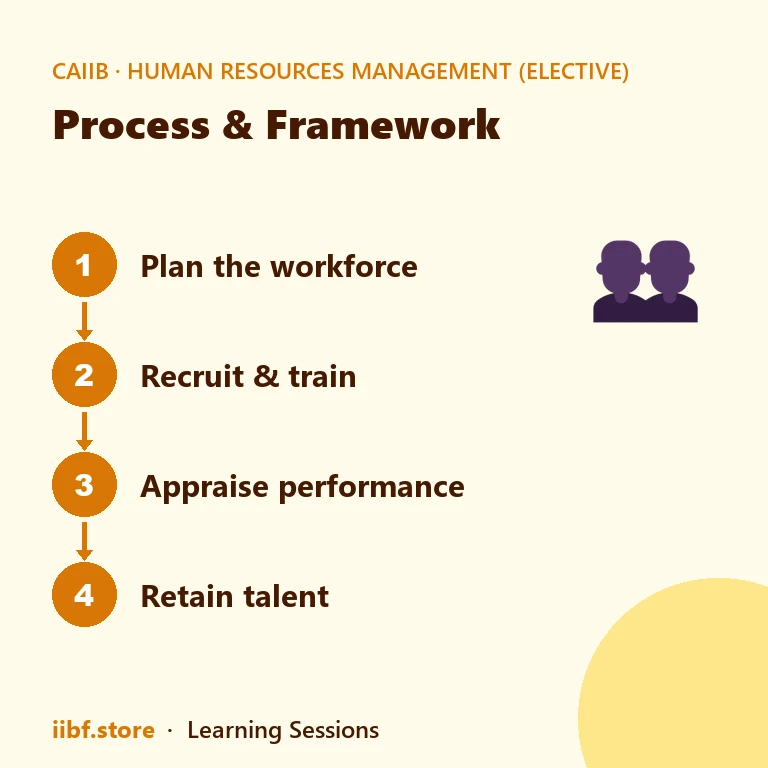
A robust programme follows a recognisable sequence. First, the bank identifies key and critical positions — those whose vacancy would materially disrupt operations, risk management or strategy. Second, it defines the competencies each role demands, often through competency mapping. Third, it assesses the current talent pool against those competencies to spot ready-now, ready-soon and long-term candidates. Fourth, it creates individual development plans — job rotation, stretch assignments, mentoring and formal training — to close the gaps. Fifth, it monitors progress and refreshes the plan regularly.
A useful analytical tool here is the nine-box grid, which plots employees on two axes — current performance and future potential — to distinguish stars, solid performers and those needing development. High-potential, high-performance staff become priority successors. Banks increasingly link this to their leadership-competency framework and to data from performance-management systems. Practise these concepts with quick-recall drills on the match game and read applied examples on the IIBF prep blog.
Regulatory dimension and key managerial personnel
Banking succession is not purely an HR choice; it operates within a supervisory frame. RBI's governance guidance expects boards to oversee succession for the Managing Director/CEO, whole-time directors and key managerial personnel, and to ensure that appointments meet "fit and proper" criteria on integrity, competence and track record. The Banking Regulation Act's provisions on management composition (such as the requirement for professionally qualified directors) reinforce the need for a deliberate leadership pipeline.
- Boards must ensure orderly succession at the top to avoid leadership vacuums.
- Nomination and Remuneration Committees typically own the succession framework.
- Successor candidates must clear "fit and proper" and any RBI approval where required.
- Contingency (emergency) succession plans handle sudden, unplanned exits.
Public-sector banks have an added layer: appointments to top posts run through mechanisms such as the Financial Services Institutions Bureau, so their succession planning must dovetail with an external selection process rather than sit entirely within the bank. Private banks enjoy more autonomy but face closer scrutiny of MD/CEO tenure and re-appointment. In both cases the board is expected to keep a live, documented succession plan and to review it at least annually, and supervisors may ask to see it during governance assessments. For CAIIB, expect questions linking succession planning to corporate governance and to the role of board committees. Keep an eye on evolving guidance through IIBF news and the official Reserve Bank of India circulars on governance.
Modern tools, challenges and 2026 practice
Contemporary succession planning leans on competency mapping, talent analytics and structured leadership-development programmes. Data-driven HR dashboards flag flight risk and readiness; assessment centres validate potential; and mentoring plus cross-functional rotation builds breadth. Yet challenges persist: over-reliance on a single "heir apparent", bias in identifying potential, poor transparency that demotivates non-chosen staff, and the difficulty of planning for fast-changing digital-era skills. In 2026, banks also plan succession for entirely new roles — data, cyber and analytics leadership — that did not exist a decade ago.
The remedy is a pipeline, not a single pick: build a bench two or three deep for each critical role, combine internal development with selective external hiring, and revisit the plan annually. Transparency, handled carefully, strengthens rather than weakens the programme — while a named "heir apparent" can demotivate peers, communicating that the bank invests in multiple high-potentials and rewards growth keeps the wider talent pool engaged. Equally, succession planning should not become an exclusive club; broad-based leadership development that lifts the whole middle-management tier gives the bank optionality and guards against the loss of any single chosen successor. Study succession planning alongside training and development and talent management for a complete HRM view, and for foundational HR concepts revisit the JAIIB course materials.
Frequently asked questions
Related study material
Go deeper with the full chapter notes and the complete article hub for this subject:
How is succession planning different from replacement planning?
Succession planning is proactive and developmental — it identifies critical roles years ahead and builds a pipeline of ready candidates. Replacement planning is reactive and merely names a temporary stand-in without systematic development.
What is the nine-box grid used for in succession planning?
The nine-box grid plots employees on performance and potential. It helps HR classify staff into categories such as stars, core performers and development needs, so high-potential, high-performing employees can be prioritised as successors.
Why does RBI care about succession planning in banks?
RBI expects boards to ensure orderly succession for the MD/CEO, whole-time directors and key managerial personnel, and to apply "fit and proper" criteria, because leadership vacuums can create governance, operational and compliance risk.
What is a contingency succession plan?
A contingency or emergency succession plan names interim successors who can step in immediately if a key executive departs suddenly through resignation, illness or death, ensuring continuity while a permanent successor is finalised.
Conclusion and next step
Succession planning protects a bank's most valuable asset — its leadership continuity. For CAIIB HRM, master the difference from replacement planning, the five-step process, the nine-box and competency tools, and the regulatory expectation on key managerial personnel. Ready to test yourself? Take an HRM elective mock on our CAIIB tests or enrol in the full CAIIB HRM course to clear the elective with confidence.
Quick quiz on this topic
5 exam-style questions from our free test bank — check yourself before you move on.
Practice this topic
Take a free mock test, download chapter PDFs, or watch a video class — all included on iibf.store.
Keep reading