Treasury Management Study Plan for Working Bankers: 21 Days
It is 9:40 pm. You have closed the branch, reconciled the day, answered one last call from the regional office and finally reached home. The syllabus is open on your phone and it looks endless: money market, debt, forex, derivatives, liquidity, front office and back office. You tell yourself you will start properly on Saturday. You have said that before.
This article gives you a Treasury Management study plan that respects that reality. It does not assume you have five free hours a day. It assumes you have about 60 to 90 minutes on weekdays and a longer block on weekends, and that you are already tired when you sit down. If you follow even the skeleton of it, you will cover all 12 chapters, practise every question set, and still have days to revise.
Why a Treasury Management study plan fails for most working bankers
Treasury looks like a subject you can finish by reading once. It is not. It is a subject of terms, quotations, instruments and the rules that sit around them. The usual failure pattern is predictable.
- Too many sources. Notes from three places, a few videos, a PDF forwarded on WhatsApp. You never finish any of them, because each one starts from a different point.
- Reading without testing. You feel you have understood the yield or the forward premium, but the first MCQ on it shows you have not.
- Starting with the hardest chapter. Derivatives on day one, motivation gone by day three.
- No fixed finish line. Without a date on the calendar, "I am preparing" can last a year.
A good Treasury Management study plan fixes all four: one source, a test after every chapter, an easy-to-hard order, and a date. Everything below is built on that.
The one rule that makes it work
Never end a study session without answering questions on what you just read. Ten questions at 10:30 pm teach you more than another 30 minutes of passive reading, and they show you honestly where the gaps are.
The chapter order that suits a tired reader
The paper has one module, Module T, and 12 chapters. The sequence below follows the order in which the printed Treasury Management book presents them, and that order is a sensible one because each chapter prepares you for the next.
Think of the 12 chapters in three blocks:
- Foundation block: Financial Markets, Money Market, Debt Markets and Fixed Income Securities, Capital Markets. This is vocabulary and instruments. It is the easiest block to read when you are exhausted.
- Dealing block: Foreign Exchange Markets, Interest Rate Quotations and Market Terminology, Derivatives. This needs a clearer head, so give it your better evenings or the weekend.
- Function and control block: Treasury Management, Liquidity Management, Front Office, Mid Office and Back Office, Regulations, Supervision and Compliance of Treasury Operations, and Role of Information Technology in Treasury Management. This is how a treasury actually runs, and it is very readable once the instruments are clear.
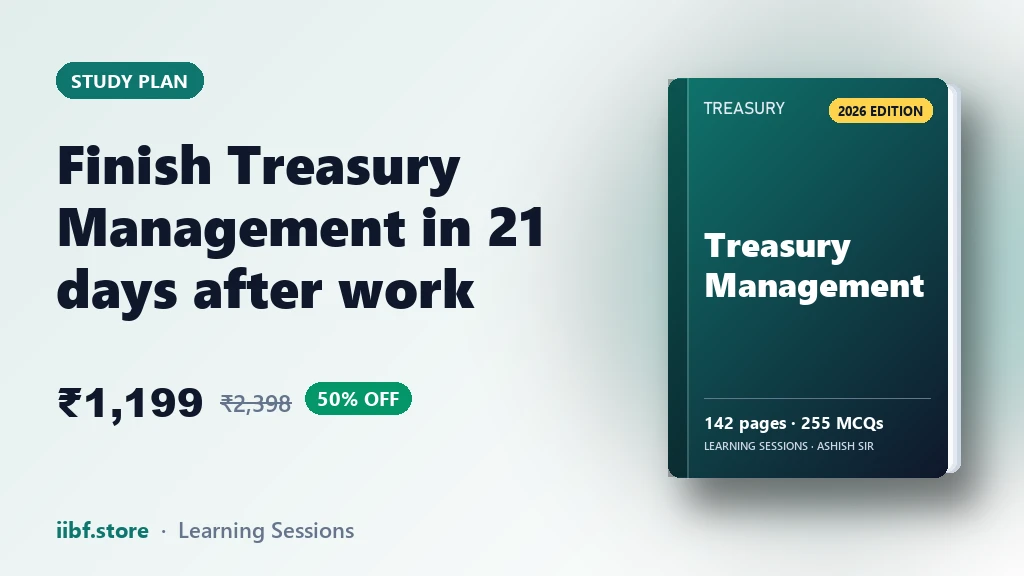
The book is 142 pages, 2026 edition, with 255 questions. At that size, one chapter is a few evenings of reading at most, not a mountain. That is the point of choosing a compact book over a thick one when you have a job: you can actually finish it.
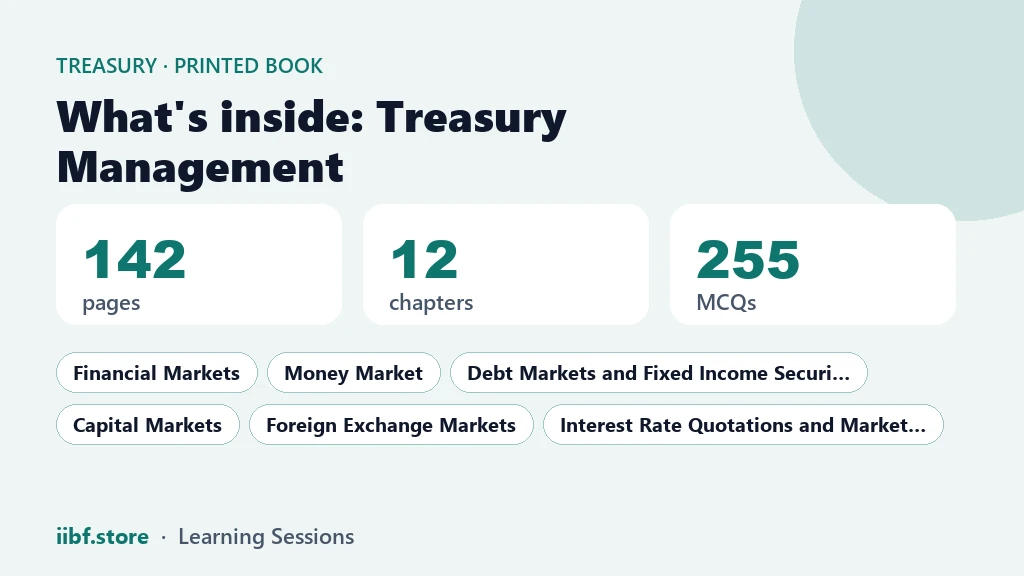
Beyond the 12 chapters, the book carries 20 Case Studies (80 questions), 4 Annexures and a Supplementary section on Risk Analysis and Control, and 5 Mega Tests (500 questions). Those extras matter for the last week of the plan, so keep them in mind.
What to do on day zero
Before you start, spend 30 minutes flipping through the whole book. Do not read it. Just see the chapter titles, look at how an end-of-chapter question set is laid out, and write your finish date on the first page. That small act makes the plan real.
The 21-day Treasury Management study plan, day by day
The table below is the core of this Treasury Management study plan. It assumes six study days a week with one day off, which protects you from burnout. If your job gets heavy in a particular week, push the whole table by a few days rather than skipping the question sets.
Daily rhythm on a normal working day: 45 to 60 minutes of reading, then 20 to 30 minutes on the chapter's end-of-chapter MCQs. On a weekend, double that.
| Days | What to read | MCQ work |
|---|---|---|
| Day 1-2 | Chapter 1: Financial Markets | Complete the chapter's question set; note every miss |
| Day 3-4 | Chapter 2: Money Market | Question set, then redo the misses next morning |
| Day 5-6 | Chapter 3: Debt Markets and Fixed Income Securities | Question set; write the price-yield relationship in your own words |
| Day 7 | Chapter 4: Capital Markets | Question set; then a quick recap of chapters 1-4 |
| Day 8-9 | Chapter 5: Foreign Exchange Markets | Question set; practise quotations on paper |
| Day 10 | Chapter 6: Interest Rate Quotations and Market Terminology | Question set |
| Day 11-12 | Chapter 7: Derivatives | Question set; repeat the ones you got wrong after a day |
| Day 13 | Chapter 8: Treasury Management | Question set |
| Day 14 | Chapter 9: Liquidity Management | Question set; recap of chapters 5-9 |
| Day 15 | Chapter 10: Front Office, Mid Office and Back Office | Question set |
| Day 16 | Chapter 11: Regulations, Supervision and Compliance of Treasury Operations | Question set; check anything regulatory against official sources |
| Day 17 | Chapter 12: Role of Information Technology in Treasury Management | Question set |
| Day 18-19 | Case Studies, Annexures, Risk Analysis and Control section | Work through the case study questions |
| Day 20-21 | Revision of your error list; Mega Tests | Attempt Mega Tests under time, review every miss |
Notice what the table does not contain: any day where you only read. Every block ends with questions. Notice also that the heavy chapters, Foreign Exchange Markets and Derivatives, get two days each, while the lighter administrative chapters get one.
How to adapt it if you only have 45 minutes a day
Stretch the plan to 30 days instead of cutting content. Give every chapter at least two evenings: one to read, one for the question set and the error list. The structure matters more than the speed.
How to read each chapter when you are tired
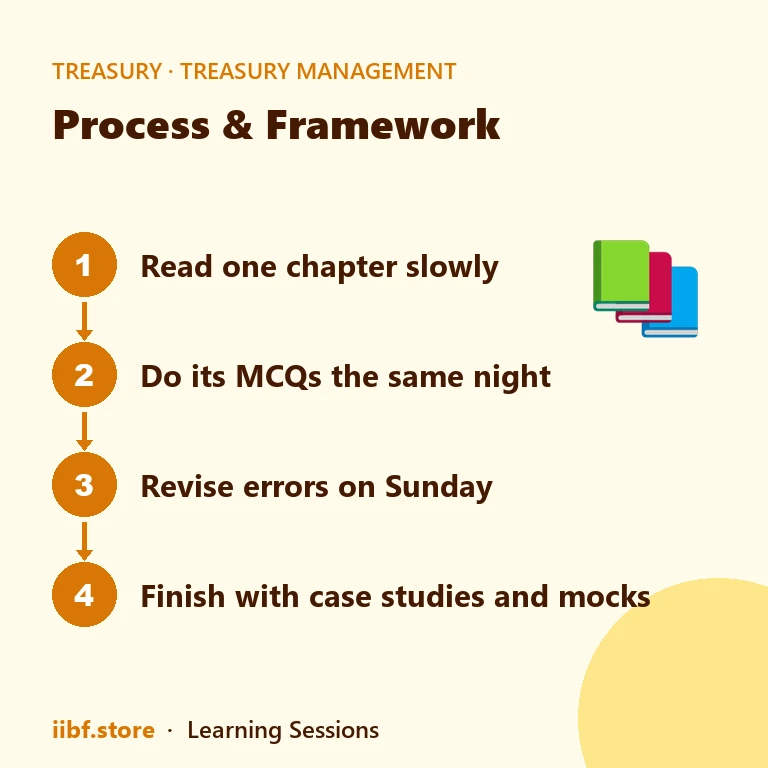
Reading technique decides whether the 45 minutes count. Use this loop for every chapter.
- Skim first (5 minutes). Read headings and any boxed or highlighted points. Know the shape before the detail.
- Read in short passes. One section at a time. After each one, close your eyes and say its main point aloud in one sentence.
- Write a one-page error sheet. Only terms and formulas you found confusing. Not a copy of the chapter.
- Do the question set the same night. If you cannot, do it before you leave for work the next morning.
Treasury rewards precise wording. Quotations, market terms and classifications are exactly where an MCQ options look alike. When two options feel close, go back to the book's own definition rather than trusting memory.
Chapters that need extra care
- Debt Markets and Fixed Income Securities: be sure of how price and yield move against each other before moving on.
- Foreign Exchange Markets and Interest Rate Quotations: practise the quotation formats on paper, not just in your head.
- Derivatives: learn the instruments one by one, with a simple example for each in your own words.
- Regulations, Supervision and Compliance: rules change, so treat the book as your base and confirm current positions at the official IIBF website and the regulator's circulars.
Using the question sets and mega tests properly
The 255 questions in the book are your feedback system, so do not waste them. Do each set once honestly, with the book closed. Mark the ones you got wrong or guessed right. The next day, redo only those.
When you reach the 20 case studies, slow down. Case-based questions test whether you can apply a concept to a situation, which is what a real treasury desk asks of you. Read the case twice before looking at the options.
The 5 Mega Tests with 500 questions are for the last stretch. Attempt them with a timer, in one sitting where you can. Then spend more time reviewing the answers than taking the test. A mock you do not review is only a measurement, not learning.
For extra practice beyond the book, there are free mock tests you can attempt at no cost, and free study PDFs if you want another angle on a topic. Use them after the book, not instead of it.
An honest note on limits
A book alone will not give you exam-hall speed. Speed comes from timed practice, so pair this Treasury Management study plan with mock tests in the final week. And since this is a printed book, it also suits readers who are tired of screens at the end of a long day.
Weekly rhythm: how to protect the plan from your job
A plan on paper is easy. A plan that survives month-end, audit week and a manager who needs a report at 6 pm is harder. A few habits help.
- Study at the same time daily. A fixed slot beats a perfect slot you keep postponing.
- Keep the book where you will see it. On your bedside table, not in a bag.
- Use commute time for recall. Go through your error sheet, not new material.
- Do not catch up by cramming. If you lose two days, shift the table, as described earlier.
- Sunday is for revision. Redo the week's errors and the previous week's question sets.
If you want to see how other papers are planned, browse the iibf.store blog, and compare options on the books page.
Is this book right for you, and what does it cost?
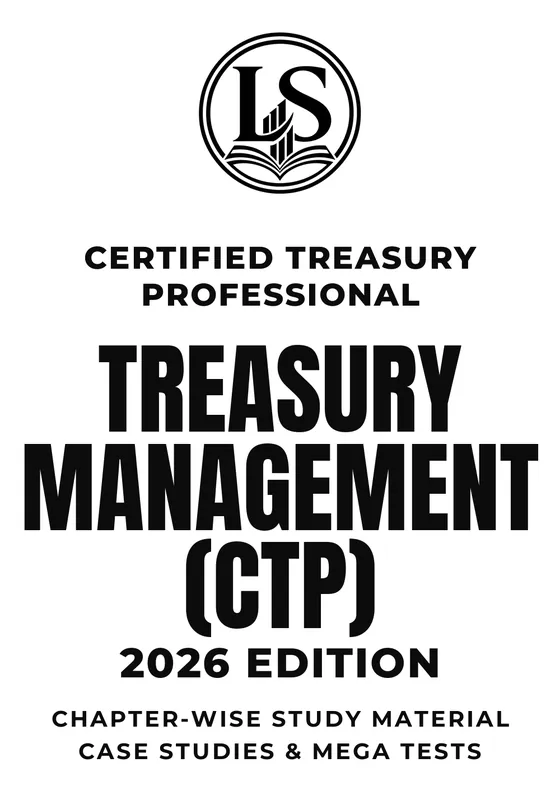
The book suits you if you want a compact, chapter-ordered resource for this certificate that you can actually finish alongside a job. It is the printed Treasury Management book, 142 pages, with the 12 chapters, 255 questions, case studies, annexures and mega tests described above. The price listed is ₹1,199 against an MRP of ₹2,398, which is 50 percent off, but prices can change, so the book page always has the current figure. There is also a free sample, so you can judge the style before you decide.
It may not be the right choice if you only want video lectures, or if you prefer to study entirely on a screen. In that case, start with the free material and tests and decide later.
Putting your Treasury Management study plan into action
Today, do three small things. Write your finish date on a calendar. Decide your daily slot. And open the first chapter for 20 minutes, with its question set waiting at the end. That is the whole start.
Follow the Treasury Management study plan one evening at a time, keep your error sheet honest, and keep the last few days for case studies and mega tests. For the official exam schedule for the upcoming cycle and any rule changes, check www.iibf.org.in before you finalise your dates. Twenty-one evenings of steady work is far more achievable than it looks from where you sit tonight.
Frequently asked questions
Can I finish Treasury Management preparation in 21 days while working full time?
For a compact 12-chapter paper, 21 days of 60 to 90 minutes on weekdays and longer on weekends is a reasonable target if every chapter ends with its question set. If your job is heavy, stretch it to 30 days instead of skipping the practice.
Which chapters should I give more time?
Give extra time to Debt Markets and Fixed Income Securities, Foreign Exchange Markets, Interest Rate Quotations and Derivatives. Those involve quotations and instruments that need practice on paper, not just reading.
Is one book enough for the exam?
The book covers all 12 chapters with questions, case studies and mega tests, which makes it a complete base. Still, add timed mock tests in the last week, and confirm regulatory topics against official sources, since rules change.
Where can I check the exam date and rules?
Always use the official website, https://www.iibf.org.in, for the schedule, fees and rules for the upcoming exam cycle. This article deliberately does not quote them.
Prefer revising from a printed book?
Chapter-wise books with MCQs after every chapter — minimal pages, complete coverage, delivered anywhere in India. Every book has a free sample to read first.










Practice this topic
Take a free mock test, download chapter PDFs, or watch a video class — all included on iibf.store.