Inside the Treasury Management Book: A Chapter-by-Chapter Tour
It is 10 pm. The branch closed two hours ago, the last customer complaint is finally filed, and you open your laptop to start on treasury. Dealing rooms, yield curves, forward premiums, front office and back office. None of it came up in your day job as a clerk or a branch officer. The syllabus feels like a foreign language, and the real question is not "how much is there" but "where do I even begin".
This article is a guided tour of the Treasury Management book on our store, written for people in exactly that position. We will walk through how it is organised, what a single chapter looks like, and what the extras are. Even if you never buy it, you will leave with a clear picture of how treasury material should be structured so that a tired person can actually get through it.
Why treasury feels harder than it is
Most bankers meet treasury in pieces. You see a forex remittance at the counter, you hear "SLR" and "CRR" in a review meeting, you notice the bank's investment portfolio in a balance sheet. Nobody puts the pieces together for you. So when you sit down with the syllabus, the topics look unrelated: markets, instruments, rates, derivatives, risk, regulation, technology.
They are related, and the link is simple. Treasury is the function that manages a bank's money: where it comes from, where it can be parked safely, what it costs, and what could go wrong. Once you hold that one idea, the chapters stop being a pile of terms and become a story with a beginning (markets), a middle (instruments and rates) and an end (control, regulation, technology).
The three questions to keep in mind
- Where do funds trade? Money, debt, capital and foreign exchange markets.
- How are they priced? Interest rate quotations, market terminology, derivatives.
- Who controls it? Liquidity management, the three offices, regulation and technology.
If you keep these three questions beside you, every chapter has an obvious place to sit. That is the real trick with this paper: do not memorise in a vacuum, file each fact under one of the three questions.
How the book is organised: one module, twelve chapters
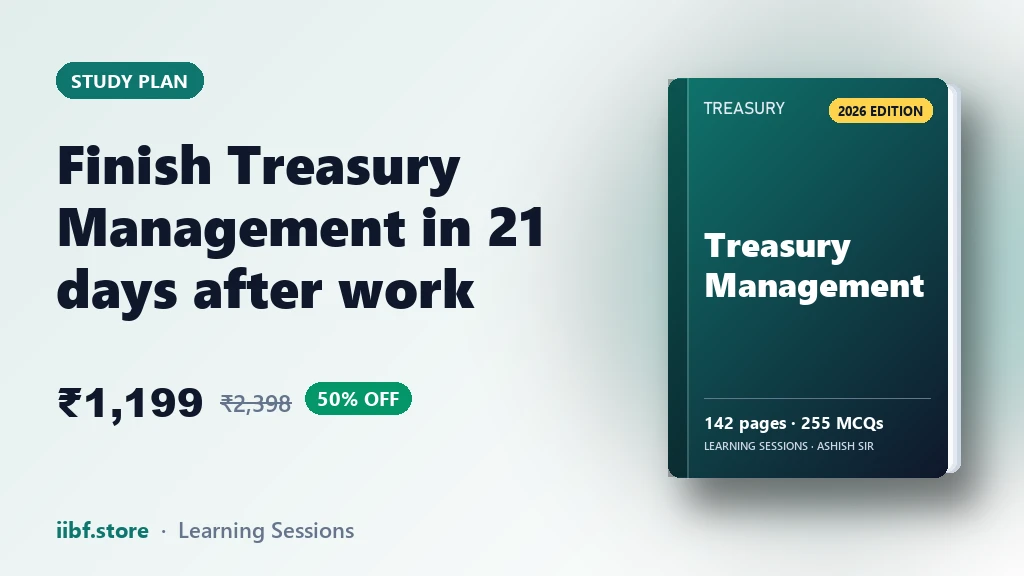
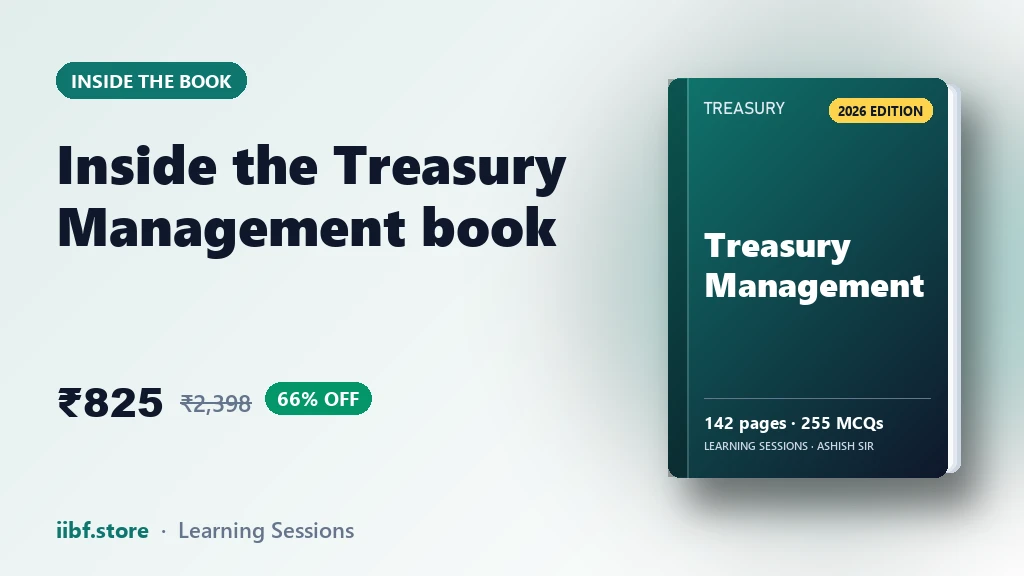
The book is deliberately compact: 142 pages, 12 chapters, all inside a single module, Module T. There are no sprawling sections to get lost in. For someone studying after work, that matters more than it sounds. A book you can finish is worth more than a library you cannot.
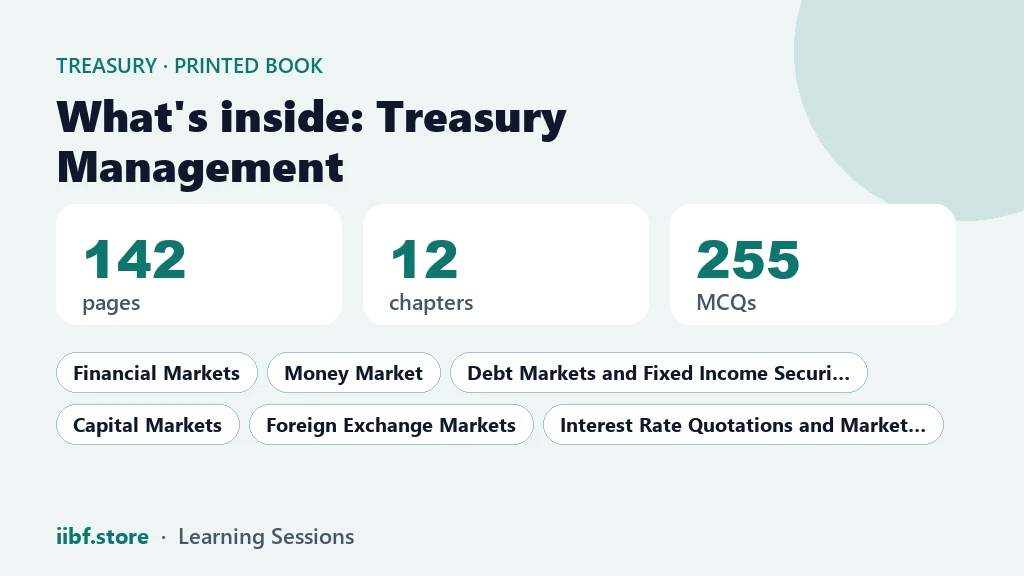
Here is how the twelve chapters group naturally, using the three questions above.
| Group | Chapters |
|---|---|
| Where funds trade | Financial Markets; Money Market; Debt Markets and Fixed Income Securities; Capital Markets; Foreign Exchange Markets |
| How they are priced | Interest Rate Quotations and Market Terminology; Derivatives |
| How the function runs | Treasury Management; Liquidity Management; Front Office, Mid Office and Back Office |
| Who controls it | Regulations, Supervision and Compliance of Treasury Operations; Role of Information Technology in Treasury Management |
The grouping is ours, a reading aid, not an official split. The book itself simply runs the chapters in order, which is the sensible way to read them, because the early chapters on markets give you the vocabulary the later chapters assume.
A tour, part by part
Chapters 1 to 5: the markets
Financial Markets sets the stage. The Money Market, Debt Markets and Fixed Income Securities, Capital Markets and Foreign Exchange Markets follow. These five chapters are the vocabulary of the paper. If you are short on time, this is where you slow down, because everything afterwards leans on them.
Chapters 6 and 7: rates and derivatives
Interest Rate Quotations and Market Terminology is the chapter many candidates skim and then regret. Quotation conventions are exactly the kind of detail an exam question can hide in. Derivatives comes straight after, and it reads far better once the rate language is fresh in your head.
Chapters 8 to 10: how a treasury actually runs
Treasury Management, Liquidity Management, and Front Office, Mid Office and Back Office describe the function in motion: who decides, who executes, who settles and checks. If you work in a branch, the front, mid and back office idea will feel familiar, since it is the same separation of duties you already live by, just applied to dealing.
Chapters 11 and 12: control and technology
Regulations, Supervision and Compliance of Treasury Operations and the Role of Information Technology in Treasury Management close the module. They are shorter in spirit and very scoring when revised last, close to the exam.
What one chapter looks like
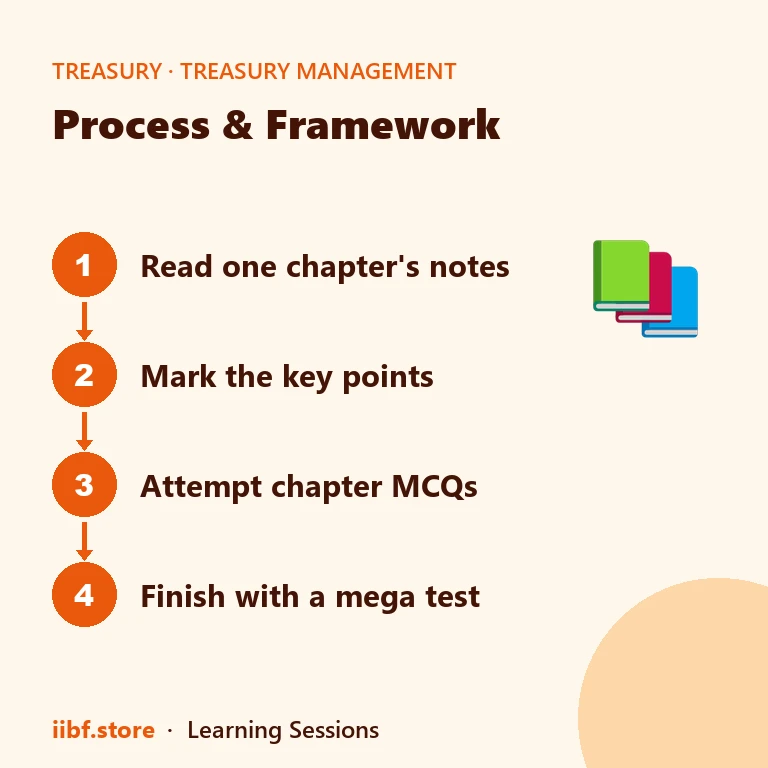
Structure is what separates a book you can use from one you merely own. Each chapter follows the same rhythm, so after the first one you know what to expect:
- Concise notes. The concept in plain language, trimmed to what the paper needs.
- Key points. The facts worth locking in, ready for a quick re-read the night before.
- MCQs. Questions that test the chapter you have just read, while it is still fresh.
Across the book there are 255 questions. That repetition of pattern is a quiet advantage: you stop spending energy figuring out how to study and put all of it into the content.
A realistic way to use one chapter
Picture a weekday evening with about an hour. Spend the first thirty-five minutes on the notes. Spend ten on the key points, writing two or three of them from memory before checking. Use the last fifteen on the chapter's MCQs, and mark every wrong answer in the margin. That marked margin becomes your revision list.
One honest limit: a Treasury Management book gives you the material and the practice questions, but it cannot give you exam-hall speed on its own. For that you need timed mocks, which is why the free tests at iibf.store/tests are worth adding alongside it.
The extras: case studies, annexures and mega tests
Beyond the twelve chapters, the book carries three additions that are easy to overlook.
- 20 Case Studies with 80 questions. Treasury is applied knowledge. Case studies make you read a situation and decide, which is closer to how a scenario-style question reads.
- 4 Annexures and a Supplementary section on Risk Analysis and Control. Useful reference material that sits outside the main flow, so the chapters stay clean.
- 5 Mega Tests with 500 questions. A full-module test bank for the final stretch, after you have been through all twelve chapters.
Treat the mega tests as a checkpoint, not a first read. Take one cold, note your weak chapters, go back to those notes, then take the next. By the fifth you will know your own gaps better than any generic advice could tell you.
Who gets the most out of it
Be honest with yourself about which of these describes you.
- You are new to treasury. The single-module, twelve-chapter shape gives you a finite map. That alone lowers the intimidation.
- You study in short windows. One chapter per sitting fits a tired evening far better than a thick reference text.
- You learn by testing yourself. With chapter MCQs, case studies and mega tests, practice is built in rather than bolted on.
- You prefer paper. This is the printed edition (2026), which many people find easier to mark up and carry on a commute.
It will help you less if you already work daily in a dealing room and only need a last-day skim, or if you want a heavy reference with every regulatory detail. This Treasury Management book is built for clear preparation, not for replacing professional experience.
You can browse the other titles at iibf.store/books, and pick up free PDFs at iibf.store/free-material to test whether the style suits you. The book also has a free sample, so you can read a few pages before deciding. Prices may change, so the book page always shows the current figure; at the time of writing it is ₹825 against an MRP of ₹2,398.
Putting it together
Treasury stops feeling foreign the moment you see its shape: markets, pricing, running the function, control. Read the twelve chapters in order, finish each with its MCQs, work through the case studies, and keep the mega tests for the end. Check the official exam schedule for the upcoming exam cycle at iibf.org.in, then work backwards from it.
Whether you choose this Treasury Management book or another route, the method above works. Start tonight with one chapter, one hour, and a pen for the margin.
Frequently asked questions
How many chapters and questions does the book have?
It has 12 chapters in a single module, 142 pages, and 255 questions. On top of that there are 20 case studies (80 questions) and 5 mega tests (500 questions).
Can I read a sample before buying?
Yes. The book page offers a free sample so you can judge the style of the notes and questions first.
Is one book enough for the exam?
It covers the material and gives you plenty of practice, but timed mock tests build exam-hall speed. Pair it with the free tests on our site and check the official syllabus on the IIBF website.
What edition is it and is the price fixed?
This is the 2026 printed edition. The price can change, so rely on the book page for the current figure.
Prefer revising from a printed book?
Chapter-wise books with MCQs after every chapter — minimal pages, complete coverage, delivered anywhere in India. Every book has a free sample to read first.









Practice this topic
Take a free mock test, download chapter PDFs, or watch a video class — all included on iibf.store.