UCP 600 and Document Discrepancies: Examination, Refusal and Waiver (IIBF ITF)
Every negotiating, confirming or issuing bank handling a letter of credit eventually runs into the same moment of truth: does this presentation comply? UCP 600 and document discrepancies sit at the centre of that question, and IIBF's ITF paper tests it in real depth — the five banking day examination window, what a complying presentation actually looks like, the discrepancies examiners flag most often, the Article 16 refusal mechanism, and the waiver route that can still rescue a discrepant set of documents. Get any one of these wrong in a live transaction and a bank can lose its right to refuse, or an exporter can lose the realisable value of a bill. This guide walks through each stage in exam-ready detail, with the exact UCP 600 articles you need to cite.
📋 What Counts as a Complying Presentation
Article 2 of UCP 600 defines a complying presentation as one that is in accordance with the terms and conditions of the credit, the applicable provisions of UCP 600 itself, and international standard banking practice — in effect, the ISBP publication that examiners read alongside UCP 600. Article 14 sets the actual examination standard: banks examine a presentation "on its face" to determine whether the documents appear, on their face, to constitute a complying presentation.
This is not a demand for a mirror image of the credit's wording. Data in a document need not be identical to data in the credit, another stipulated document, or UCP 600 itself, but it must not conflict with that data. The discipline candidates must internalise is strict compliance without literal duplication — documents are read as a coherent set, not in isolation. This is exactly the mechanism covered under the broader trade finance instruments chapter, where documentary credits sit alongside collections and guarantees as the core payment tools of cross-border trade.
The regulatory framework governing letters of credit chapter is worth revising alongside this topic, because complying presentation is not just a UCP 600 concept — Indian banks apply it within FEMA-linked import and export reporting obligations too, which is why examiners like to combine an Article 14 question with a documentation-compliance scenario.
⏳ The Five Banking Day Examination Period
Article 14(b) is one of the most heavily tested provisions in the whole International Trade Finance paper. Each bank in the chain — the nominated bank acting on its nomination, a confirming bank, and the issuing bank — has a maximum of five banking days following the day of presentation to determine whether a presentation is complying. This period is not extended or curtailed by any event or circumstance falling on or after the expiry date of the credit.
Two details trip candidates up repeatedly. First, the clock runs in banking days, not calendar days, and it starts the day after presentation, not the day of presentation itself. Second, five banking days is a ceiling, not an entitlement — a bank cannot sit on documents for the full period simply because the rule permits it; it must act "no later than" the fifth banking day. If a bank exceeds this window while attempting to examine or seek a waiver, it forfeits its right to claim the documents are discrepant, regardless of how obvious the discrepancy actually is.
💡 Exam Tip: The five-banking-day rule under Article 14(b) applies to the presentation as a whole, not document by document, and it is completely independent of the credit's expiry date.
🔍 Common Discrepancies Bankers Flag
In practice, a small set of recurring discrepancies accounts for most refusals. Late shipment against the credit's latest shipment date, and late presentation beyond 21 calendar days after the shipment date (or the period stated in the credit) under Article 14(c), are the two most common timing failures. Beyond timing, examiners commonly flag: invoice amount exceeding the credit value; description of goods on the invoice not corresponding with the credit; inconsistent data between the invoice, the transport document, and the certificate of origin; a bill of lading that is not "clean" or lacks a required on-board notation; an insurance document dated after the shipment date; missing or incorrect endorsement on an order bill of lading; and a beneficiary's name or address that does not match the credit exactly.
Many of these overlap with the transport-document risks discussed in the sibling piece on bills of exchange and bill of lading in trade finance, since the bill of lading alone generates a disproportionate share of real-world discrepancies. Candidates preparing case-study questions should also revisit how these document risks tie into the wider risk management in international trade finance framework, because a discrepant presentation is, at its core, a documentary risk crystallising at the negotiation stage.
⚠️ Common Mistake: Candidates assume a bank can flag one discrepancy, wait for correction, then flag a second one later. Article 16(c) requires a single, consolidated refusal notice listing every discrepancy at once — piecemeal notices are not compliant.
🚫 Refusal Notice Under Article 16
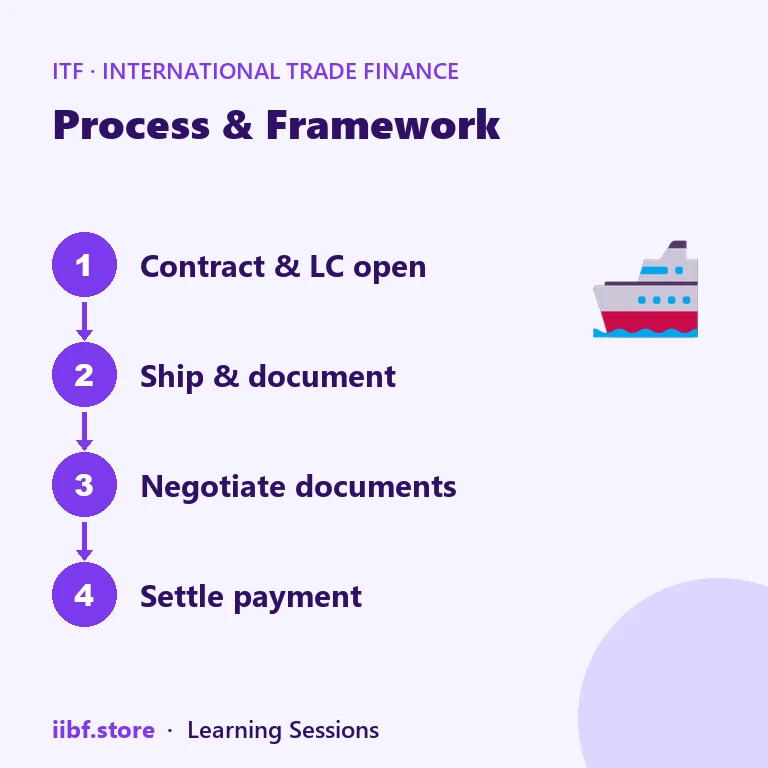
When a bank determines a presentation does not comply, Article 16 governs everything that follows. If the issuing bank decides the documents are discrepant, it may in its sole judgement approach the applicant for a waiver — but this does not extend the Article 14(b) period. If the bank still decides to refuse, Article 16(c) requires it to give a single notice to the presenter stating: that the bank is refusing to honour or negotiate; each and every discrepancy for which the bank refuses; and what it is doing with the documents — holding them pending further instructions from the presenter, holding them until it receives a waiver from the applicant and agrees to accept it, returning the documents, or acting per instructions previously received.
This notice must be given by telecommunication or other expeditious means, no later than the close of the fifth banking day following the day of presentation. Miss that window in form or substance, and Article 16(f) precludes the bank from claiming the documents are discrepant at all — it must then honour or negotiate.
| Stage | UCP 600 Article | Action | Bank Bound to Honour? |
|---|---|---|---|
| Presentation lodged | Art. 14(a) | Documents presented at the bank's counter | — |
| Examination window | Art. 14(b) | Maximum five banking days to decide | — |
| Complying presentation | Art. 15 | No discrepancies found on face of documents | ✅ Yes |
| Single refusal notice | Art. 16(c) | One consolidated notice listing all discrepancies | ❌ No, unless waived |
| Applicant waiver accepted | Art. 16(b) | Issuing bank agrees to honour despite discrepancy | ✅ If accepted |
| Notice given late or defective | Art. 16(f) | Bank precluded from claiming discrepancy | ✅ Yes, must honour |
🤝 Waiver Route and the Discrepancy Fee
A discrepant presentation is not automatically a dead transaction. Under Article 16(b), the issuing bank can go back to the applicant and ask whether it will accept the documents despite the discrepancies. If the applicant waives, the issuing bank may honour the credit even though the documents did not strictly comply on their face — the waiver decision, however, remains the issuing bank's own, made in its sole judgement, and it is never obliged to accept even an applicant's waiver.
Separately, banks commonly levy a "discrepancy fee" — a commercial charge deducted from bill proceeds or billed to the presenting bank when a negotiating or issuing bank agrees to process documents despite discrepancies. This fee is not a UCP 600 creation; UCP 600 is silent on it entirely. It is a bank-level or correspondent-level practice, disclosed in the credit's charges clause or the negotiating bank's schedule of charges, and it is frequently negotiable or waived once a formal waiver is accepted. Exporters negotiating export bills should always check whether their credit's charges clause allocates this fee to the beneficiary or the applicant before assuming it will be absorbed.
📌 Remember: Seeking a waiver under Article 16(b) never extends the five-banking-day period in Article 14(b) — the bank must still decide and, if refusing, issue its notice within that same window.
Indian banks layer these UCP 600 mechanics on top of FEMA-linked reporting for import and export bills, so a discrepancy is never purely a documentary matter — it can also delay EDPMS or IDPMS closure. For the underlying regulatory backdrop, see the Reserve Bank of India's published Master Directions on foreign exchange transactions, which govern how Indian AD banks handle import and export documentation alongside UCP 600.
🧠 Practice MCQs: UCP 600 and Document Discrepancies
Q1. Under UCP 600, what is the maximum period a bank has to examine a presentation and decide whether it complies? (a) Three banking days (b) Five banking days (c) Seven calendar days (d) Ten banking days
Answer: (b) — Article 14(b) fixes five banking days following the day of presentation, regardless of the credit's expiry date.
Q2. Which UCP 600 article governs a bank's refusal of a discrepant presentation? (a) Article 14 (b) Article 15 (c) Article 16 (d) Article 20
Answer: (c) — Article 16 covers discrepant documents, waiver, disposal of documents, and the notice of refusal.
Q3. A valid refusal notice under Article 16(c) must state: (a) Only the discrepancy fee payable (b) That the bank refuses to honour or negotiate, each discrepancy, and how the documents are being held (c) A reference to the buyer's purchase order (d) The exchange rate applicable on the refusal date
Answer: (b) — a single, consolidated notice must cover the refusal, every discrepancy, and the disposal of documents.
Q4. If a bank fails to give notice of refusal within the timeframe and manner required by Article 16, what happens? (a) It may still refuse after consulting the applicant (b) It is precluded from claiming the documents are discrepant (c) The applicant automatically absorbs the loss (d) The nominated bank alone becomes liable
Answer: (b) — Article 16(f) precludes the bank from claiming discrepancy, and it must then honour or negotiate.
Q5. A "discrepancy fee" deducted from bill proceeds is best described as: (a) A statutory RBI levy (b) A bank-level commercial charge, not created by UCP 600, often waived once a waiver is accepted (c) A fine imposed by the ICC (d) A mandatory FEMA penalty
Answer: (b) — UCP 600 is silent on discrepancy fees; they are a correspondent or issuing bank practice disclosed in the charges clause.
Want chapter-wise mock tests with 100+ MCQs? Start practising free →
❓ Frequently Asked Questions
What is a complying presentation under UCP 600?
A presentation that is in accordance with the terms of the credit, the applicable UCP 600 provisions, and international standard banking practice, as defined in Article 2 and examined under Article 14.
Does the five banking day period run per document or for the whole presentation?
It applies to the presentation as a whole. Each bank in the chain gets up to five banking days after the day of presentation to decide, and the period is unaffected by the credit's expiry date.
Can an issuing bank ask the applicant to waive a discrepancy?
Yes, under Article 16(b) the issuing bank may approach the applicant for a waiver in its sole judgement, but doing so does not extend the Article 14(b) examination period.
Is the discrepancy fee fixed by UCP 600?
No. UCP 600 does not prescribe a discrepancy fee. It is a commercial charge set by individual banks and disclosed in the credit's charges clause or the bank's own schedule of charges.
✅ Conclusion: Master UCP 600 Before Exam Day
UCP 600 and document discrepancies form one continuous chain: a complying presentation under Articles 2 and 14, a strict five-banking-day examination clock, a closed list of recurring discrepancies, and a single consolidated refusal notice under Article 16 that a bank can lose the right to issue if it moves too slowly. Candidates who can walk through this chain article by article, with the correct sub-clause for each step, consistently score well on ITF case studies.
If you are also revising CAIIB BFM alongside ITF, compare this documentary-compliance discipline with interest-rate-risk controls covered in the IRRBB framework — both papers reward the same habit of citing the exact governing article or standard rather than a general description. For more explainers like this one, browse the International Trade Finance tag hub, and when you are ready to test yourself, work through timed questions on iibf.store's CAIIB course or revisit export promotion schemes in India for the export-side context that often pairs with UCP 600 questions in the exam.
Practice this topic
Take a free mock test, download chapter PDFs, or watch a video class — all included on iibf.store.