IRRBB Framework Explained: EVE vs NII for CAIIB BFM 2026
Interest rates rose and the bank booked a loss. Was that a loss of economic value of equity, or a loss of net interest income? If you hesitated, you have found the exact spot where the CAIIB BFM paper likes to catch candidates. The IRRBB framework exists to answer that question precisely, and getting the two measures the right way round is worth more marks than memorising any formula in the chapter.
IRRBB framework — the CAIIB BFM latest update · Watch on YouTube
What the IRRBB framework covers
IRRBB stands for Interest Rate Risk in the Banking Book. The banking book holds the assets and liabilities a bank intends to keep to maturity — loans, deposits, held-to-maturity investments — as distinct from the trading book, which is marked to market and handled under market risk capital. Rate movements still hurt the banking book; they simply hurt it through earnings and value rather than through daily mark-to-market.
The Reserve Bank set out its expectations in the circular on Governance, measurement and management of Interest Rate Risk in Banking Book (RBI/2022-23/180, DOR.MRG.REC.102/00-00-009/2022-23) dated 17 February 2023. The circular aligned Indian practice with the Basel standard and stated that the date for implementation would be communicated in due course — a detail worth remembering, because questions sometimes assume an effective date that was never notified.
Under the IRRBB framework, the risk is measured from two distinct angles, and a bank is expected to run both rather than choose between them.
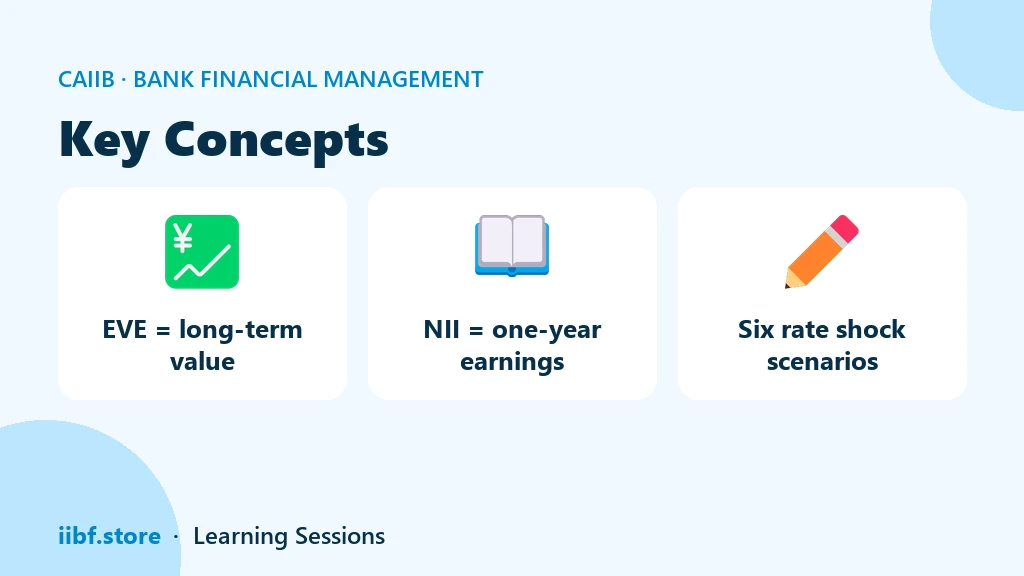
EVE and NII: long-term value versus short-term earnings
The economic value of equity approach discounts all future cash flows from banking book assets, liabilities and off-balance-sheet items and asks what happens to the present value of the bank's equity when the discount curve shifts. It is a long-horizon, whole-life measure. A change in EVE tells you the bank's underlying worth has moved even if this year's profit and loss account looks untouched.
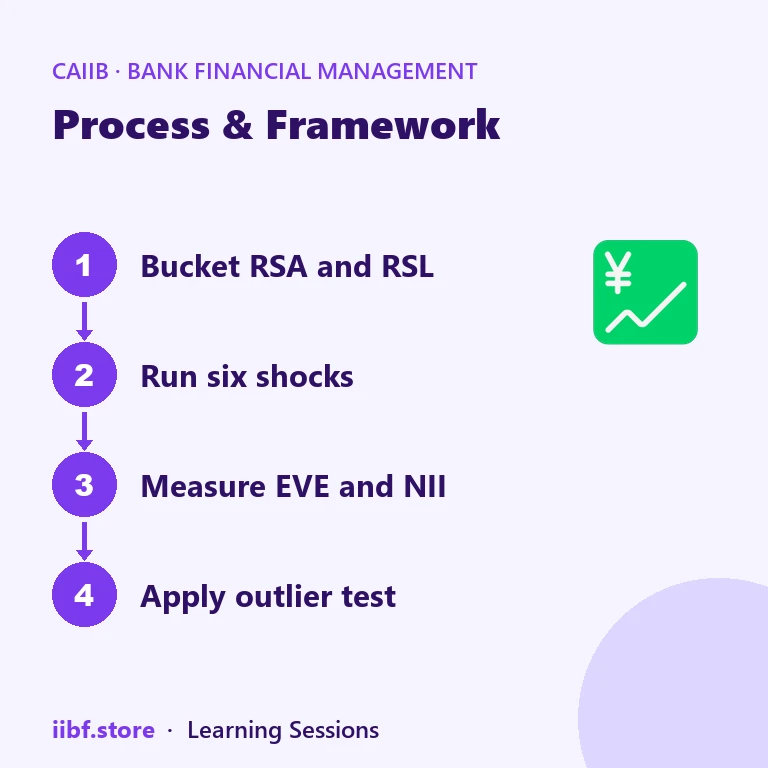
The net interest income approach is deliberately narrower. It measures the impact on earnings over a short horizon, conventionally one year, using traditional gap analysis: bucket every rate-sensitive asset and rate-sensitive liability by repricing date, compute the gap in each bucket, and derive earnings at risk under different rate scenarios.
The everyday illustration is the cleanest one. Suppose deposit costs jump while a large chunk of the loan book sits at a fixed rate. Liabilities reprice upward, assets do not, and the spread compresses within months — that is a hit to NII. Separately, if the present value of long-dated cash flows shifts because the whole curve moved, that is a hit to EVE. Same rate rise, two different windows on the damage.
| Dimension | ΔEVE | ΔNII |
|---|---|---|
| Horizon | Full remaining life of the book | Short term, typically one year |
| What it measures | Present value of equity | Accrual earnings |
| Method | Discounting of future cash flows | Repricing gap analysis of RSA and RSL |
| Perspective | Economic value | Earnings |
| Typical output | Change in economic value of equity | Earnings at Risk |
The six shock scenarios and the outlier test
IRRBB is measured under six prescribed interest rate shock scenarios: parallel shock up, parallel shock down, steepener shock with short rates down and long rates up, flattener shock with short rates up and long rates down, short rates shock up, and short rates shock down. Running all six matters because a book that looks safe under a parallel move can be badly exposed to a twist in the curve.
The supervisory trigger inside the IRRBB framework is the outlier test. A bank that generates a decline in EVE of more than 15 per cent of its Tier 1 capital under any one of the six prescribed scenarios is identified as an outlier potentially carrying undue IRRBB exposure. Two details decide the marks here: the threshold is measured against Tier 1 capital, not total capital or net worth, and the test bites if any single scenario breaches it, not the average across scenarios.
Governance is part of the syllabus too
The circular is not only about measurement. Banks are expected to have a board-approved risk appetite statement expressed in terms of risk to both economic value and earnings, an effective stress testing framework for IRRBB, and qualitative and quantitative reverse stress tests that identify the rate scenarios capable of seriously threatening capital and earnings. Behavioural assumptions matter as much as the arithmetic — how non-maturity deposits are expected to behave, and how prepayment on fixed-rate loans is modelled, can move the result more than the size of the shock itself.
How to answer this in the exam
Fix the mapping first: value questions point to EVE, earnings questions point to NII. When a question mentions a one-year horizon, repricing buckets or earnings at risk, it is testing NII. When it mentions present value, discounting or the long-term worth of the bank, it is testing EVE. Then keep three numbers ready from the IRRBB framework — six scenarios, 15 per cent, Tier 1 capital.
Work through the risk management module on the CAIIB course page before attempting past questions, and cover the related asset-liability material on the Advanced Bank Management page so the gap analysis carries over cleanly. Then attempt the timed sets on our CAIIB mock tests and read the original circular text on the Reserve Bank of India website once — the definitions in the exam are lifted almost verbatim from it.
What is the difference between the banking book and the trading book for IRRBB?
The banking book holds positions the bank intends to hold to maturity, such as loans, deposits and held-to-maturity investments. The trading book holds positions taken for short-term resale and is covered under market risk. IRRBB applies only to interest rate risk arising in the banking book.
What exactly is the outlier test threshold?
A bank whose decline in economic value of equity exceeds 15 per cent of its Tier 1 capital under any one of the six prescribed interest rate shock scenarios is identified as an outlier potentially having undue IRRBB exposure. The test is against Tier 1 capital and is triggered by a single breaching scenario.
Which measure should be used, EVE or NII?
Both. They answer different questions over different horizons, and the RBI circular expects banks to measure risk to economic value as well as to earnings. Relying on one alone can leave a large exposure invisible.
Are the six shock scenarios the same for every currency?
The six scenario types are common, but the size of the shock is calibrated by currency under the Basel standard. For the exam, the names and shapes of the six scenarios are what matter most.
Quick quiz on this topic
5 exam-style questions from our free test bank — check yourself before you move on.
Practice this topic
Take a free mock test, download chapter PDFs, or watch a video class — all included on iibf.store.
Keep reading