UPI Charges 2026: What the MDR Amendment Actually Changes
You hand over your phone, scan the QR code, and ₹1,000 leaves your account. The shopkeeper's phone chimes back — but under the amendment Parliament cleared in the Lok Sabha this month, the amount that eventually lands in his account may one day be a little less than ₹1,000. That single sentence is the whole story behind the noise about UPI charges in August 2026. Ashish Jain's take is in the short below. This is the written version, with the section numbers, the timeline and the arithmetic an examiner actually asks for. And before the panic sets in: as of today no UPI charges have been notified, and nothing has changed in the app you used this morning.
UPI charges · Learning Sessions · Watch on YouTube
The law that made UPI free in the first place
UPI was never free by accident. It was made free by two provisions inserted through the Finance (No. 2) Act, 2019, and candidates mix them up constantly, so pin them down now.
Section 269SU of the Income-tax Act, 1961 is the obligation on the merchant side. Every person carrying on business with turnover above ₹50 crore in the immediately preceding year must provide facilities for accepting payment through prescribed electronic modes, in addition to whatever else they already accept. The Central Board of Direct Taxes notified those modes in December 2019: UPI, UPI QR code and RuPay debit card. A failure to comply attracts a penalty under Section 271DB — ₹5,000 for every day of default, running from 1 February 2020.
Section 10A of the Payment and Settlement Systems Act, 2007 is the price control that sat on top of it. In its original form it said, flatly, that no bank and no system provider shall impose any charge on a payer making payment, or on a beneficiary receiving payment, through the electronic modes prescribed under Section 269SU. That is the famous "zero-MDR" regime, effective from 1 January 2020. It is why a kirana store has never paid a rupee to accept a UPI transfer, while the same store pays every time you tap a credit card.
What the 2026 amendment actually does
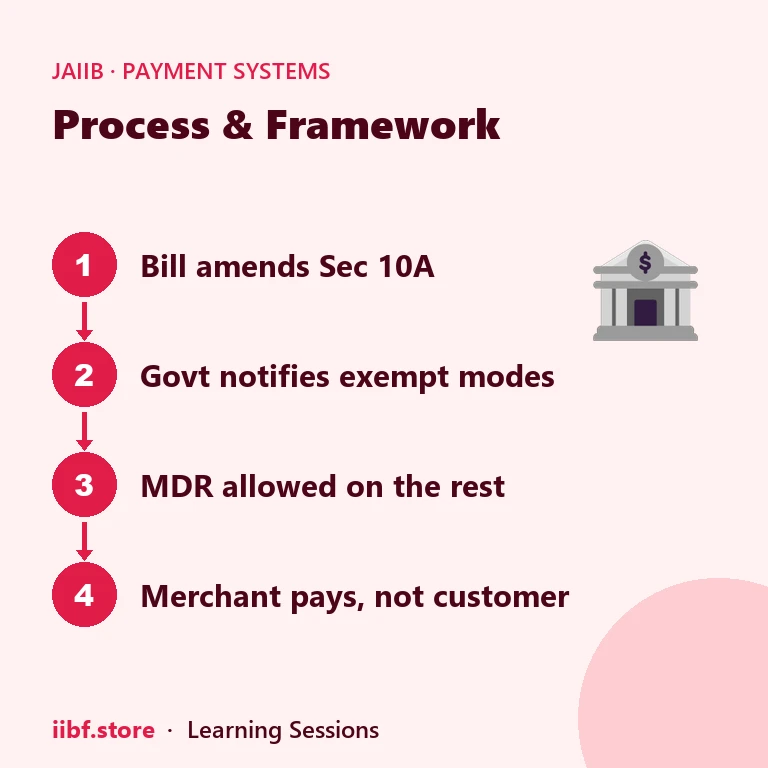
The Taxation and Other Laws (Amendment) Bill, 2026 was introduced in the Lok Sabha on 4 August 2026 by Finance Minister Nirmala Sitharaman and passed by that House on 6 August 2026 by voice vote. It is a wide-ranging Bill covering tax, foreign investment and manufacturing, and buried inside it is the clause that touches Section 10A.
Read the change precisely, because this is where most commentary goes wrong. The Bill does not levy a fee. It does not fix a merchant discount rate. It does not name a single rupee figure. What it does is swap a blanket statutory prohibition for a notification-based framework: instead of the Act itself banning charges on all prescribed modes, the Central Government gains the power to notify which electronic payment modes remain exempt. Any mode not carried into that exemption list could then lawfully attract a merchant discount rate.
So the honest summary of the UPI charges story is this — Parliament is removing a lock, not opening a door. Whether the door ever opens, and how far, depends on a separate executive notification that has not been issued.
| Aspect | Position until now | Position under the amended Section 10A |
|---|---|---|
| Legal form | Blanket prohibition written into the statute | Government notifies the modes that stay exempt |
| Modes covered | UPI, UPI QR, RuPay debit card (CBDT, Dec 2019) | Whatever the Centre notifies as exempt |
| Who may be charged | Nobody — payer or beneficiary | The merchant, if and when a mode is left out |
| Change needed to take effect | — | Passage by both Houses, assent, then a notification |
| Status on 10 August 2026 | In force | Passed by Lok Sabha; listed before the Rajya Sabha |
Merchant pays, not the customer
The Finance Minister's clarification on the floor was unambiguous: a merchant discount rate applies to merchants and not to end users, and the stated rationale is that it lets banks and fintechs fund the infrastructure, innovation and security that carry billions of transactions a month. Reported proposals under discussion put any future rate somewhere in the region of a quarter to half a percent on person-to-merchant payments above ₹2,000, leaving person-to-person transfers untouched — but treat those numbers as press reporting, not as law. Nothing in that range has been notified.
The worry raised in the video is the more interesting one, and it is not a legal question at all. It is a pass-through question. Merchants have never absorbed card MDR quietly; walk into enough shops and somebody will ask you to add roughly 2% for a credit card swipe, or offer a discount for cash. If UPI charges ever arrive for merchants, the same behaviour could migrate to the QR code, and the person actually paying would be the customer standing in front of it — especially at the thin-margin end, the street vendor and the tea stall, where a half-percent is real money. That is a genuine risk. It is also, so far, a prediction rather than a fact.
The arithmetic, on one bill
Take the example from the short. You buy goods worth ₹1,000 and pay by UPI. Today the merchant receives ₹1,000 and the cost of running the rails is met elsewhere — partly by the banks, partly by the Government's incentive scheme that reimburses banks for low-value BHIM-UPI person-to-merchant transactions. Now suppose a 0.30% rate were notified on that payment.
| Payment mode on a ₹1,000 bill | Indicative rate | Merchant receives |
|---|---|---|
| UPI today (zero-MDR) | Nil | ₹1,000.00 |
| UPI at a hypothetical 0.30% | 0.30% | ₹997.00 |
| Debit card, small merchant (RBI cap) | 0.40%, capped at ₹200 | ₹996.00 |
| Credit card (market-determined) | around 1.5%–2% plus GST | roughly ₹976–₹982 |
Three rupees on a thousand sounds trivial, and for a supermarket it is. Run the same three rupees across a vendor turning over ₹3,000 a day and it is about ₹270 a year — not ruinous, but enough to change behaviour at the margin. Note also that debit card MDR is capped by the Reserve Bank while credit card MDR is left to the market; that asymmetry is itself a favourite one-mark question.
What this means for your JAIIB and CAIIB paper
Payment systems sit in the JAIIB Principles and Practices of Banking syllabus, and the Payment and Settlement Systems Act, 2007 is the parent statute for the whole area — the Reserve Bank is the designated authority for regulation and supervision of payment systems under it, and NPCI is the umbrella organisation that actually operates UPI, IMPS, RuPay, NACH and NETC. Examiners love this cluster because it is factual and it moves.
The four things worth memorising from this episode: the pairing of Section 269SU with Section 10A; the ₹50 crore turnover threshold and the ₹5,000-per-day penalty under Section 271DB; the fact that MDR is charged to the merchant, never the payer; and the distinction between a statutory prohibition and a notification-based exemption, which is exactly what the 2026 Bill changes. If a question asks who bears MDR, the answer is the merchant, whatever happens at the counter afterwards.
One more discipline point. Anything moving through Parliament is a moving target. Check the current position against the Reserve Bank of India before you quote a figure in an interview, keep an eye on our RBI rates and updates page, and work the topic through the payment-systems questions in the JAIIB course. When you want to see whether it has actually stuck, run a set on tests, and browse the rest of the current-affairs write-ups on the blog.
Where it stands today
On 10 August 2026 the position is simple. The Bill has cleared the Lok Sabha and is before the Rajya Sabha. It still needs passage there and Presidential assent. After that, the Government would have to issue a notification specifying which modes stay exempt, and only a mode left off that list could attract a rate. Until every one of those steps is done, UPI charges remain a possibility on paper and nothing more — your transfer this evening will cost you exactly what it cost you last week.
Will I be charged for sending money to a friend on UPI?
No. Person-to-person transfers are not what the discussion is about. The reported proposals concern person-to-merchant payments only, and in any case a merchant discount rate is levied on the merchant, not on the person making the payment.
Has the Government actually imposed a fee on UPI?
No. The Taxation and Other Laws (Amendment) Bill, 2026 changes Section 10A of the Payment and Settlement Systems Act, 2007 so that the Centre can notify which modes stay exempt from MDR. It does not itself levy a charge or fix a rate, and no such notification has been issued.
What exactly is MDR?
Merchant Discount Rate is the fee a merchant pays, as a percentage of the transaction value, for accepting a digital payment. It is shared among the acquiring bank, the issuing bank and the network. RBI caps debit card MDR; credit card MDR is market-determined.
How should I answer a JAIIB question on zero-MDR?
Anchor it to the two 2019 provisions: Section 269SU of the Income-tax Act, 1961 mandates prescribed electronic modes for businesses above ₹50 crore turnover, and Section 10A of the PSS Act, 2007 barred any charge on those modes from 1 January 2020. Then note that the 2026 Bill replaces that blanket bar with a notification framework.
Quick quiz on this topic
5 exam-style questions from our free test bank — check yourself before you move on.
Practice this topic
Take a free mock test, download chapter PDFs, or watch a video class — all included on iibf.store.
Keep reading