UPI Fraud Prevention for Banks: IIBF Cyber Crime Guide
UPI moves more retail payment volume in India than any other rail, and that scale is exactly why fraudsters target it. For JAIIB and CAIIB candidates, UPI fraud prevention for banks is not a side topic — it sits at the centre of the Prevention of Cyber Crime syllabus, because bank staff are the last line of defence when a customer's app, device or trust is exploited. This article walks through how UPI fraud actually happens, what RBI and NPCI expect banks to control, and how to answer exam questions on the subject with confidence.
Unlike card fraud, most UPI fraud does not need the victim's PIN to be stolen through a data breach. It relies on the customer being tricked into approving a transaction themselves — which makes staff training and app-level design controls just as important as the back-end fraud engine. Understanding this distinction is the first thing examiners test.
🎯 Understanding UPI Fraud: Types Banks Must Watch
UPI fraud typically falls into a handful of repeatable patterns rather than endless variety, which is good news for anyone building a mental checklist for the exam.
- Fake collect requests: The fraudster sends a "collect" request disguised as a refund or cashback. The customer does not realise that approving it authorises a debit, not a credit.
- QR code swaps: A merchant's displayed QR code is physically or digitally replaced, redirecting payment to the fraudster's linked account instead of the merchant.
- Screen-sharing app fraud: The victim is coaxed into installing a remote-access screen-sharing app "for support," letting the fraudster watch the UPI PIN being entered.
- Fake customer-care numbers: Search-engine or social-media listings for bank helplines are spoofed, and the caller walks the victim through an "UPI reset" that actually re-registers the device to the fraudster's phone.
Several of these overlap with wider social-engineering patterns covered in our article on phishing vishing and smishing, since the initial contact is almost always a message, call or fake link rather than a technical exploit. The Cyber Crime Methods chapter groups these under social-engineering-led financial fraud, which is a useful lens for MCQs that ask you to classify a scenario.
🛡️ RBI Rules and Bank-Side Controls for UPI Fraud Prevention
Banks cannot rely on customer caution alone, so RBI's guidance and NPCI's operating rules push controls into the system design itself. Key control layers examiners expect you to know include:
- Device binding: A UPI handle is tied to a specific SIM and device; re-registration on a new device requires fresh OTP and, for most banks, a cooling period before high-value transactions are allowed.
- Daily and per-transaction limits: UPI transaction ceilings, set jointly by NPCI and participating banks, cap the damage from a single compromised session.
- Velocity and risk scoring: Banks run real-time rule engines that flag unusual frequency, new-payee first transactions, or device/location mismatches for step-up authentication or a hold.
- Cooling period on new payees: A short delay before large payments to a newly added payee reduces the window for social-engineering fraud to succeed.
These controls sit alongside the broader defensive posture described in the RBI cybersecurity framework for banks, which sets the governance baseline every payment channel — including UPI — must operate within. For the exam, remember that UPI-specific controls are layered on top of, not a substitute for, a bank's general cybersecurity framework and its Computer Fraud Protection measures.
💡 Exam Tip: If a question describes a customer approving their own debit through a message that looked like a credit, the correct classification is a "collect request" fraud, not phishing of banking credentials.
🔍 Detection, Reporting and the Bank's Response Workflow
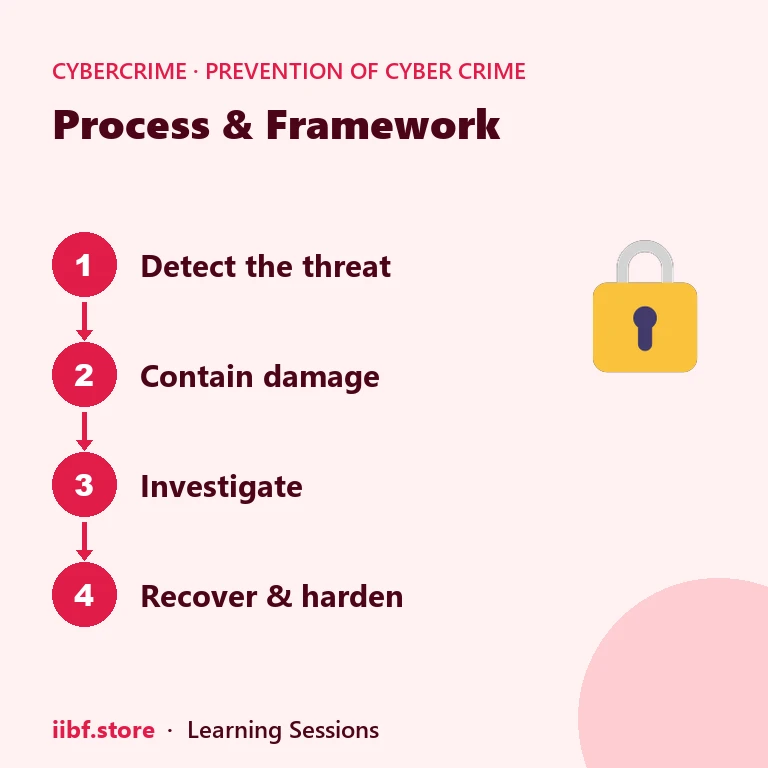
Speed matters more in UPI fraud than in most other channels because funds usually move instantly between linked bank accounts and can be withdrawn within minutes. A bank's incident response for a reported UPI fraud generally follows this sequence:
- Freeze or flag the beneficiary account through the UPI dispute redressal mechanism the moment a complaint is logged.
- Trace the transaction chain across participating banks using the NPCI dispute system, since UPI payments can hop through multiple accounts quickly.
- File the mandatory cyber incident report with the appropriate regulatory and law-enforcement channels, in line with the bank's documented escalation matrix.
- Advise the customer on preserving evidence — screenshots, SMS alerts, UPI reference numbers — for the formal complaint.
This mirrors the structured approach in the Incident Management chapter, where the emphasis is on containment first and root-cause analysis second. A related but distinct threat pattern — where the fraudster impersonates a law-enforcement caller rather than a payment app — is covered separately in our piece on the digital arrest scam, and it is worth distinguishing the two in case an exam scenario blends elements of both.
Card-linked UPI transactions add another layer, since a compromised card can also be used to set up a UPI mandate. That overlap is why the Electronic Card Frauds chapter is worth revising alongside this topic rather than in isolation.
⚠️ Common Mistake: Students often assume UPI PIN theft is the main fraud vector. In practice, most reported cases involve the customer entering the PIN themselves under manipulation — not the PIN being stolen through a technical breach.
🧩 Building a Bank-Side UPI Fraud Prevention Checklist
For frontline and branch staff, prevention comes down to a short, repeatable checklist that examiners like to test as scenario-based questions:
- Never guide a customer to approve a "collect request" without confirming they expect money to leave their account, not enter it.
- Treat any request to install a screen-sharing app "to fix an issue" as a red flag requiring escalation, never routine support.
- Verify that customer-care numbers customers use come only from the bank's official app or website, not search results or forwarded messages.
- Educate customers that a genuine bank or NPCI process never requires sharing a UPI PIN, OTP or full card number over a call.
- Log and escalate repeated small "test" transactions from an unfamiliar payee, which often precede a larger fraud attempt.
Banks that combine this staff-level vigilance with the technical controls from RBI's framework and the case patterns in Cyber Crime Methods see meaningfully lower fraud losses. It also pays to study cross-channel controls used in other payment ecosystems — for instance, the SWIFT Customer Security Programme applies a similar layered-control philosophy to high-value interbank transfers, and comparing the two is a useful revision exercise for the IT Security paper.
📌 Remember: UPI fraud prevention is a shared responsibility between the customer's awareness, the bank's real-time controls, and NPCI's system-level rules — an exam answer that names only one of the three is usually incomplete.
📊 UPI Fraud Types at a Glance
| Fraud Type | How It Typically Works | Primary Bank-Side Control | Real-Time Blockable |
|---|---|---|---|
| Fake collect request | Disguised as refund/cashback approval | Clear request-type labelling in app UI | ✅ |
| QR code swap | Merchant QR physically/digitally replaced | Payee-name confirmation before debit | ✅ |
| Screen-sharing app fraud | Remote app used to view PIN entry | Staff/customer awareness, not a system block | ❌ |
| Fake customer-care reset | Spoofed helpline re-registers device | Device-binding cooling period + OTP | ✅ |
| SIM-triggered re-registration | New SIM used to re-link UPI handle | Telecom-bank data matching, device binding | ✅ |
Note that the one clearly ❌ row above — screen-sharing fraud — is the pattern examiners favour precisely because no system control can stop a customer from voluntarily sharing their screen; the only defence is awareness, which is why staff training carries so much weight in this chapter.
🧠 Practice MCQs: UPI Fraud Prevention
Test yourself with these five exam-style questions before moving to the FAQ section below.
Q1. A customer receives a "collect request" labelled as a cashback offer and approves it, resulting in a debit from their account. This is best classified as: (a) card skimming (b) a fake collect request fraud (c) SIM cloning (d) ransomware
Answer: (b) — Approving a disguised collect request authorises a debit, the defining feature of this fraud type.
Q2. Which control most directly reduces the risk from a fraudulently re-registered UPI device? (a) daily transaction limit (b) device-binding cooling period (c) merchant QR verification (d) cyber insurance
Answer: (b) — A cooling period after device re-registration delays high-value transactions long enough for verification checks to catch fraud.
Q3. Why is screen-sharing app fraud considered hard to block in real time? (a) it uses stolen card data (b) the customer voluntarily authorises the session and PIN entry (c) it always originates from a foreign IP (d) it bypasses NPCI entirely
Answer: (b) — Because the customer knowingly installs the app and enters the PIN, no automated system rule flags the action as fraudulent.
Q4. In the standard bank response to a reported UPI fraud, what is the first action? (a) file a police FIR (b) freeze or flag the beneficiary account (c) close the customer's account (d) issue a new debit card
Answer: (b) — Freezing or flagging the beneficiary account immediately limits further withdrawal while the dispute is investigated.
Q5. A QR code swap fraud primarily exploits which weakness? (a) weak UPI PIN complexity (b) trust in a visually displayed payee identity (c) expired digital certificates (d) unpatched banking software
Answer: (b) — The customer trusts the QR code's apparent source without verifying the payee name shown before confirming payment.
Want chapter-wise mock tests with 100+ MCQs? Start practising free →
❓ Frequently Asked Questions
Is UPI PIN theft the most common cause of UPI fraud?
No. Most reported cases involve the customer entering the PIN themselves after being manipulated, rather than the PIN being stolen through a technical breach.
What should a bank employee do if a customer describes installing a screen-sharing app before losing money?
Escalate immediately as a likely remote-access fraud case, advise the customer to uninstall the app and change their UPI PIN, and initiate the standard incident and dispute process.
Does a cooling period apply to every UPI transaction?
No, it typically applies to new or recently re-registered payees and devices, and to high-value transactions shortly after such changes, not to routine transfers to established payees.
How does UPI fraud differ from card-present ATM fraud?
UPI fraud usually relies on the customer's own approval of a transaction through social engineering, while ATM fraud more often involves device tampering or stolen card credentials without the customer's knowing consent.
📌 Conclusion: Turning Awareness into Exam-Ready Knowledge
UPI fraud prevention for banks blends three layers that the Prevention of Cyber Crime paper expects candidates to connect: customer-facing awareness, real-time bank controls, and system-wide RBI and NPCI rules. Scenario questions almost always test whether you can correctly classify the fraud type and match it to the right control, so revise the pattern list above rather than memorising isolated facts. For deeper reading on regulatory expectations, see the RBI's published guidance at rbi.org.in, and browse more chapter-linked reads on the Prevention of Cyber Crime tag hub. Ready to lock this in? Enrol in the CAIIB prep course and pair it with timed mock tests to build exam speed.
Practice this topic
Take a free mock test, download chapter PDFs, or watch a video class — all included on iibf.store.