JAIIB IEIFS: The agriculture sector in the Indian economy explained
The agriculture sector in the Indian economy is the one segment a JAIIB candidate cannot afford to treat as background reading. It contributes a modest share of Gross Value Added but supports the largest block of the workforce, sets the tone for rural demand, and decides the credit quality of a very large slice of every public sector bank's loan book. Examiners in Indian Economy and Indian Financial System (IEIFS) test this chapter through numbers, scheme names and linkages rather than through opinion. This guide walks through GVA share, the cropping pattern, minimum support price and procurement, the flow of agri-credit, and how PM-KISAN and PMFBY transmit government money into deposits and repayments at your branch.
🌾 Why the Agriculture Sector Still Anchors the Economy
Agriculture and allied activities — crop husbandry, livestock, forestry and logging, and fishing and aquaculture — form a single reporting block in national accounts. Their combined share of Gross Value Added has fallen steadily since Independence and now sits in the mid-teens in percentage terms, yet the share of the workforce dependent on the sector remains far higher, close to double the GVA share as reported in successive Periodic Labour Force Surveys. That gap between output share and employment share is the single most examinable fact about the sector: it explains low per-worker productivity, disguised unemployment, and the political weight of farm policy.
The structural transformation story is covered in the chapter on an overview of Indian economy, where the shift of GVA towards industry and services is traced decade by decade. The mirror image of that shift is discussed in our note on the services sector in the Indian economy, which now dominates output but absorbs far fewer workers than farming does.
For a banker the practical point is different. Roughly half the net sown area is still rain-fed, so a deficient or badly distributed south-west monsoon feeds straight through to kharif output, rural wages, two-wheeler and tractor sales, gold loan demand and crop loan repayment behaviour. Agriculture is therefore not just a lending category; it is a leading indicator for retail asset quality across the rural and semi-urban branch network.
📊 GVA Share, Employment and the Cropping Pattern
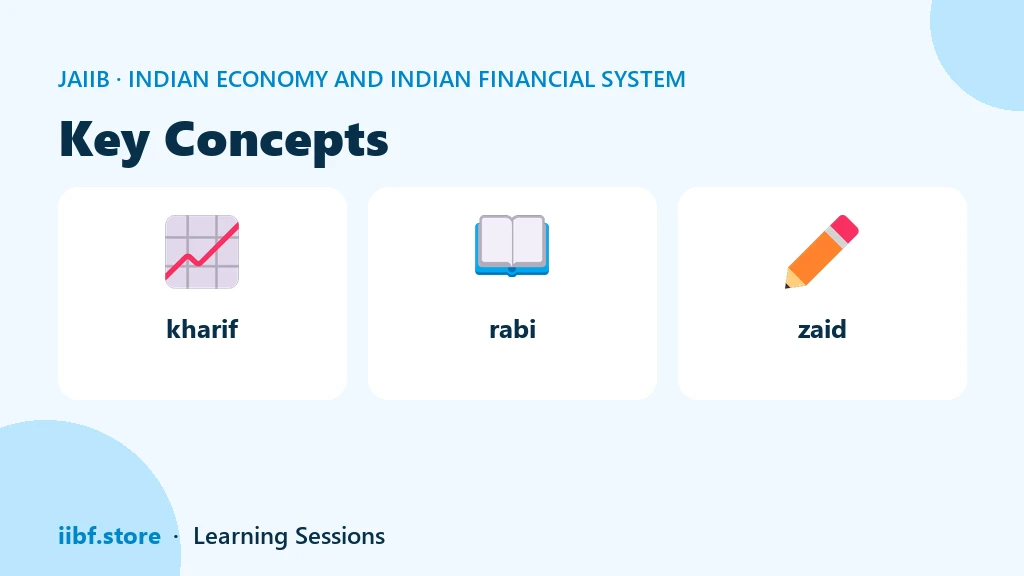
The cropping calendar splits the year into three seasons. Kharif crops are sown with the onset of the south-west monsoon around June and harvested from September onwards — paddy, maize, bajra, jowar, tur, soyabean, groundnut and cotton belong here. Rabi crops are sown in October–November on residual soil moisture and irrigation, and harvested in March–April — wheat, gram, mustard, barley and lentil dominate. Zaid is the short summer season between rabi and kharif, used for watermelon, cucurbits, fodder and some pulses.
Within crops, foodgrains still occupy the largest area, with rice and wheat far ahead of nutri-cereals (coarse cereals), pulses and oilseeds. India remains structurally short of pulses and edible oils, which is why import dependence in edible oil is a recurring examination and policy theme, and why oilseed missions keep reappearing in Budget documents. Horticulture output — fruits and vegetables — has for several years exceeded foodgrain output in tonnage terms, an easy one-mark fact that candidates often miss.
The allied segment is where growth actually is. Livestock, dairying and fisheries have grown faster than crop output for a sustained period, and their share within agricultural GVA keeps rising. This matters commercially: dairy and fisheries generate a monthly or weekly cash flow, unlike the lumpy seasonal cash flow of a crop, and so support different loan products and different repayment schedules.
💡 Exam Tip: Remember the pair "output share low, employment share high" for agriculture and the reverse pair for services. Most IEIFS questions on sectoral composition are testing exactly this contrast.
💰 MSP, Procurement and the Price Floor
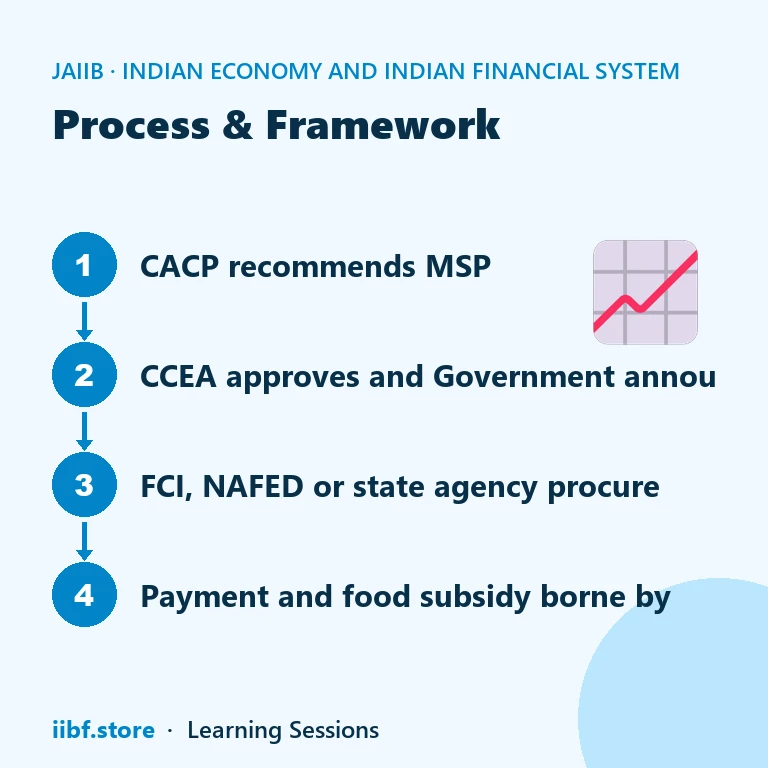
Minimum Support Price is a pre-announced floor price. The Commission for Agricultural Costs and Prices (CACP) recommends MSP; the Cabinet Committee on Economic Affairs approves and the Government of India announces it. MSP is announced for 22 mandated crops covering kharif crops, rabi crops and commercial crops, while sugarcane is handled separately through the Fair and Remunerative Price (FRP) mechanism notified under the Essential Commodities Act framework. Candidates should note that MSP is an administered floor, not a statutory guarantee of purchase for every farmer.
Announcement alone does not put money in a farmer's hands — procurement does. The Food Corporation of India and state agencies procure rice and wheat for the central pool under the price support and decentralised procurement arrangements, while NAFED and NCCF handle pulses and oilseeds under the Price Support Scheme. Because procurement infrastructure is concentrated in a few states and in two cereals, the effective benefit of MSP is uneven across regions and crops — a standard descriptive-answer point.
The fiscal consequence is the food subsidy: the gap between the economic cost of procurement, storage and distribution and the issue price under the National Food Security Act is borne by the Budget. Buffer stocking norms are fixed by the Government and revised periodically, so quote the principle rather than a stale tonnage figure in the examination hall.
⚠️ Common Mistake: MSP is not the same as procurement price or issue price. MSP is the announced floor, procurement price is what an agency actually pays including any state bonus, and issue price is what a ration cardholder pays.
🏦 Agri-Credit Flow, KCC and the Bank's Balance Sheet
Ground-level credit to agriculture is targeted annually in the Union Budget and delivered by commercial banks, regional rural banks and cooperatives, with NABARD as the refinancing and supervisory apex. Within priority sector norms the overall agriculture target is 18 per cent of Adjusted Net Bank Credit or the credit equivalent of off-balance-sheet exposure, whichever is higher, with a carved-out sub-target for small and marginal farmers. Shortfalls are parked with NABARD's Rural Infrastructure Development Fund and with other specified funds, which is why priority sector compliance has a direct earnings cost.
The Kisan Credit Card is the workhorse product. It provides a revolving short-term production limit, a term loan component for farm assets, and consumption and allied-activity needs, and it carries interest subvention with an additional prompt-repayment incentive that reduces the effective rate for eligible borrowers. Both the collateral-free lending limit and the subvention ceiling have been revised upward in recent years, so verify the current figures against the latest RBI circular and Master Direction before quoting them to a customer.
| Instrument | What it does | Bank's role | Counts as agriculture PSL? |
|---|---|---|---|
| Kisan Credit Card | Revolving short-term crop and allied needs limit | Sanction, renew, apply subvention | ✅ Yes |
| PM-KISAN income support | Direct benefit transfer to eligible landholding farmers | Credit to account via DBT, no lending | ❌ No |
| PMFBY crop insurance | Yield-loss cover on notified crops | Debit premium, remit to insurer, credit claims | ❌ No (not a loan) |
| Agriculture Infrastructure Fund loan | Post-harvest and community farming assets | Term lending with interest subvention | ✅ Yes |
| Loan to a Farmer Producer Organisation | Aggregation, inputs, marketing | Working capital and term loan | ✅ Yes, subject to norms |
Asset quality in this book behaves differently from retail. Repayment is seasonal, restructuring follows RBI's natural calamity relief framework, and state loan waivers periodically distort credit discipline. Compare this with how a court order freezes a customer's balance — our note on the garnishee order and attachment order explains the parallel legal process on the liability side.
🛡️ PM-KISAN, PMFBY and Rural Demand Transmission
Two schemes dominate the income and risk side of farm policy. PM-KISAN pays eligible landholding farmer families ₹6,000 a year in three equal instalments of ₹2,000, credited directly to Aadhaar-seeded bank accounts through the Direct Benefit Transfer route. For a branch this is a predictable inflow that lifts CASA balances in a defined week and improves the repayment window for crop loans falling due.
Pradhan Mantri Fasal Bima Yojana caps the farmer's share of premium at 2 per cent of sum insured for kharif food and oilseed crops, 1.5 per cent for rabi food and oilseed crops, and 5 per cent for commercial and horticultural crops; the balance of the actuarial premium is shared by the Centre and the state. Enrolment is compulsory-linked for loanee farmers only on an opt-out basis after the scheme was made voluntary, and claim settlement rests on yield estimation and technology-based assessment.
The transmission channel is straightforward and highly examinable. A good monsoon raises kharif output, which raises farm incomes and rural wages, which raises demand for FMCG, two-wheelers, tractors and housing, which raises bank credit demand and lowers slippages. A drought reverses each link. Climate risk now sits on top of this chain, and the chapter on climate change and sustainable development goals connects farm vulnerability to India's SDG commitments. The liberalisation-era policy backdrop is set out in the chapter on economic reforms, which explains why farm markets were opened later and more cautiously than industry.
📌 Remember: PM-KISAN is income support, PMFBY is risk transfer and KCC is credit. Questions frequently swap these three, so fix the category before you read the options.

🎯 Conclusion and Revision Route
Study this chapter as a chain rather than as a list. Sectoral shares explain the productivity problem; the cropping pattern explains seasonality and import dependence; MSP and procurement explain the price floor and the food subsidy; KCC, priority sector norms and NABARD refinance explain the credit pipe; and PM-KISAN and PMFBY explain how public money reaches the household and returns to the banking system as deposits and repayments. Link the sector to headline aggregates using our explainer on national income accounting in India, and to the labour market using the note on poverty and unemployment in India. More IEIFS material is indexed on the Indian Economy and Indian Financial System tag hub, and current policy rates are tracked on our RBI rates page. Ready to test yourself chapter by chapter? Explore the full JAIIB course and lock this chapter in before the next attempt.
🧠 Practice MCQs: Agriculture in the Indian Economy
Q1. Under PMFBY, the maximum farmer's share of premium for notified rabi food and oilseed crops is: (a) 1% of sum insured (b) 1.5% of sum insured (c) 2% of sum insured (d) 5% of sum insured
Answer: (b) — Rabi food and oilseed crops attract 1.5%, kharif 2% and commercial or horticultural crops 5%.
Q2. PM-KISAN provides ₹6,000 per year to an eligible farmer family in: (a) two instalments of ₹3,000 (b) six instalments of ₹1,000 (c) four instalments of ₹1,500 (d) three equal instalments of ₹2,000
Answer: (d) — The benefit is released as three equal four-monthly instalments of ₹2,000 through DBT.
Q3. Minimum Support Price for the mandated crops is recommended to the Government by: (a) Commission for Agricultural Costs and Prices (b) NITI Aayog (c) Food Corporation of India (d) NABARD
Answer: (a) — CACP recommends, the Cabinet Committee on Economic Affairs approves and the Government announces; FCI only procures.
Q4. Under priority sector lending norms for domestic scheduled commercial banks, the overall target for agriculture is: (a) 10% of ANBC (b) 15% of ANBC (c) 18% of ANBC (d) 40% of ANBC
Answer: (c) — Agriculture carries an 18% target, with a sub-target for small and marginal farmers; 40% is the total priority sector target.
Q5. The Rural Infrastructure Development Fund, funded largely by priority sector shortfalls, is maintained with: (a) SIDBI (b) NABARD (c) National Housing Bank (d) EXIM Bank
Answer: (b) — RIDF is maintained with NABARD and is used to finance rural infrastructure projects of state governments.
Want chapter-wise mock tests with 100+ MCQs? Start practising free →
What share of GVA does agriculture contribute in India?
Agriculture and allied activities contribute a mid-teens percentage share of Gross Value Added at current prices, and the share drifts down as industry and services expand. Because the figure is revised with every National Statistical Office release, quote the latest advance or provisional estimate rather than a remembered number.
Is MSP legally binding on buyers?
No. MSP is an administered floor price announced by the Government on the recommendation of CACP. It becomes effective for a farmer only where a government agency actually procures under the price support or decentralised procurement arrangement. There is no statutory obligation on private traders to pay MSP.
Which crops are covered by MSP?
MSP is announced for 22 mandated crops spanning cereals, pulses, oilseeds and commercial crops such as cotton, jute and copra. Sugarcane is covered separately through the Fair and Remunerative Price mechanism rather than by MSP.
Why do banks track the monsoon so closely?
Around half the net sown area is rain-fed, so monsoon performance drives kharif output, rural wages and rural demand. That flows into crop loan repayment, gold loan demand, tractor and two-wheeler finance, and slippage ratios in the rural and semi-urban book, making the monsoon a leading indicator of retail asset quality.
Source and further reading: Reserve Bank of India and the Indian Institute of Banking & Finance.
Quick quiz on this topic
5 exam-style questions from our free test bank — check yourself before you move on.
Practice this topic
Take a free mock test, download chapter PDFs, or watch a video class — all included on iibf.store.
Keep reading