
API banking and open banking: Complete CAIIB ITDB Guide
API banking and open banking are the two ideas that explain how a modern bank stops being a closed system and starts behaving like a platform. In the CAIIB Information Technology and Digital Banking elective, examiners expect you to know what an API actually is, how a bank exposes one safely through a gateway and a sandbox, how consent and authentication work, and where India's Account Aggregator framework fits in. This guide walks through the whole chain — from a REST call to a corporate host-to-host file replacement — in the plain, exam-oriented language the paper rewards.
🔌 What API Banking and Open Banking Mean in Practice
An API (Application Programming Interface) is a published contract that lets one piece of software ask another for something in a fixed, machine-readable way. API banking is the bank's side of that contract: instead of a customer logging into net banking, a partner application calls the bank's endpoint and gets back a balance, a payment status, or a payment confirmation. The customer never sees the bank's screen at all — the banking capability is embedded inside the partner's app.
Open banking is the broader policy idea sitting on top of it: that a customer's financial data belongs to the customer, and that with the customer's explicit consent it can be shared with a third party the customer chooses. Note the distinction the examiner loves. API banking is a technology arrangement; open banking is a consent and rights arrangement that usually uses APIs to deliver itself. A bank can run API banking with a single corporate client without doing anything that resembles open banking.
India did not import the European mandated-access model. Instead, the country built open finance in layers — UPI for payments, and the RBI-regulated Account Aggregator framework for data — while bank-to-partner APIs continued to be governed by bilateral contracts and outsourcing rules. Understanding this layered picture is easier once you are comfortable with basic software concepts, so revise the introduction to software chapter before attempting numerical or scenario questions on integration.
💡 Exam Tip: If a question contrasts "API banking" with "open banking", the safest one-line answer is: API banking is the delivery mechanism, open banking is the consent-driven data-sharing model built on it.
🧱 REST APIs, the Sandbox and the API Gateway
Almost every banking API you will meet in the exam is a REST API. REST (Representational State Transfer) is an architectural style, not a product. It runs over HTTPS, treats every resource as a URL, and uses the standard HTTP verbs: GET to read, POST to create, PUT or PATCH to update, DELETE to remove. Data is exchanged as JSON, which is lighter and easier to parse than the older SOAP/XML style still found in legacy interfaces. Each call is stateless — the server keeps no memory of the previous request, so every call must carry its own credentials and context.
Before a partner touches production, the bank gives it a sandbox: a look-alike environment with dummy accounts and simulated responses. The sandbox lets the developer test error codes, timeouts and edge cases without moving a rupee. Certification in the sandbox is normally a pre-condition for production keys, and this is exactly the kind of control-point question that appears in a two-mark item.
Sitting in front of the real core banking system is the API gateway. It is the single front door and it does several jobs at once: it authenticates the caller, validates the request format, enforces rate limits and quotas, routes the call to the right internal service, logs everything for audit, and transforms responses. Because the gateway terminates the connection, the core banking application is never directly exposed to the internet. Since gateways depend heavily on routing, load balancing and protocol behaviour, pair this with the networking systems chapter, and note how the same layered thinking appears in enterprise architecture in banks.
🔐 OAuth 2.0, Tokens and Webhooks
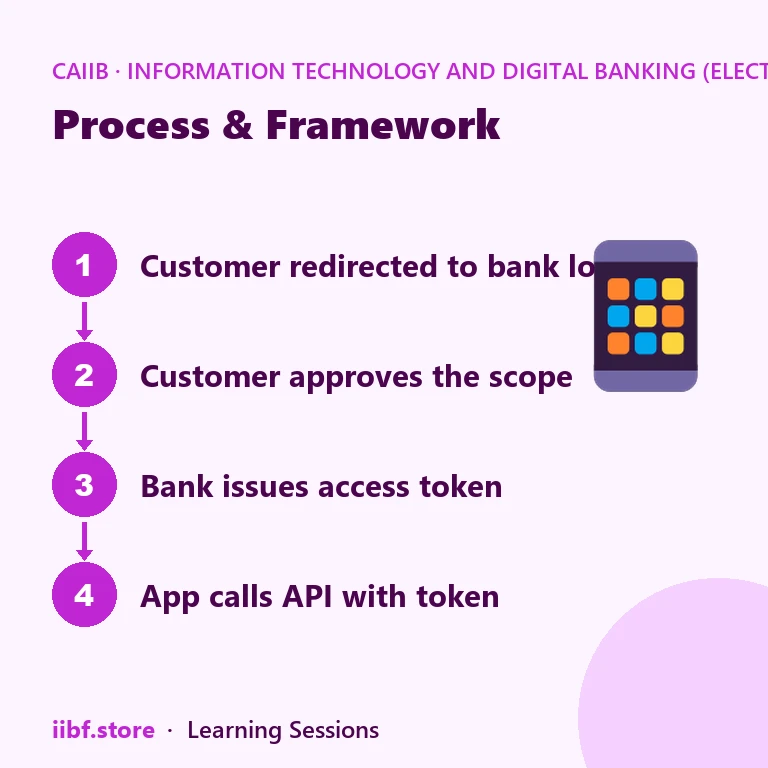
Authentication answers "who is calling?" and authorisation answers "what may they do?". In API banking and open banking both are usually handled by OAuth 2.0. The key insight — and the reason OAuth exists — is that the customer never gives the third-party application their net banking password. Instead the customer is redirected to the bank's own login page, authenticates there, approves a specific scope of access, and the bank issues the third party an access token.
That token is short-lived, scope-limited and revocable. Scope matters: a token issued for "read account balance" cannot initiate a payment. A longer-lived refresh token lets the application obtain a fresh access token without dragging the customer through login again. Machine-to-machine integrations, where no human is present, typically use the client-credentials flow with a client ID and secret, often reinforced by mutual TLS certificates so that both sides prove their identity.
Two more mechanisms complete the picture. Webhooks reverse the direction of the conversation: rather than the partner polling "has the payment settled yet?" every few seconds, the bank pushes an HTTPS callback to a URL the partner registered, the moment the event occurs. Webhooks must be signed — usually with an HMAC over the payload — so the receiver can prove the message really came from the bank, and they must be idempotent, because a retried delivery must not be processed twice. Digital certificates and message signing protect payload integrity end to end. Tokens, keys and consent records all have to be stored and expired correctly, which is why the database management systems chapter is worth a second reading.
⚠️ Common Mistake: Candidates write that OAuth "encrypts the password". It does not. OAuth avoids sharing the password altogether by substituting a scoped, expiring token — encryption in transit is TLS's job, not OAuth's.
🏦 Open Banking APIs vs the Account Aggregator Framework
This comparison is the single most examinable part of the topic, because candidates routinely treat the two as synonyms. A bilateral bank API is a commercial arrangement between the bank and one partner. The Account Aggregator (AA) framework is a regulated, consent-based data-sharing rail: RBI licenses NBFC-AAs under its Master Direction for Account Aggregators, and they sit between a Financial Information Provider (FIP, such as your bank) and a Financial Information User (FIU, such as a lender). The AA itself is deliberately data-blind — it moves encrypted data and never reads or stores the content.
| Aspect | Bank open API (API banking) | Account Aggregator framework |
|---|---|---|
| Basis of the relationship | Bilateral contract between bank and partner | RBI-regulated three-party model: FIP, AA, FIU |
| Standardised consent artefact | ❌ Varies bank by bank | ✅ Common electronic consent artefact |
| Technical specification | Bank's own API documentation | Common technical standards published for the ecosystem |
| Can the intermediary read the data? | Partner receives the data directly | AA is data-blind; encrypted pass-through only |
| Typical use case | Payments, balance enquiry, corporate integration | Lending underwriting, wealth advisory, personal finance |
| Customer's revocation right | Handled through the partner or bank channel | Consent revocable at any time from the AA app |
Remember also that consent in the AA world is granular and time-bound: it names the purpose, the data types, the frequency of fetch and an expiry date. That granularity is what makes it a genuine open-banking construct rather than a bulk data dump. For related infrastructure themes, see how deployment models change the risk picture in cloud computing adoption in banks.
🏢 API-Led Corporate Banking, Rate Limits and RBI's Stance
On the corporate side, API banking replaces a much older habit: host-to-host file exchange. In the traditional model, a company's ERP generated a batch payment file, pushed it over SFTP at a cut-off time, and waited for a return file with the status. It worked, but it was slow, batch-bound, and every failure surfaced hours later. API-led corporate banking collapses that cycle — the ERP calls a payment-initiation API directly, receives an immediate acknowledgement, and gets a webhook when the payment settles. Real-time balance and statement APIs then let the treasury team see positions across banks continuously instead of once a day. Do not conclude that files are dead, though: high-volume bulk salary and vendor runs are still often more efficient as files, and most large corporates run both channels.
Because an exposed API is an exposed attack surface, controls are non-negotiable. Rate limiting caps how many calls a client may make per second or per day, protecting the core from a runaway loop or a denial-of-service attempt; throttling smooths bursts; quotas allocate capacity commercially. Add IP whitelisting, mutual TLS, payload schema validation to stop injection attacks, encryption in transit and at rest, and a full audit trail of every call. Segregating a partner into its own tier means one misbehaving client cannot starve the others.
RBI's approach has been enabling rather than prescriptive. It has not mandated a European-style access regime; it has instead built public digital infrastructure, licensed the AA ecosystem, run a regulatory sandbox for innovators, and tightened accountability through directions on outsourcing of IT services and on digital lending — under which the bank stays responsible for a partner's conduct and customer data must flow only to regulated entities. The exposure risk this creates is measured and managed with the same discipline as asset liability management in banks. Because API guidance moves, always verify the current position against the latest RBI master directions before quoting a specific circular. For the wider syllabus map, browse the Information Technology and Digital Banking elective tag hub, and see device-level integration in internet of things in banking.
📌 Remember: Gateway = traffic control and policy enforcement. Sandbox = safe testing. OAuth = who and what. Webhook = the bank calling you back. Four words, four marks.
🧠 Practice MCQs: API Banking and Open Banking
Q1. In a REST API, which HTTP method is normally used to retrieve an account balance without changing any data? (a) POST (b) GET (c) DELETE (d) PATCH
Answer: (b) — GET is the safe, read-only verb; POST creates, PATCH partially updates and DELETE removes a resource.
Q2. The primary purpose of an API sandbox provided by a bank is to: (a) store production customer data securely (b) act as the disaster recovery site (c) encrypt API payloads (d) let partners test integrations against simulated data before going live
Answer: (d) — A sandbox mirrors the production interface with dummy data so developers can certify their integration without any real financial impact.
Q3. Under OAuth 2.0, what does a third-party application actually receive after the customer authenticates at the bank? (a) A scoped, time-limited access token (b) The customer's net banking password (c) The bank's private encryption key (d) A permanent unrestricted certificate
Answer: (a) — The whole point of OAuth is that credentials are never shared; the app gets a revocable token limited to an approved scope.
Q4. In the Account Aggregator framework, the entity that supplies the customer's financial data is called the: (a) Financial Information User (b) Technical Service Provider (c) Financial Information Provider (d) Payment System Operator
Answer: (c) — The FIP holds and shares the data, the FIU consumes it, and the NBFC-AA moves it in encrypted, data-blind fashion.
Q5. A bank caps a fintech partner at a fixed number of API calls per minute. This control is best described as: (a) Tokenisation (b) Rate limiting (c) Idempotency (d) Data masking
Answer: (b) — Rate limiting protects the core banking system from overload and from denial-of-service style abuse by a single client.
Want chapter-wise mock tests with 100+ MCQs? Start practising free →
Frequently Asked Questions
Is API banking the same as open banking?
No. API banking is the technical method by which a bank exposes services to an external application. Open banking is the wider model under which a customer consents to share their own financial data with a third party of their choice. Open banking is usually delivered through APIs, but a bank can run API banking purely bilaterally with a corporate client and never touch open banking at all.
Why is OAuth 2.0 preferred over sharing login credentials with a partner app?
Because credential sharing gives the partner unlimited, permanent access and makes revocation almost impossible. OAuth 2.0 keeps authentication on the bank's own page and issues a token that is scoped to specific permissions, expires automatically, and can be revoked by the customer or the bank at any time without changing the customer's password.
What is the difference between a webhook and a normal API call?
Direction. In a normal API call the partner initiates the request and the bank responds. In a webhook the bank initiates the message and pushes it to a URL the partner registered in advance, as soon as an event such as payment settlement occurs. Webhooks avoid wasteful polling but must be signed and processed idempotently to prevent spoofing and duplicate handling.
How much of this topic is asked in the CAIIB IT and Digital Banking elective?
Conceptual definitions, the gateway–sandbox–token chain, the Account Aggregator roles (FIP, AA, FIU) and API security controls are the recurring themes. Focus on being able to define each term in one clean sentence and to state one contrast — API banking versus open banking, webhook versus polling, sandbox versus production — because most questions are testing whether you can separate look-alike concepts.
Conclusion
API banking turns the bank into a set of callable services; open banking decides, with the customer's consent, who is allowed to call them. Master the chain — REST verbs, sandbox certification, gateway policy enforcement, OAuth scopes and tokens, signed webhooks, rate limits, and the FIP–AA–FIU roles — and you can answer almost anything the paper throws at this section. Keep your facts current by checking RBI's latest master directions rather than relying on older notes. Then test yourself: work through the full elective on the CAIIB course page and attempt a timed chapter test at iibf.store mock tests to convert this reading into marks.
Source and further reading: Reserve Bank of India and the Indian Institute of Banking & Finance.
Quick quiz on this topic
5 exam-style questions from our free test bank — check yourself before you move on.
Practice this topic
Take a free mock test, download chapter PDFs, or watch a video class — all included on iibf.store.
Keep reading



