Cloud Computing Adoption in Banks: CAIIB ITDB Guide
Cloud computing adoption in banks is a scoring area in the CAIIB Information Technology and Digital Banking elective because the questions are rarely definitional — they ask you to match a workload to the right service model, the right deployment model and the right regulatory control. Examiners like this topic precisely because it sits at the junction of technology, outsourcing risk and audit.
An Indian bank moving a workload to a cloud provider does not transfer accountability along with it. The board and senior management remain answerable to RBI for customer data, service continuity and grievance redress, whatever the contract says. That single principle explains most of the answer keys in this chapter.
This article walks through service models, deployment models, RBI's outsourcing expectations, the shared responsibility model, and the migration patterns banks actually use for core banking — in the sequence the ITDB syllabus follows.
☁️ Why Cloud Computing Adoption in Banks Became Unavoidable
Three pressures pushed Indian banks off the "everything in our own data centre" model. First, volume: UPI, IMPS and card traffic in India is spiky and seasonal, and buying peak-day hardware that sits idle for 340 days a year is capital wasted. Second, speed: a competitor can ship a lending journey in weeks if its test environments are provisioned in minutes. Third, talent and tooling — analytics, fraud scoring and model training now assume elastic compute.
The commercial argument is a shift from capital expenditure to operating expenditure. Instead of a three-year hardware refresh cycle, the bank pays for consumption. That is genuinely cheaper for bursty and short-lived workloads, and often more expensive for a steady, predictable, always-on workload running at high utilisation. Exam questions frequently hinge on this asymmetry.
What cloud does not fix
- Bad architecture. A monolith lifted to a virtual machine is still a monolith, now with a bill attached.
- Weak identity controls. Most publicised cloud incidents trace back to misconfigured access and open storage, not to a provider breach.
- Accountability. Outsourcing the activity never outsources the responsibility.
The five essential characteristics that define cloud — on-demand self-service, broad network access, resource pooling, rapid elasticity and measured service — are a favourite one-mark question. Learn them as a list of five, because a distractor option usually swaps one for something plausible like "guaranteed data localisation" or "unlimited storage".
💡 Exam Tip: If a question describes a workload with predictable, flat, round-the-clock demand and asks whether cloud saves money, the defensible answer is "not necessarily" — elasticity only pays when demand actually varies.
🧱 IaaS, PaaS and SaaS: Matching the Model to the Workload
The three service models differ in one variable — how much of the stack the provider operates. Move up the ladder and the bank writes less infrastructure code but gives up configuration control.
Infrastructure as a Service (IaaS)
The provider supplies compute, storage, network and virtualisation. The bank installs and patches the operating system, middleware, runtime and application. Maximum control, maximum operational burden. Typical banking use: disaster recovery sites, non-production environments, and lifted legacy applications that cannot be re-architected yet.
Platform as a Service (PaaS)
The provider also runs the operating system, middleware and runtime; the bank supplies only application code and data. Managed databases, container platforms and API gateways sit here. This is where most new digital lending and onboarding builds land, because the bank's teams stop patching servers and start shipping features. The trade-off is portability — PaaS services are the stickiest layer for lock-in.
Software as a Service (SaaS)
The provider runs everything; the bank configures and consumes. HRMS, collaboration suites, CRM, e-KYC vendors and marketing tools are SaaS. Control is limited to configuration and data. The due-diligence burden shifts almost entirely to contract terms, certifications, exit rights and data-handling clauses — which is exactly why the procurement discipline covered in the competitive bid process, RFP and SLA chapter matters more for SaaS than for IaaS.
A reliable memory hook: in IaaS you manage the house, in PaaS you manage the furniture, in SaaS you are a guest. The higher you go, the fewer knobs you hold and the more your protection comes from paper rather than from configuration.
🏛️ Public, Private, Community and Hybrid Deployment Models
Deployment model answers who else is on the infrastructure. This is a separate axis from IaaS/PaaS/SaaS, and mixing the two axes is the single most common error in this chapter.
| Deployment model | Who uses it | Tenancy isolation | Elastic on demand | Typical banking workload |
|---|---|---|---|---|
| Public cloud | Any customer of the provider | Logical (shared hardware) | ✅ | Websites, analytics, dev/test, mobile back ends |
| Private cloud | Single bank (on-premise or hosted) | Dedicated | ❌ (bounded by owned capacity) | Core banking, treasury, customer master data |
| Community cloud | A group with shared concerns | Shared within the group | ❌ (limited) | Sector utilities, co-operative and RRB shared platforms |
| Hybrid cloud | One bank, two or more linked estates | Mixed, by workload | ✅ (burst to public) | Sensitive data private, seasonal traffic public |
Hybrid is the dominant Indian pattern. Customer master data, the core banking system and anything feeding regulatory returns stay on private infrastructure; channel front-ends, analytics sandboxes and campaign systems burst into public cloud. Community cloud is the model to remember for sector-level utilities and for smaller co-operative banks and RRBs that pool a common platform they could not individually afford.
⚠️ Common Mistake: Treating "private cloud" as a synonym for "on-premise". A private cloud can be hosted by a third party on dedicated infrastructure — what defines it is single-tenant use, not physical location.
📋 RBI Expectations: Outsourcing of IT Services
RBI's Master Direction on Outsourcing of Information Technology Services is the governing text for cloud arrangements, read alongside the Master Direction on IT Governance, Risk, Controls and Assurance Practices. Both are examinable as principles; do not memorise paragraph numbers you are unsure of. The recurring expectations are:
- Board-approved policy. A comprehensive IT outsourcing policy, with the board and senior management retaining ultimate responsibility.
- Due diligence before onboarding. Financial soundness, technical competence, security posture, sub-contracting chain, reputation and track record of the service provider.
- Material outsourcing. Arrangements whose failure would materially impair continuity, reputation or regulatory compliance attract heavier governance and monitoring.
- Contract and SLA rigour. Enforceable service levels, audit and inspection rights for the bank, its auditors and RBI, incident-reporting obligations, and clear data-ownership clauses.
- Concentration risk. Both bank-level (over-dependence on one provider) and system-level (many banks on the same provider) concentration must be assessed.
- Documented exit strategy. Tested, funded and realistic — including data return in usable format, transition assistance and a step-in or stressed-exit plan.
- Business continuity and DR. Continuity plans covering provider failure, with periodic testing rather than paper assurance.
Data localisation
For payment systems, RBI's storage of payment system data requirement means the entire data relating to payment systems operated by system providers must be stored in a system only in India. Cross-border processing is permitted in defined circumstances, but the data must come back and be stored domestically. Practically, this decides which cloud regions a bank may switch on at all — a control point that also shapes RBI's cyber security guidelines testing and reporting obligations.
Assurance is continuous, not one-time. Cloud estates change daily, so the audit programme described in the information system audit chapter must cover configuration drift, privileged access and third-party attestations — not just an annual certificate on file. If you are building the wider governance picture, pair this with IT service management in banks, which supplies the incident, change and problem processes a cloud contract's SLAs are actually measured against.
🔐 Shared Responsibility, Resilience and Cost Trade-offs
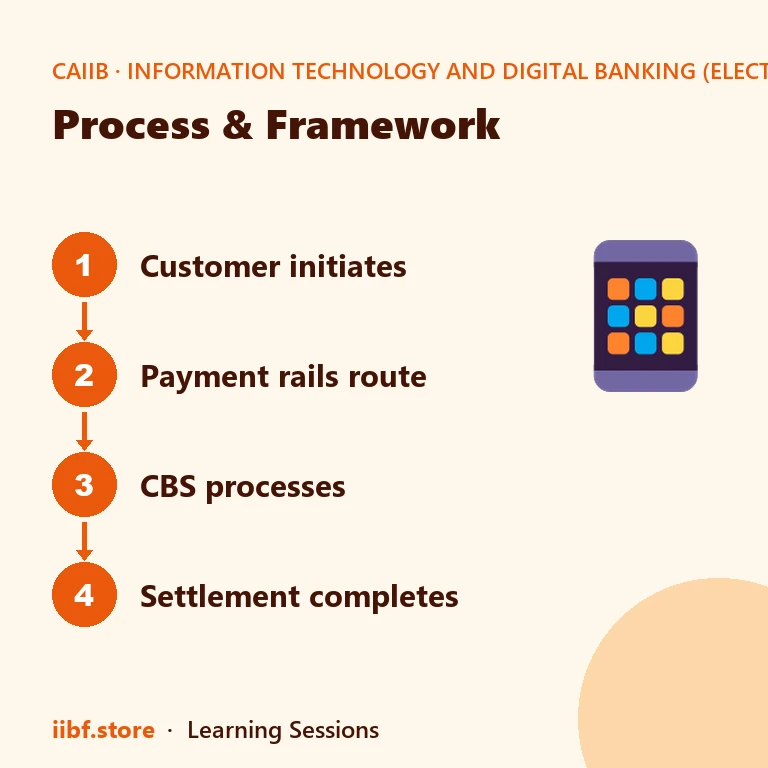
The shared responsibility model is the exam's favourite conceptual test in cloud computing adoption in banks. The provider is responsible for security of the cloud — physical facilities, host infrastructure, hypervisor, network fabric. The bank is responsible for security in the cloud — identity and access management, data classification and encryption, key management, network configuration, and in IaaS the guest operating system as well.
The boundary moves with the service model. In IaaS the bank patches the OS; in PaaS the provider does; in SaaS the bank's remaining duties are user access, data governance and configuration. What never moves is responsibility for data and for customer outcomes.
Resilience
- Availability zones and regions. A workload in one zone is not resilient; multi-zone deployment is the minimum bar for anything customer-facing.
- Provider concentration. A well-architected estate can still be a single point of failure if every critical workload sits with one provider.
- Encryption and keys. Bank-controlled key management materially strengthens the exit position, because data the provider cannot decrypt is data the bank can walk away from.
- Secure connectivity. Dedicated links and encrypted tunnels between the bank and the cloud, as covered under IT communication security.
📌 Remember: "Security of the cloud" belongs to the provider; "security in the cloud" belongs to the bank. Misconfiguration by the bank is the leading cause of cloud data exposure — not provider compromise.
On cost, the honest exam answer is that cloud converts capex to opex and improves elasticity, but total cost of ownership depends on utilisation, data egress charges and the engineering maturity of the bank. Poorly governed cloud spend rises fast, which is why cost management is a governance control, not just a finance activity.
🔁 Migration Patterns for Core Banking
Core banking is migrated last and most cautiously, and the syllabus expects you to know the standard patterns by name.
- Rehost (lift and shift). Move the workload as-is onto cloud infrastructure. Fastest, lowest risk, smallest benefit — you inherit the old architecture's limits.
- Replatform. Minor changes such as moving to a managed database or container runtime, without rewriting business logic.
- Refactor / re-architect. Decompose into services and APIs. Highest cost and risk, highest long-term payoff in elasticity and release speed.
- Repurchase. Replace the in-house application with a SaaS product.
- Retain and retire. Keep some systems where they are; decommission the ones nothing depends on.
Indian banks typically sequence it as: channels and customer-facing front ends first, then analytics and data platforms, then peripheral applications, and only afterwards the core — often through a strangler pattern in which new capabilities are built as cloud services around a core that is progressively hollowed out. The target-state design discipline behind that sequencing is exactly what enterprise architecture in banks provides, and the data classification driving what may leave the private estate comes from data governance in banks.
Two migration controls are always examinable: a tested rollback plan for every cut-over, and parallel running or reconciliation to prove the migrated system produces identical financial outcomes. Where payment rails are involved, the supervisory angle links directly to payment systems oversight in India.
🧠 Practice MCQs: Cloud in Banking
Q1. A bank runs a managed database service on cloud and deploys only its application code and data. Which service model is this? (a) IaaS (b) PaaS (c) SaaS (d) Community cloud
Answer: (b) — PaaS: the provider operates the OS, middleware and runtime, while the bank supplies application code and data.
Q2. Which of the following is NOT one of the five essential characteristics of cloud computing? (a) On-demand self-service (b) Resource pooling (c) Guaranteed data localisation (d) Measured service
Answer: (c) — Data localisation is a regulatory requirement in India, not an inherent characteristic of cloud computing.
Q3. Under the shared responsibility model for an IaaS deployment, patching the guest operating system is the responsibility of: (a) the bank (b) the cloud service provider (c) the regulator (d) the hardware vendor
Answer: (a) — In IaaS the provider secures the underlying infrastructure; the bank owns the guest OS, applications and data.
Q4. Several co-operative banks jointly use a shared cloud platform built for their common regulatory and functional needs. This is best described as: (a) public cloud (b) private cloud (c) hybrid cloud (d) community cloud
Answer: (d) — A community cloud serves a group of organisations with shared concerns and requirements.
Q5. In RBI's expectations on outsourcing of IT services, a documented and tested exit strategy primarily addresses: (a) reduction of monthly cloud spend (b) the bank's ability to transition out of a provider without disrupting services (c) faster provisioning of test environments (d) elimination of the need for an IS audit
Answer: (b) — Exit strategy ensures continuity, return of data in usable form and transition assistance if the arrangement ends or the provider fails.
Want chapter-wise mock tests with 100+ MCQs? Start practising free →
❓ Frequently Asked Questions
Is a bank allowed to put its core banking system on public cloud?
There is no blanket prohibition, but the governance bar is high. The arrangement would be material outsourcing, requiring board-approved policy, deep due diligence, audit and inspection rights for RBI, tested exit and continuity plans, and compliance with data storage requirements. In practice Indian banks keep core banking on private or dedicated infrastructure and use public cloud for channels, analytics and non-production workloads.
What is the difference between service models and deployment models?
Service model (IaaS, PaaS, SaaS) describes how much of the stack the provider operates. Deployment model (public, private, community, hybrid) describes who shares the infrastructure. They are independent axes — you can have SaaS on a community cloud or IaaS on a private cloud.
What is concentration risk in cloud arrangements?
It has two levels. Bank-level concentration is over-dependence on a single provider or a single region for critical workloads. System-level concentration is many regulated entities relying on the same provider, so one outage becomes a sector event. Supervisors track both, which is why multi-region design and credible exit planning are expected rather than optional.
How is cloud usage audited in a bank?
Through the IS audit programme, covering identity and privileged access, configuration and configuration drift, encryption and key management, logging and monitoring, third-party attestations and certifications, SLA performance, and evidence that exit and continuity plans have actually been tested. Continuous configuration monitoring supplements periodic audit because cloud estates change daily.
Cloud computing adoption in banks rewards candidates who can separate the technology question from the accountability question: the service model tells you who patches what, the deployment model tells you who shares the hardware, and RBI's outsourcing framework tells you who answers for the outcome — always the bank. Revise this chapter alongside the rest of the Information Technology and Digital Banking elective notes, then test yourself under time pressure.
Ready to convert these concepts into marks? Work through the full chapter-wise question bank on the CAIIB preparation course and finish with a timed mock.
Quick quiz on this topic
5 exam-style questions from our free test bank — check yourself before you move on.
Practice this topic
Take a free mock test, download chapter PDFs, or watch a video class — all included on iibf.store.
Keep reading