API Banking in India: A CAIIB Guide to Interfaces, Security and Regulation
For the CAIIB elective on Information Technology and Digital Banking, few topics carry as much practical weight as API banking in India. Application Programming Interfaces have quietly become the plumbing of modern financial services, connecting core banking systems, fintech apps, payment rails and account aggregators into a single interoperable ecosystem. If you can explain how a bank exposes its ledger and payment functions through secure APIs, you already understand why the Unified Payments Interface, Bharat Bill Payment System and the Account Aggregator framework work the way they do. This guide breaks down the concepts, architecture, security controls and regulatory context an examinee needs, and shows where each piece maps to your CAIIB syllabus.
What API Banking Means and Why It Matters
An API, or Application Programming Interface, is a defined contract that lets one software system request a service from another without knowing how that service is implemented internally. In banking, an API might let an authorised third party check an account balance, initiate a payment, or fetch a customer's consented financial data. Instead of screen-scraping or manual file exchange, systems talk over structured, versioned, secured endpoints — typically REST over HTTPS returning JSON. This is a direct application of the software concepts covered in your Introduction to Software chapter, where the distinction between an interface and an implementation is foundational.
API banking matters because it decouples innovation from the core. A bank's monolithic core banking system, built for ledger integrity and settlement, is not designed to iterate weekly on a slick mobile experience. By exposing capabilities as APIs, the bank lets fintech partners, its own digital teams, and aggregators build on top without touching the ledger. This is the engine behind open banking, embedded finance and Banking-as-a-Service. For the exam, remember the three broad API categories: private/internal APIs, partner APIs shared with vetted third parties under contract, and open/public APIs. Most Indian banking APIs today are partner APIs governed by bilateral agreements and regulatory frameworks rather than fully open ones.
The Technical Architecture Behind Banking APIs
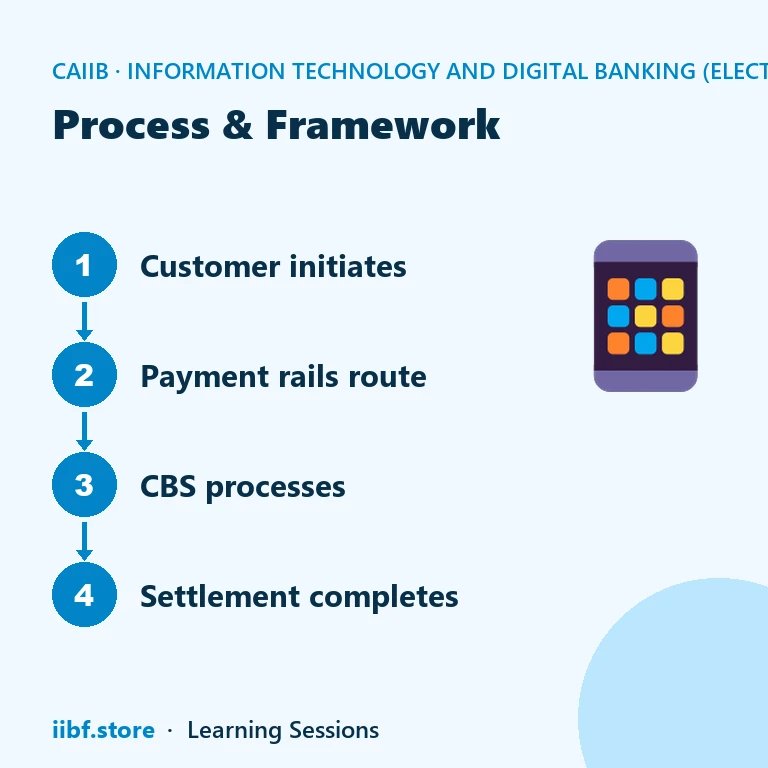
A production banking API stack is layered. At the base sits the core banking system holding accounts and balances. Above it, an integration or middleware layer translates internal formats into clean external contracts. In front of that sits the API gateway — the single controlled entry point that handles authentication, rate limiting, request routing, logging and throttling. Developers discover and subscribe to APIs through a developer portal, and traffic is monitored end to end. Understanding this networking and data flow ties directly to your Networking Systems chapter, since every API call is a network request traversing firewalls, load balancers and TLS-terminating gateways.
Two design styles dominate. REST APIs use standard HTTP verbs (GET, POST, PUT, DELETE) and are stateless, cacheable and simple to consume — the default for most Indian bank and NPCI interfaces. SOAP, an older XML-based protocol with built-in standards for security and transactions, still appears in legacy interbank and enterprise integrations. For robustness, banks version their APIs (v1, v2) so that upstream changes do not break existing partners, and they publish clear error codes and idempotency keys so a retried payment is never processed twice. These reliability patterns are exactly the kind of practical detail CAIIB questions probe.
Security, Consent and the Regulatory Frame
Because banking APIs move money and sensitive data, security is non-negotiable. Access is controlled through OAuth 2.0 style token authorisation, mutual TLS to authenticate both client and server, API keys, digital signatures on payloads, and strict role-based scopes so a token that can read balances cannot also initiate transfers. The Reserve Bank of India expects strong customer authentication, encryption of data in transit and at rest, comprehensive audit logging, and continuous monitoring for anomalous call patterns that could signal credential abuse. You can review the RBI's expectations on digital and cyber controls directly on the regulator's site at rbi.org.in.
Consent is the legal heart of data-sharing APIs. India's Account Aggregator framework, regulated by the RBI, lets a customer share financial data across institutions only after granting explicit, revocable, purpose-limited consent through a consent artefact — no data flows without it. Layered on top, the Digital Personal Data Protection Act establishes data-fiduciary obligations, purpose limitation and data-principal rights that any API exchanging personal financial data must honour. For the exam, the key principle to memorise is consent-driven, purpose-bound data sharing: the customer, not the bank, controls who sees what and for how long.
Real-World API Ecosystems and a Comparison
India runs one of the world's most advanced public API-driven payment ecosystems, largely orchestrated by the National Payments Corporation of India. UPI exposes payment initiation and collection through APIs that any compliant app can integrate. The Bharat Bill Payment System standardises bill fetch and payment APIs. IMPS provides real-time interbank transfer APIs, and the Account Aggregator network provides consented data-sharing APIs. Each of these builds on the same principle: a standardised, secured interface that hides internal complexity. Mapping these to fundamentals is easier once you have worked through Information Technology and its Implications, and you can explore related write-ups through the Information Technology and Digital Banking tag hub.
The table below contrasts the main API-driven systems a CAIIB candidate should be able to distinguish. Treat it as high-yield revision — questions often ask you to match a use case to the correct rail.
| System | Operator / Regulator | Primary Purpose | Core Function Exposed via API |
|---|---|---|---|
| UPI | NPCI | Instant retail payments | Push/pull payment initiation, collect requests |
| IMPS | NPCI | Real-time interbank transfer | Immediate fund transfer, 24x7 |
| BBPS | NPCI | Standardised bill payments | Bill fetch and bill payment |
| Account Aggregator | RBI-regulated AA network | Consented financial data sharing | Consent-based data fetch |
How API Banking Fits Your CAIIB Preparation
API banking is not a standalone topic to cram in isolation — it is where several IT and digital banking themes converge, which is exactly why examiners like it. A single well-framed question can test your grasp of software interfaces, networking, data communication, database access, security and RBI regulation all at once. When you revise, connect each concept back to its foundation: the interface-versus-implementation idea from software design, the request-response flow from networking, and the consent and authorisation logic from the regulatory chapters. This integrated view is what separates a scoring answer from a vague one.
A practical study routine helps. Read the concept, then test recall under exam conditions on the CAIIB mock tests, and reinforce terminology with quick match games so definitions stick. Keep an eye on regulatory movement too, because digital banking is a fast-changing area and current-affairs questions do appear; the IIBF news and updates page is a convenient tracker. Approach API banking as the connective tissue of the whole elective and you will find the rest of the syllabus clicks into place.
Frequently Asked Questions
What is API banking in simple terms?
API banking is the practice of a bank exposing its services — such as balance enquiry, payments or consented data sharing — through secure Application Programming Interfaces so that authorised apps, fintechs and aggregators can use those services programmatically, without direct access to the bank's internal core systems.
Is UPI an example of API banking?
Yes. UPI, operated by NPCI, is built entirely on standardised payment APIs. Any compliant application integrates these APIs to initiate or collect payments, making UPI one of the largest real-world examples of API banking in India.
How are banking APIs kept secure?
Banking APIs rely on OAuth 2.0 style token authorisation, mutual TLS, API keys, digital signatures, role-based scopes, encryption in transit and at rest, and continuous monitoring. The RBI additionally expects strong customer authentication, audit logging and anomaly detection for any interface that moves money or personal data.
What role does consent play in API-based data sharing?
Consent is central. Under the RBI-regulated Account Aggregator framework, financial data can be shared only after the customer grants an explicit, revocable, purpose-limited consent artefact. The Digital Personal Data Protection Act reinforces this with data-principal rights and purpose limitation.
Conclusion
API banking sits at the intersection of software, networking, security and regulation, which is precisely why it rewards focused study for the CAIIB Information Technology and Digital Banking elective. Understand the layered architecture, the REST-first design patterns, the token-based security model and the consent-driven data frameworks, and you will be able to answer whatever form the question takes. Ready to test yourself? Put this knowledge to work on the full CAIIB course and mock tests and turn understanding into marks.
Quick quiz on this topic
5 exam-style questions from our free test bank — check yourself before you move on.
Practice this topic
Take a free mock test, download chapter PDFs, or watch a video class — all included on iibf.store.
Keep reading