Core Banking Systems (CBS): CAIIB ITDB 2026 Guide
Core banking systems are the technological backbone of every modern bank, and they are a foundational topic in the CAIIB ITDB (Information Technology and Digital Banking) paper. CBS — an acronym for Core Banking Solution — is the centralised software platform that lets a customer bank at any branch rather than only the one where the account was opened. It powers everything from deposits and loans to ATMs, internet banking, UPI and the interbank settlement rails. For 2026 candidates, understanding CBS architecture, its modules, its benefits and its resilience requirements is essential because almost every downstream digital-banking topic assumes CBS underneath. This guide explains core banking systems in exam-ready depth.
What Core Banking Systems Are and Why They Matter
The term CBS is often expanded as "Centralised Online Real-time Exchange", capturing its defining traits: a single centralised database, online access from any channel, and real-time processing of transactions. Before CBS, each branch ran its own ledger, so a customer was tied to their home branch. CBS dissolved that limitation and made "anywhere, anytime banking" possible. Its significance for the ITDB syllabus lies in three properties:
- Centralisation — all customer and account data live in one central repository, usually hosted at the bank's data centre.
- Real-time processing — a transaction at an ATM or on a mobile app updates the ledger instantly, keeping balances consistent across channels.
- Channel integration — branches, ATMs, internet banking, mobile banking, call centres and payment systems all plug into the same core.
Popular CBS products in Indian banks include Finacle, Flexcube (Oracle FLEXCUBE), BaNCS and iFlex-derived platforms. Grounding yourself in these fundamentals sets up the rest of the digital-banking syllabus, which you can study in sequence through the CAIIB course.
CBS Architecture: The Three-Tier Model
Examiners frequently ask about the layered architecture of a core banking system, which typically follows a three-tier design:
- Presentation layer (client tier): the user-facing interfaces — teller terminals, ATMs, internet and mobile banking front-ends — that capture inputs and display results.
- Application layer (business-logic tier): the application servers that enforce business rules, validations, interest calculations and workflows. This is the "brain" that processes each request.
- Database layer (data tier): the centralised database (often Oracle or a similar RDBMS) that stores all customer, account and transaction records and guarantees data integrity.
Separating these tiers improves scalability, security and maintainability — the presentation layer can change without touching the core logic, and the database can be secured and backed up independently. Communication between tiers is protected by encryption, and access is controlled through role-based permissions. This modular design also lets banks add new channels — such as a UPI or Account Aggregator integration — without re-engineering the whole system. Test your grasp of these layers on the IIBF practice tests.
Modules, Benefits and Integration with Payment Systems
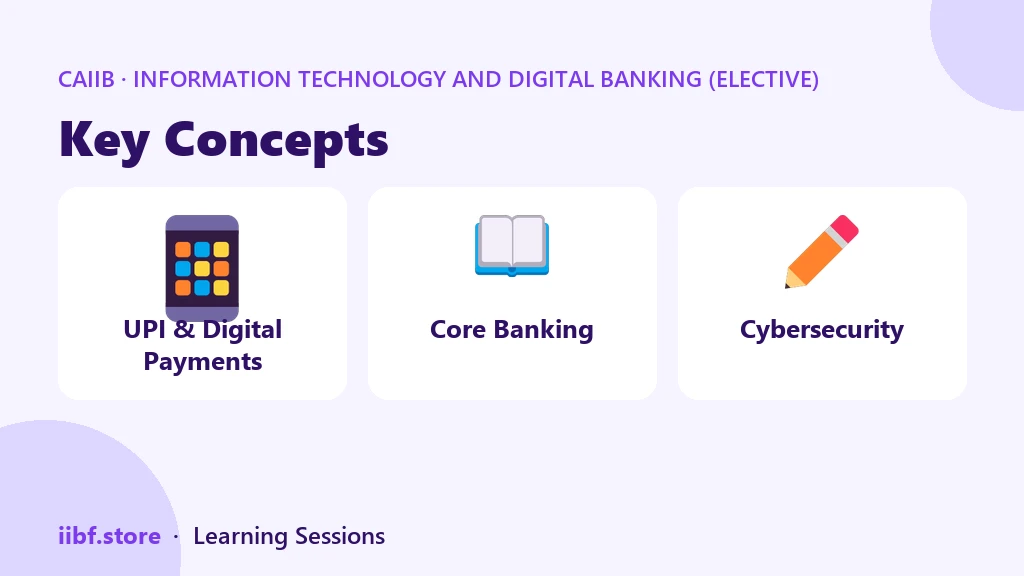
A CBS is not a single monolith but a suite of integrated modules covering the whole banking operation:
- Deposits and CASA — savings, current, fixed and recurring accounts.
- Loans and advances — origination, disbursement, EMI scheduling and NPA classification.
- Clearing and payments — integration with NEFT, RTGS, IMPS and UPI.
- Trade finance, treasury and general ledger — for corporate banking and the bank's own books.
- Customer relationship and MIS — reporting, analytics and regulatory returns.
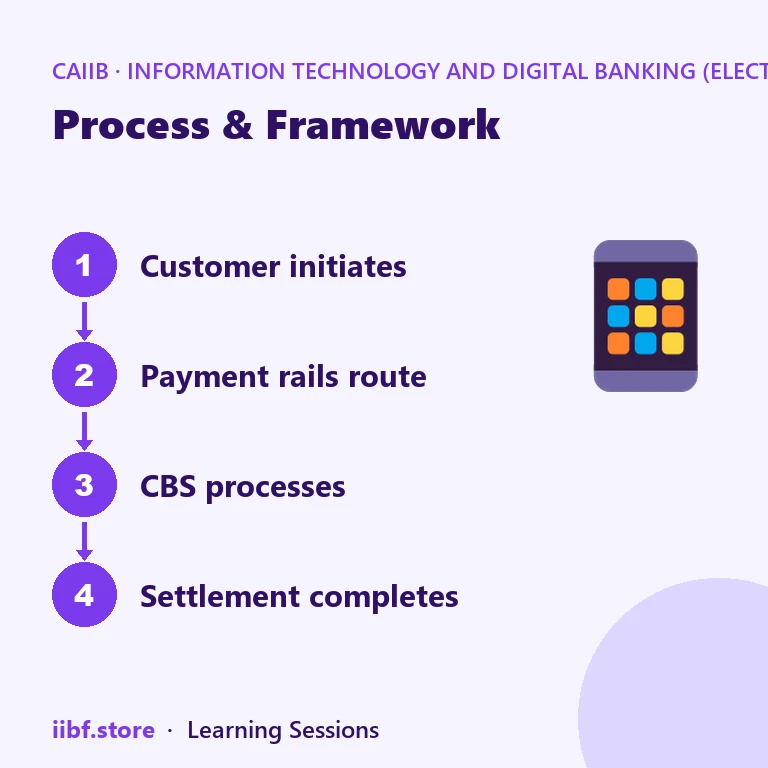
The benefits are what make CBS indispensable: anywhere banking, faster service, standardised processes, reduced operational risk, easier regulatory reporting and a single customer view that enables cross-selling. Crucially for ITDB, CBS is the system that connects to national payment infrastructure operated by bodies such as the National Payments Corporation of India (NPCI), so that a UPI or IMPS transaction can debit one bank's CBS and credit another's in seconds. Keep track of new digital-banking circulars on the IIBF news page and current policy rates on the RBI rates tracker.
Data Centre, Disaster Recovery and Business Continuity
Because a CBS outage can halt an entire bank, resilience is a heavily tested theme. Banks run CBS from a primary Data Centre (DC) and replicate it to a geographically separate Disaster Recovery (DR) site, so operations can fail over if the primary site is lost. Two metrics define the recovery objective:
- RTO (Recovery Time Objective): the maximum acceptable downtime before services must be restored.
- RPO (Recovery Point Objective): the maximum acceptable data loss, measured as the time between the last usable backup and the disruption.
Robust banks aim for near-zero RPO through real-time or near-real-time data replication and a low RTO through hot-standby DR. The RBI's cyber-security and IT-governance frameworks require regular DR drills, and a well-documented Business Continuity Plan (BCP) is mandatory. Some banks now add a third "near-DR" site for zero-data-loss synchronous replication. Understanding DC-DR is essential because it links CBS to the broader themes of IT risk and operational resilience. Reinforce these terms with the match-the-concept game and read deeper explainers on the study blog.
A 2026 trend reshaping CBS is the shift toward cloud-native and API-first cores. Newer banks and fintech-partnered lenders deploy microservices-based core systems that expose functionality through APIs, enabling rapid integration with Account Aggregators, co-lending partners and digital-lending platforms. This modularity contrasts with the older monolithic CBS but retains the same non-negotiables — centralised data integrity, real-time posting, strong access control and tested disaster recovery. For the exam, be able to explain both the traditional three-tier CBS and this emerging API-driven model, and why the RBI's outsourcing and cloud-adoption guidelines still hold the bank fully accountable for data security regardless of where the core is hosted.
Frequently Asked Questions
Related study material
Go deeper with the full chapter notes and the complete article hub for this subject:
- INTRODUCTION TO SOFTWARE
- Information Technology and its Implications
- All Information Technology and Digital Banking (Elective) articles & notes
What does CBS stand for and what is its defining feature?
CBS stands for Core Banking Solution or Core Banking System, often expanded as Centralised Online Real-time Exchange. Its defining feature is a single centralised database that allows real-time, anywhere-anytime banking, so a customer can transact at any branch or channel rather than only their home branch.
What are the three tiers of a core banking system architecture?
The three tiers are the presentation layer (user interfaces such as ATMs and mobile apps), the application layer (servers enforcing business logic and rules), and the database layer (the centralised store of all customer and transaction data). Separating them improves scalability, security and maintainability.
What is the difference between RTO and RPO in CBS disaster recovery?
RTO (Recovery Time Objective) is the maximum acceptable downtime before the CBS must be restored, while RPO (Recovery Point Objective) is the maximum acceptable data loss, measured back to the last usable backup. Banks aim for low RTO and near-zero RPO through DR sites and real-time replication.
How does CBS connect to payment systems like UPI and NEFT?
CBS integrates with national payment infrastructure through dedicated modules and interfaces. When a customer initiates a UPI, IMPS, NEFT or RTGS transfer, the CBS debits the payer's account and communicates with the payment system operator so the beneficiary bank's CBS credits the recipient, enabling seamless interbank settlement.
Conclusion: Master the Core, Ace the Paper
Core banking systems tie together almost every ITDB concept — architecture, modules, payment integration and disaster recovery — so a solid grasp here pays dividends across the whole paper. Learn the three-tier model, the RTO/RPO distinction and how CBS plugs into UPI, and you will answer both conceptual and scenario questions confidently. Ready to test your command of the topic? Take a full ITDB mock on the IIBF practice tests, or work through the complete syllabus in the CAIIB course today.
Quick quiz on this topic
5 exam-style questions from our free test bank — check yourself before you move on.
Practice this topic
Take a free mock test, download chapter PDFs, or watch a video class — all included on iibf.store.
Keep reading