Balance Sheet Management in Banks: Capital, RoA and NIM (CAIIB ABM)
Balance sheet management in banks is the Module D skill that CAIIB ABM candidates most often under-prepare, because it looks like accounting and behaves like strategy. A bank's balance sheet is not a passive record of what happened last year — it is the control panel through which management decides how much risk to carry, how fast to grow advances, how much capital to keep, and what spread to earn. Every ratio the examiner asks about, from RoA to NIM to CRAR, is simply a different lens on the same two columns. This article walks through composition of assets and liabilities, disclosure schedules, capital planning, internal capital generation, and the capital-versus-growth trade-off in exam language.
🏦 What Balance Sheet Management in Banks Really Means
A commercial bank's balance sheet is structurally inverted compared with a manufacturing company. Deposits — other people's money — dominate the liability side, while advances and investments dominate the asset side. Owned funds (capital plus reserves) typically form a small single-digit share of total liabilities. That thin equity cushion is precisely why the discipline exists: a small percentage swing in asset quality can wipe out a large percentage of net worth.
Managing the balance sheet therefore means managing four things simultaneously. First, composition — the mix of current, savings and term deposits on one side and cash, statutory investments, and advances on the other. Second, maturity profile — banks borrow short and lend long, so a maturity mismatch is deliberate but must stay inside board-approved tolerance limits. Third, rate sensitivity — how much of the book reprices within each time bucket when the policy rate moves. Fourth, capital — whether owned funds are sufficient to absorb unexpected losses on the risk-weighted assets the bank has chosen to hold.
The Asset Liability Committee (ALCO) is the body that operationalises all four. It sets deposit and lending rate direction, monitors the structural liquidity statement and interest rate sensitivity statement, and approves tolerance limits on negative gaps. For CAIIB, remember that ALCO decisions are balance sheet decisions: raising bulk deposits, running down excess SLR investments, or shifting from corporate to retail advances all change the shape of the two columns at once. Quantitative techniques you meet elsewhere in ABM — including correlation and regression between deposit growth and branch expansion — feed directly into these projections.
💡 Exam Tip: When a question says "the bank wants to improve NIM without increasing risk", the expected answer is almost always a mix change — more CASA, more retail/priority-sector-eligible high-yield advances — not a rate change.
📋 Disclosure Schedules: Reading Form A Line by Line
Indian banks publish their balance sheet in Form A and profit and loss account in Form B of the Third Schedule to the Banking Regulation Act, 1949. The eighteen schedules are examinable and the pattern is stable, so learn them as a map rather than as a list. Schedules 1 to 5 sit on the liabilities side, schedules 6 to 11 on the assets side, schedule 12 carries contingent liabilities and bills for collection, schedules 13 to 16 unpack income and expenditure, and schedules 17 and 18 carry accounting policies and notes.
The examiner's favourite trap is schedule 12. Contingent liabilities — guarantees, letters of credit, forward exchange contracts, acceptances and endorsements — appear below the balance sheet total, not inside it. They generate fee income without consuming balance sheet size, which is exactly why off-balance-sheet business is attractive to a capital-constrained bank. They are not free, however: they attract a credit conversion factor, are converted into a credit equivalent amount, and then carry a risk weight like any funded exposure.
| Schedule | Contents | Side | Earning asset / costing liability? |
|---|---|---|---|
| 1 & 2 | Capital; Reserves and Surplus | Liabilities | ❌ Owned funds, no contractual cost |
| 3 | Deposits (demand, savings, term) | Liabilities | ✅ Main costing liability |
| 4 | Borrowings (RBI, banks, bonds) | Liabilities | ✅ Usually costliest funds |
| 6 & 7 | Cash and balances with RBI; balances with banks | Assets | ❌ CRR balances earn nothing |
| 8 | Investments (SLR and non-SLR) | Assets | ✅ Yield lower than advances |
| 9 | Advances (net of provisions) | Assets | ✅ Highest-yielding block |
| 12 | Contingent liabilities, bills for collection | Off balance sheet | ❌ Fee income, but capital charge applies |
Note that advances are shown net of provisions, so a rise in provisioning shrinks the asset side and reduces the denominator of several ratios at the same time as it reduces net profit in the numerator. Statutory reserve requirements such as CRR and SLR change from time to time; always quote the prevailing figures from the current RBI rates reference rather than a figure memorised from an old textbook.
🛡️ Capital Planning and Internal Capital Generation
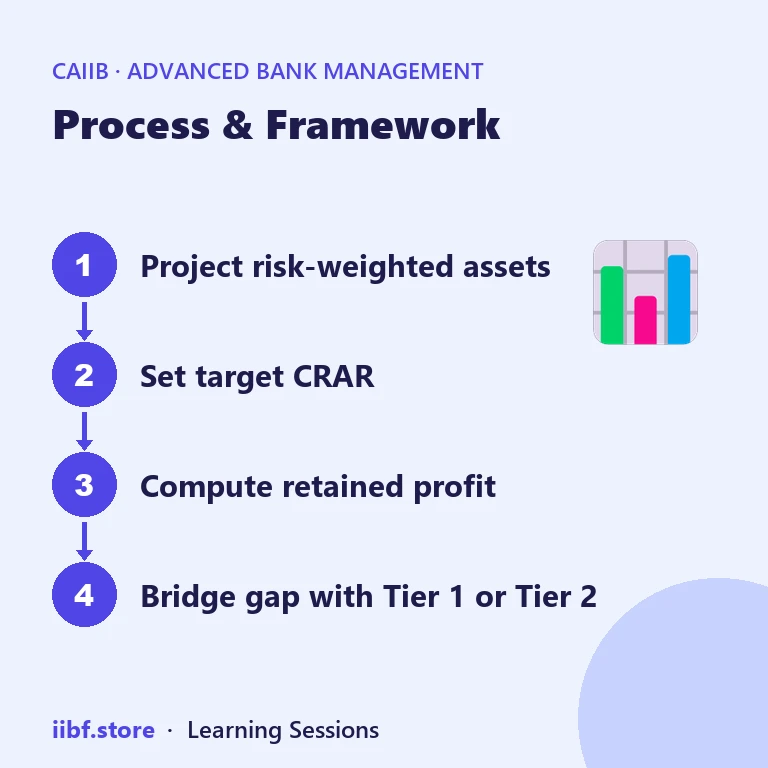
Capital adequacy links the two columns. Under the Basel III framework as implemented by RBI, banks must maintain minimum Common Equity Tier 1, Tier 1 and total capital ratios against risk-weighted assets, plus a capital conservation buffer built out of CET1. Breaching into the buffer does not close the bank, but it restricts discretionary distributions — dividends, buybacks and discretionary bonus — which is the regulator's way of forcing internal capital rebuilding before shareholders are paid.
Capital planning starts from the projected risk-weighted asset base, not from the projected balance sheet size. Two banks with identical total assets can have very different RWA depending on whether they hold sovereign securities, home loans, or unrated corporate exposures. A bank that wants to grow advances 20% while keeping CRAR constant must grow eligible capital at broadly the same pace on the RWA it is adding.
That capital can come from outside — a rights issue, a qualified institutional placement, Additional Tier 1 bonds or Tier 2 subordinated debt — or from inside. Internal capital generation is retained profit: net profit less dividend and tax on distribution, flowing into reserves under schedule 2. The internal capital generation rate is conveniently expressed as return on equity multiplied by the retention ratio. A bank earning 12% RoE and retaining 60% of profit generates roughly 7.2% internal capital growth a year, which caps sustainable RWA growth at about the same rate unless external capital is raised or the asset mix is made lighter.
⚠️ Common Mistake: Candidates compute capital requirement on total assets. Capital ratios are always measured against risk-weighted assets plus the capital charge for market and operational risk — never against the plain balance sheet footing.
📊 RoA, RoE and NIM: Decomposing Bank Profitability
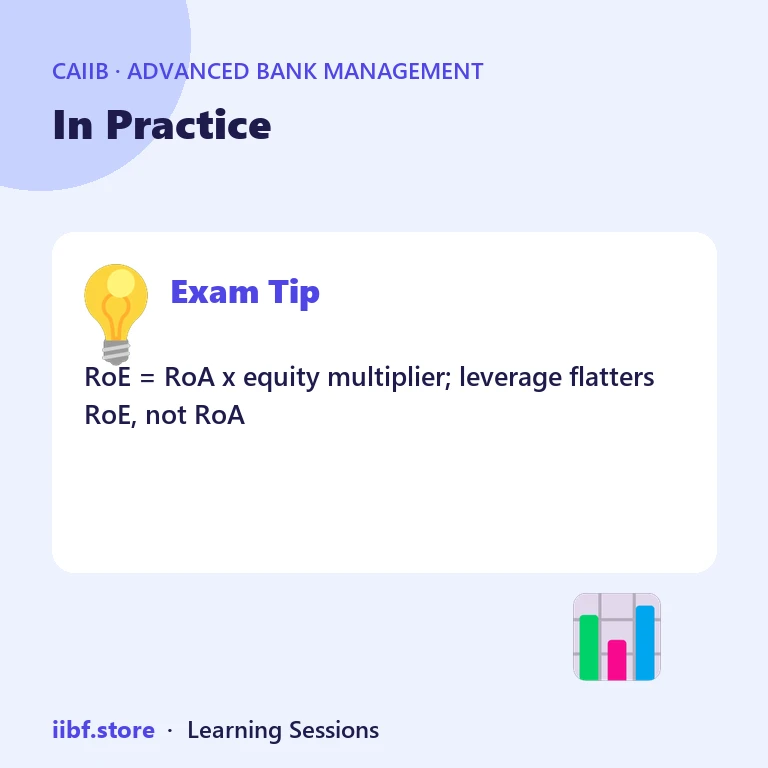
Three ratios carry most of the marks. Return on Assets is net profit divided by average total assets, and it answers "how well is the balance sheet being worked?" Return on Equity is net profit divided by average owned funds, and it answers "how well are shareholders being served?" The bridge between them is the equity multiplier — average assets divided by average equity — so RoE equals RoA multiplied by leverage. A bank can lift RoE simply by holding less capital, which is exactly the behaviour Basel leverage limits are designed to restrain.
Net Interest Margin is net interest income divided by average earning assets. Two banks with the same spread can post different NIM because one funds a larger share of earning assets with non-costing funds — CASA deposits and owned funds. This is why the CASA ratio is watched so closely: it is a NIM driver, not merely a marketing statistic.
Decomposition in the DuPont style is worth memorising: RoA = (net interest income + other income − operating expenses − provisions) ÷ average assets. Each term is a lever. Fee-based and off-balance-sheet income lifts other income without adding assets. Cost-to-income discipline lifts the third term. Credit underwriting quality controls the fourth, which is where provisioning volatility usually destroys an otherwise good year. Statistical tools from earlier modules — the measures of dispersion used to study variability — help management judge whether a margin movement is signal or noise. For a market-risk perspective on how the same securities are treated differently by intent, see trading book vs banking book.
⚖️ The Capital Versus Growth Trade-off in Practice
Every balance sheet decision eventually collides with capital. If a bank grows its loan book faster than it generates capital, CRAR falls; if it grows slower, capital piles up and RoE falls because the same profit is spread over a larger equity base. Balance sheet management in banks is therefore an optimisation, not a maximisation: find the growth rate the bank's profitability can actually fund.
Practical levers when capital is tight are worth listing in an answer. The bank can re-mix the asset side toward lower risk weights — retail housing, well-rated corporates, sovereign paper. It can churn — originate and sell down, or use direct assignment, so the exposure leaves the books while the fee stays. It can grow fee income through guarantees, remittances, third-party distribution and trade finance, since these lift RoA with a small capital footprint. It can cut the cost of funds by chasing CASA rather than bulk deposits. And it can improve recovery, because every rupee of provision written back is capital restored without any issuance.
MSME and mid-corporate exposures deserve special mention here, since capital treatment and turnover-based working capital assessment interact. Candidates strengthening this area usually pair balance sheet study with credit topics such as supply chain finance for banks and revival and rehabilitation of MSME units, because both change the asset mix without changing the bank's risk appetite statement. Projection work also rests on sampling and estimation techniques covered in estimation.
📌 Remember: Sustainable growth in risk-weighted assets ≈ RoE × retention ratio, when no fresh capital is raised. Quote this relationship whenever a question links dividend policy to expansion plans.
🧠 Practice MCQs: Balance Sheet Management
Q1. In which schedule of Form A are contingent liabilities and bills for collection disclosed? (a) Schedule 5 (b) Schedule 12 (c) Schedule 9 (d) Schedule 17
Answer: (b) — Schedule 12 carries contingent liabilities and bills for collection, shown below the balance sheet total.
Q2. A bank's RoE is 15% and its dividend payout ratio is 40%. Its approximate internal capital generation rate is: (a) 15% (b) 6% (c) 40% (d) 9%
Answer: (d) — Internal capital generation = RoE × retention ratio = 15% × 0.60 = 9%.
Q3. Net Interest Margin is best defined as: (a) Net interest income divided by average earning assets (b) Net profit divided by average total assets (c) Interest income divided by total deposits (d) Spread between prime lending rate and savings rate
Answer: (a) — NIM measures net interest income against average earning assets, not total assets or deposits.
Q4. Which relationship correctly links the two profitability ratios? (a) RoA = RoE × equity multiplier (b) RoE = RoA ÷ equity multiplier (c) RoE = RoA × equity multiplier (d) RoA = RoE + leverage ratio
Answer: (c) — RoE equals RoA multiplied by the equity multiplier (average assets ÷ average equity).
Q5. Under Basel III as implemented in India, capital adequacy is computed against: (a) Total assets as per Form A (b) Risk-weighted assets including credit, market and operational risk (c) Net advances only (d) Deposits plus borrowings
Answer: (b) — The denominator is risk-weighted assets, covering credit, market and operational risk charges.
Want chapter-wise mock tests with 100+ MCQs? Start practising free →
❓ Frequently Asked Questions
Which ABM module covers balance sheet management?
It sits in Module D of Advanced Bank Management, alongside capital adequacy, profitability analysis and disclosure requirements. Questions frequently combine it with credit and risk topics from other modules.
Why are advances shown net of provisions in the balance sheet?
Schedule 9 reports advances after deducting provisions for non-performing assets, so the asset side reflects realisable value. This is why higher provisioning reduces both reported profit and reported asset size.
Do off-balance-sheet items require capital?
Yes. Guarantees, letters of credit and derivative exposures are converted into credit equivalent amounts using credit conversion factors and then risk-weighted, so they consume capital even though they do not appear in the balance sheet total.
How can a bank raise RoE without raising RoA?
By increasing leverage — holding fewer owned funds against the same assets. Regulators constrain this through minimum capital ratios and the leverage ratio, so it is not a sustainable strategy for the exam answer or in practice.
🎯 Conclusion and Next Step
Treat the balance sheet as a set of levers rather than a statement. Know the schedules, know that capital is measured against risk-weighted assets, know that RoE is RoA geared by leverage, and know that sustainable growth is bounded by internal capital generation. That framework answers most Module D questions, including the case-study style ones that give you a small balance sheet extract and ask what management should do next. Browse more topic guides on the Advanced Bank Management tag hub, then lock the concepts in with the full syllabus coverage on the CAIIB course page and a timed attempt at the ABM mock tests.
Source and further reading: Reserve Bank of India and the Indian Institute of Banking & Finance.
Quick quiz on this topic
5 exam-style questions from our free test bank — check yourself before you move on.
Practice this topic
Take a free mock test, download chapter PDFs, or watch a video class — all included on iibf.store.
Keep reading