Bank Investment Portfolio Classification: HTM, AFS and HFT
How a bank slots each security into its books is not an accounting afterthought — it shapes the bank's reported profit, its capital, and the risk it carries. The bank investment portfolio classification into distinct categories is therefore one of the most examinable and practically important topics in Treasury Investment and Risk Management. This guide explains the traditional Held to Maturity, Available for Sale and Held for Trading buckets, how they determine valuation, and how they connect to the wider discipline of treasury risk.
Bank investment portfolio classification is the framework by which a bank assigns every investment — chiefly government securities, bonds and other approved instruments — to a category that dictates how it is valued and how gains or losses flow through the accounts. The category is not chosen at random; it must reflect the bank's genuine intent and ability to hold the instrument. Get the classification right and the books tell the truth; get it wrong and both profit and capital are distorted.
The Three Traditional Investment Categories
The classical bank investment portfolio classification uses three buckets defined by holding intent. Held to Maturity (HTM) covers securities the bank intends and is able to hold until they redeem; these are carried at acquisition cost (amortised for any premium), so day-to-day market movements do not touch the profit and loss account. Available for Sale (AFS) covers securities the bank may sell as opportunities arise; these are marked to market, with valuation changes typically routed through reserves. Held for Trading (HFT) covers securities bought to profit from short-term price movements; these are marked to market most frequently, with changes flowing straight to the profit and loss account.
The logic is intent-driven and intuitive once grasped. A security a bank plans to hold for a decade should not swing the year's profit merely because yields wobbled this quarter — hence HTM at cost. A security held for active trading, by contrast, should reflect its true current value at all times. The RBI's master directions on investment classification and valuation, published at rbi.org.in, set out the detailed rules, including limits on the HTM book and the treatment of transfers between categories. This intent-based logic recurs throughout our CAIIB and certification course.
Mark to Market and Its Impact on the Books
The single most important consequence of bank investment portfolio classification is how mark to market (MTM) applies. Marking to market means revaluing a security at its current market price rather than its purchase cost. For AFS and HFT holdings, an adverse move in yields — remember that bond prices fall when yields rise — forces the bank to recognise a valuation loss, either through reserves or directly through profit. HTM shelters the bank from this volatility, which is precisely why regulators cap how much can be parked there.
This is where treasury and risk management meet accounting. A treasury that piles long-dated bonds into AFS is exposed to interest-rate risk that will show up as MTM losses the moment rates rise. Measuring that exposure is the job of concepts like duration — the sensitivity of a bond's price to a change in yield — and Modified Duration, which quantifies the expected percentage price change for a 1% move in yield. A longer-duration portfolio swings more violently, so the classification decision and the risk-measurement decision are two sides of the same coin. Candidates should practise linking a classification to its MTM consequence, a skill our mock tests drill repeatedly.
Classification, Capital and Prudent Treasury Management
Beyond profit, bank investment portfolio classification feeds directly into capital adequacy and prudent balance-sheet management. Because AFS and HFT positions are marked to market, their losses can erode the bank's capital, whereas the HTM shelter limits that hit. Regulators therefore watch the size and composition of each book closely and require banks to hold buffers such as the Investment Fluctuation Reserve to absorb valuation swings. A treasury that ignores these linkages can find a benign-looking bond portfolio suddenly consuming scarce capital when rates turn.
Prudent treasury management, then, is about aligning classification with genuine intent, respecting regulatory limits, and continuously measuring interest-rate risk through duration and scenario analysis. It also means understanding how the primary market works — for instance, how the RBI conducts government-securities auctions on behalf of the sovereign — so the treasury knows what it is buying and why. For the Treasury Investment and Risk Management exam, be ready to trace a security from purchase, through its classification, to its valuation and capital impact. Keep current with rate movements via our RBI rates resource, reinforce terms with match games, and browse more explainers on the blog.
Frequently Asked Questions
What is bank investment portfolio classification?
Bank investment portfolio classification is the framework by which a bank assigns each investment to a category — traditionally Held to Maturity, Available for Sale or Held for Trading — based on its intent and ability to hold. The category determines how the security is valued and how gains or losses are recognised.
What is the difference between HTM, AFS and HFT?
Held to Maturity securities are held until redemption and carried at cost. Available for Sale securities may be sold and are marked to market through reserves. Held for Trading securities are bought for short-term gains and marked to market through profit and loss.
What does mark to market mean?
Mark to market means revaluing a security at its current market price rather than its purchase cost. It applies to AFS and HFT holdings, so a rise in yields that lowers bond prices forces the bank to recognise a valuation loss.
How does duration relate to classification?
Duration measures how sensitive a bond's price is to a change in yield. A longer-duration portfolio held in AFS or HFT swings more with rates, producing larger mark-to-market losses or gains, which is why classification and interest-rate risk measurement go hand in hand.
Conclusion and Next Steps
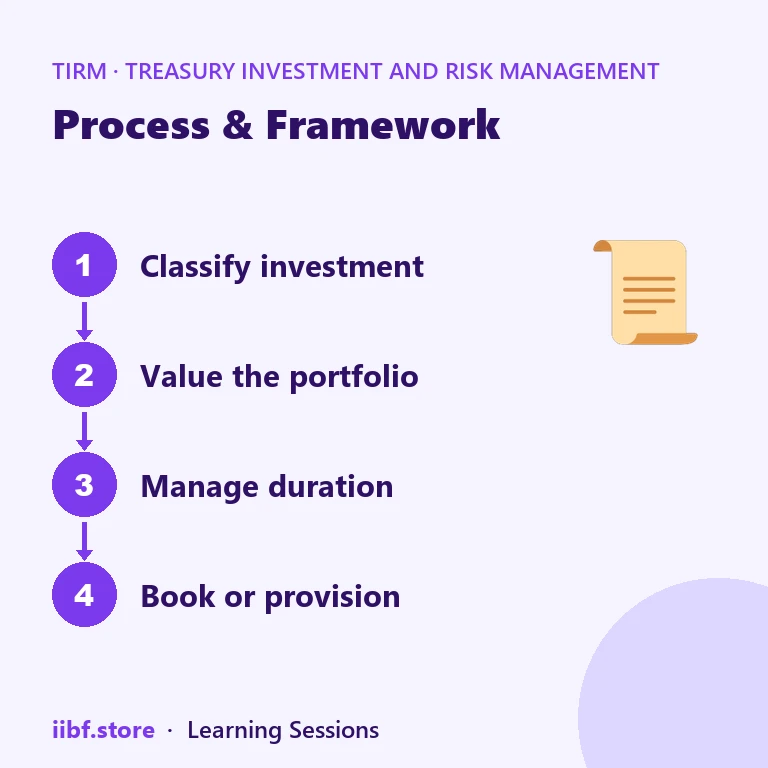
Bank investment portfolio classification ties together accounting, treasury and risk in a single, highly examinable topic. Master the intent-based logic of HTM, AFS and HFT, understand how mark to market drives profit and capital, and connect it all to duration and interest-rate risk, and you will handle both the exam and real treasury decisions with confidence. Treat classification not as a label but as a risk statement about the whole balance sheet. Ready to test yourself? Attempt a focused mock on our practice tests and explore the complete treasury and risk management course.
Practice this topic
Take a free mock test, download chapter PDFs, or watch a video class — all included on iibf.store.