Bank Job Reality 2026: What Nobody Tells New Bankers

The gap between the job you imagined and the job you joined shows up somewhere around month two. Nobody warned you, because nobody describes the ordinary parts in a coaching class. The bank job reality is not that the work is bad — it is that it is different from the brochure in three specific ways, and the people who struggle are usually the ones who were surprised by them rather than the ones who found them difficult. Knowing the bank job reality in advance is most of the adjustment.
Banker job reality · Watch on YouTube
Surprise one: the counter is only half the job
The picture most people carry into a branch is transactional — deposits, withdrawals, passbooks, a queue that ends when the shutter comes down. That part exists, and on some days it is genuinely the whole day. But the modern branch officer spends a large share of their time on things the public never sees: compliance checks, KYC periodic updation, documentation for advances, reconciliation, audit queries, and the follow-up on accounts that have stopped behaving.
This is where the first mismatch bites. Customer-facing work has a natural end point; the back-office work does not. It accumulates quietly, and it is the part that keeps you at your desk after the shutter is down. New officers often read that as a personal failure of speed. It is not. It is the shape of the job.
The practical adjustment is to stop treating the queue as the day's work and the rest as overflow. Block time for the paperwork the way you would block time for a meeting, and it stops feeling like an ambush every evening.
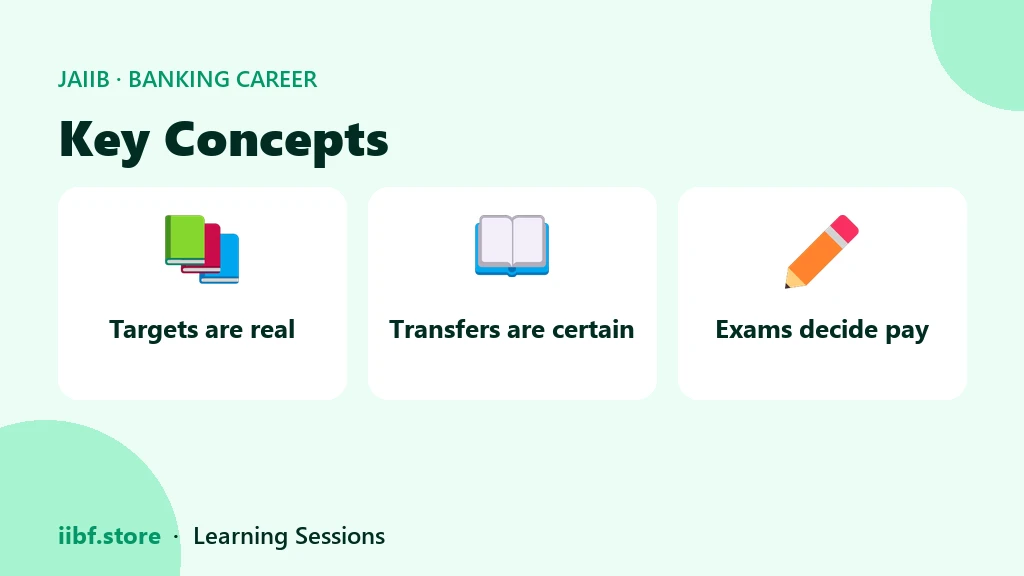
Surprise two: targets are part of the role, not an add-on
Very few people join a bank expecting to sell anything. Then the first review meeting arrives with numbers attached to your name — insurance, deposits, digital activations, whatever the season's push happens to be — and the job suddenly looks like a different job.
It helps to reframe rather than resent. A branch is a business unit, and every business unit is measured. What separates the officers who cope from the ones who burn out is usually not sales talent; it is whether they build the habit early of understanding the products properly. An officer who genuinely knows which product suits which customer is doing advisory work that happens to hit a target. An officer who has memorised a pitch is doing cold-calling, and that is exhausting.
The second thing that helps is separating what you control from what you do not. You control conversations initiated and follow-ups made. You do not control whether a customer says yes. Track the first, and the second stops feeling personal.
Surprise three: your pay grade moves through examinations
Here is the part that most changes what a fresher should do in year one. In banking, the route upward is unusually formalised. Professional qualifications from the Indian Institute of Banking and Finance — JAIIB first, then CAIIB — sit directly in the path of increments and promotion eligibility at most institutions.
That makes the calculation unusually clean compared with other industries. The syllabus is public, the pass mark is fixed at 50 out of 100 in a subject, there is no negative marking, and credits for subjects you have cleared are retained until your time limit runs out. You get five attempts within three years of first registering, whichever comes earlier.
| What people expect | The bank job reality | What to do about it |
|---|---|---|
| Work ends when the branch closes | Compliance and documentation continue after | Schedule back-office time; do not treat it as overflow |
| No selling involved | Targets are a standing part of the role | Learn products deeply; track effort, not outcomes |
| Promotions follow seniority | Exams and postings weigh heavily | Clear JAIIB in year one, while habits are fresh |
| You stay where you joined | Transfers are near-certain over a career | Plan life logistics with mobility assumed |
The first year, spent well
Treat year one as the cheapest year you will ever have. Your responsibilities are lighter than they will ever be again, and you have not yet acquired the commitments that make evening study hard. Almost everyone who clears their professional exams late says the same thing: they meant to start in year one.
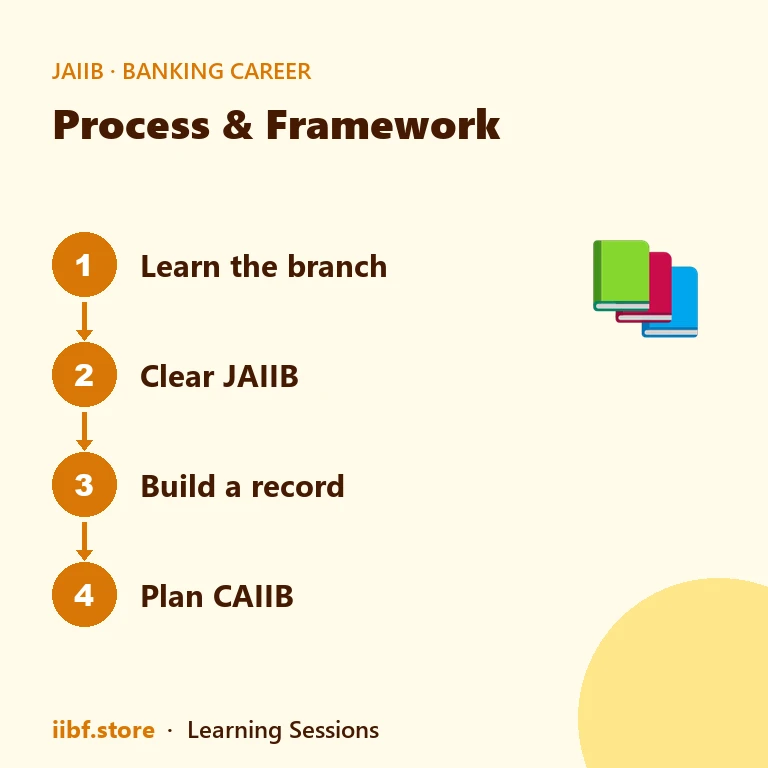
Concretely, that means four things running in parallel. Learn the branch properly — not just your desk but what happens at every other desk, because that context is what turns you from a processor into an officer. Clear JAIIB while the material still overlaps with what you are handling daily; the syllabus and the counter reinforce each other in a way they never will again. Build a visible record, which mostly means being the person whose files are clean when audit arrives. And start reading toward CAIIB before you need it.
For the studying itself, the constraint is never information, it is consistency. Short daily sessions with immediate self-testing beat weekend marathons; the practice tests are the fastest way to find out whether a chapter actually landed, and the planner keeps a schedule alive through the weeks when the branch runs long. When the day has drained you, the match drills still move definitions into place without demanding fresh concentration.
None of this makes the difficult parts disappear. Long days, transfers, targets and audit season are permanent features. But the bank job reality also includes things people rarely mention on the way in: a role that is genuinely respected in most towns, a skill set that stays relevant across your whole career, and a promotion path where the entrance requirements are written down and open to anyone willing to study. That is a rarer combination than it looks from inside month two.
Is a bank job as stable as people say?
Stability in banking is real but it is stability of employment, not of location or routine. Transfers, changing product pushes and evolving compliance requirements are normal. Plan for a career that stays secure while moving you around.
Do I have to clear JAIIB and CAIIB?
They are not universally compulsory, but at most institutions these qualifications feed directly into increments and promotion eligibility, which is why they are treated as near-essential in practice. Clearing them early is the cheapest version of that decision.
How bad are the sales targets really?
They are a standing part of the role rather than an occasional campaign. Officers who learn the products properly and measure their own effort rather than the customer's answer generally find targets manageable; those who rely on scripts find them draining.
When should a fresher start studying for JAIIB?
Year one, without much debate. Responsibilities are lightest then, the syllabus overlaps heavily with daily branch work, and JAIIB allows five attempts within three years of first registration — so starting early leaves room to recover from a bad sitting.
Prefer revising from a printed book?
Chapter-wise books with MCQs after every chapter — minimal pages, complete coverage, delivered anywhere in India. Every book has a free sample to read first.
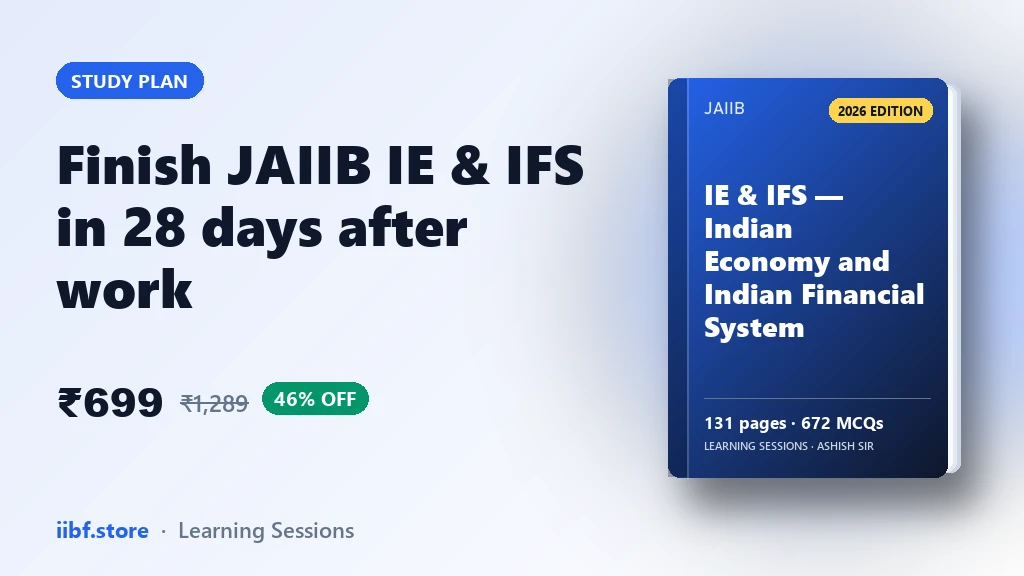
131 pages · 672 MCQs
Learning Sessions · Ashish Sir
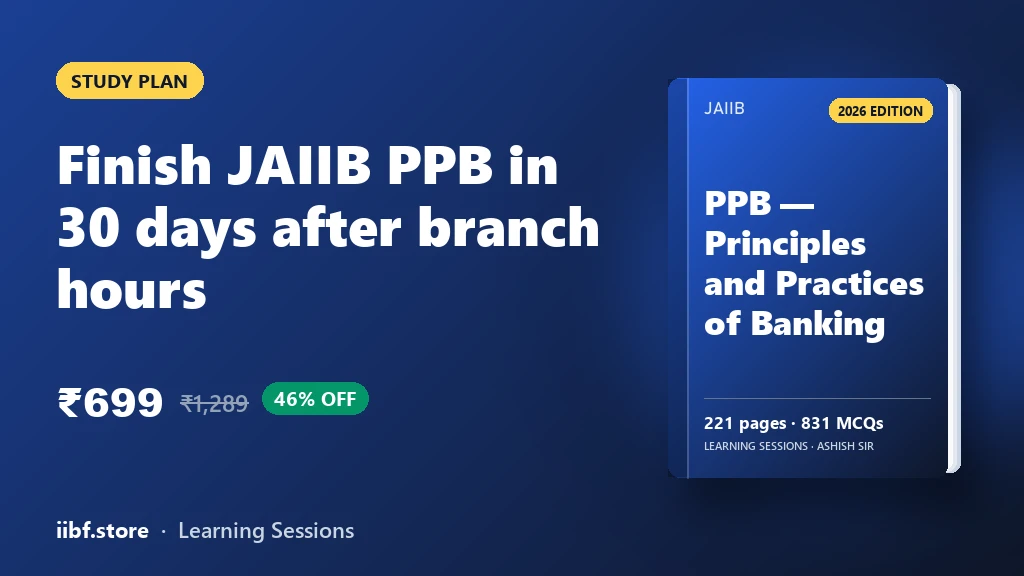
221 pages · 831 MCQs
Learning Sessions · Ashish Sir
128 pages · 524 MCQs
Learning Sessions · Ashish Sir
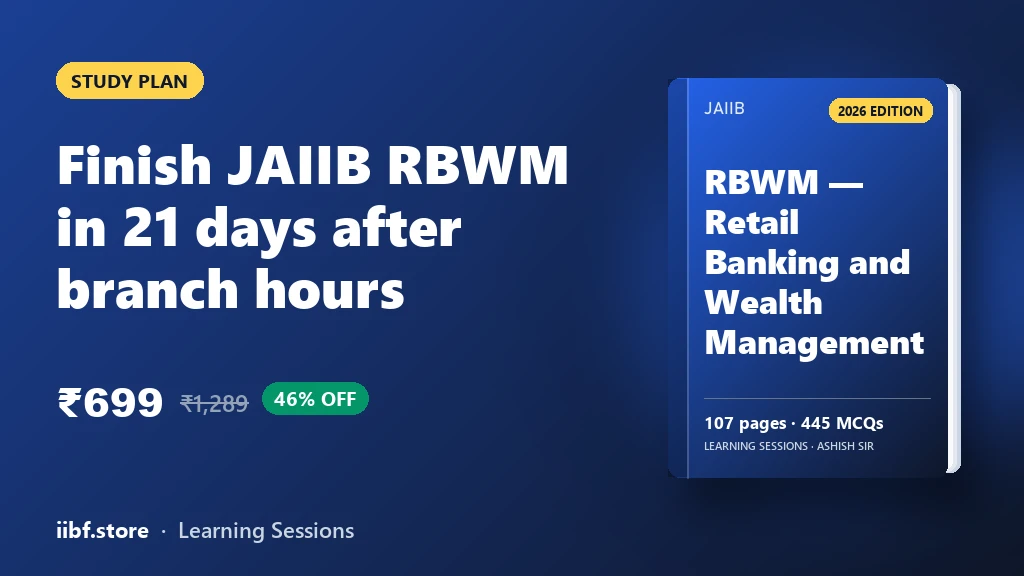
107 pages · 445 MCQs
Learning Sessions · Ashish Sir
148 pages · 478 MCQs
Learning Sessions · Ashish Sir
151 pages · 465 MCQs
Learning Sessions · Ashish Sir
148 pages · 375 MCQs
Learning Sessions · Ashish Sir
216 pages · 895 MCQs
Learning Sessions · Ashish Sir
109 pages · 300 MCQs
Learning Sessions · Ashish Sir
104 pages · 360 MCQs
Learning Sessions · Ashish Sir
82 pages · 297 MCQs
Learning Sessions · Ashish Sir
151 pages · 600 MCQs
Learning Sessions · Ashish Sir
98 pages · 282 MCQs
Learning Sessions · Ashish Sir
132 pages · 225 MCQs
Learning Sessions · Ashish Sir
188 pages · 435 MCQs
Learning Sessions · Ashish Sir
117 pages · 236 MCQs
Learning Sessions · Ashish Sir
Learning Sessions · Ashish Sir
118 pages · 299 MCQs
Learning Sessions · Ashish Sir
Learning Sessions · Ashish Sir
Learning Sessions · Ashish Sir
Learning Sessions · Ashish Sir
115 pages · 255 MCQs
Learning Sessions · Ashish Sir
Learning Sessions · Ashish Sir
334 pages · 936 MCQs
Learning Sessions · Ashish Sir
Learning Sessions · Ashish Sir
115 pages · 344 MCQs
Learning Sessions · Ashish Sir
107 pages · 240 MCQs
Learning Sessions · Ashish Sir
90 pages · 150 MCQs
Learning Sessions · Ashish Sir
Learning Sessions · Ashish Sir
Quick quiz on this topic
5 exam-style questions from our free test bank — check yourself before you move on.
Practice this topic
Take a free mock test, download chapter PDFs, or watch a video class — all included on iibf.store.