Treasury Management 2026: Forex, Money Markets and ALM
The bank treasury is where liquidity, interest-rate risk and foreign-exchange exposure are managed in real time, and where a bank earns or loses money the moment markets move. For candidates of the IIBF Certificate in Treasury Management, the syllabus is less about formulas and more about understanding how the treasury function connects the dealing room to the balance sheet. Strong treasury management turns a cost centre into a profit centre while keeping the bank within RBI prudential limits.
This guide focuses on the treasury function itself: the forex markets and nostro/vostro plumbing, the money-market instruments that fund and deploy short-term cash, the derivatives used to hedge, and the all-important interface with Asset-Liability Management (ALM). These are the exam favourites, and they are also exactly what a desk dealer or mid-office officer must know on day one.
We will keep everything India-specific and current to 2026, referencing RBI, FIMMDA and FEDAI conventions so your answers match the regulator's language rather than a generic textbook.
What the Treasury Function Actually Does
A bank treasury has three classic mandates: liquidity management, reserve management (CRR and SLR maintenance), and proprietary and customer trading across money, forex and securities markets. Modern treasury management in India sits inside an integrated treasury, where the rupee desk and the forex desk operate under one roof so that domestic and foreign-currency liquidity are managed together.
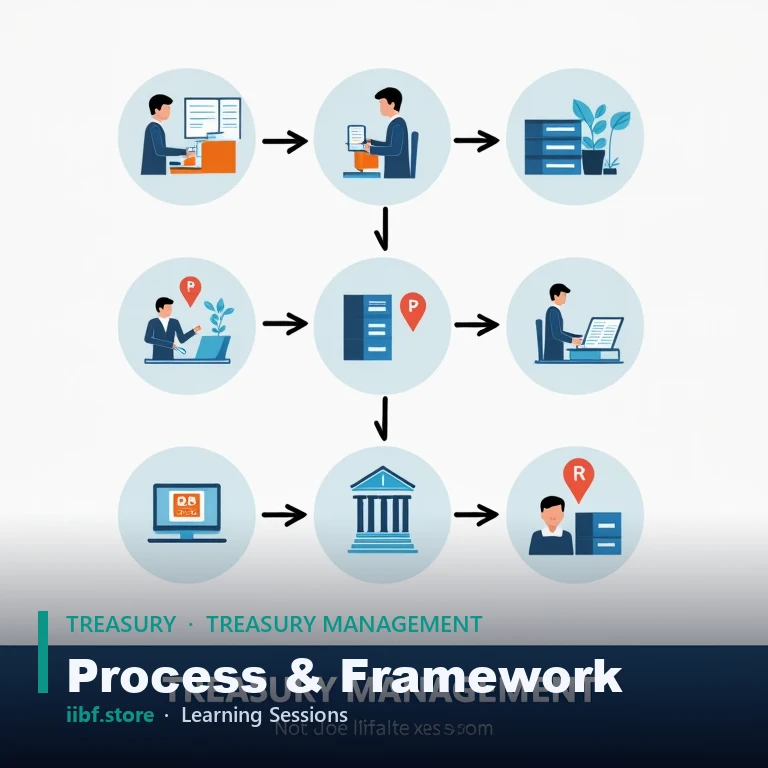
The treasury is organised into three independent layers to control risk:
- Front office (dealing room) — dealers quote, take positions and execute trades within board-approved limits.
- Mid office — measures and reports market risk, monitors limits (VaR, stop-loss, open position, aggregate gap) and is functionally separate from the front office.
- Back office — confirms, settles, reconciles nostro accounts and accounts for every deal.
This segregation of duties is a core exam point: the same person must never deal and settle. Treasury income comes from net interest income on the investment book, trading profits, and fee-based forex and derivative business. Candidates targeting the broader curriculum should also revisit the CAIIB syllabus, where treasury and risk topics reinforce each other.
Forex Markets, Nostro and Vostro Accounts
The foreign-exchange desk runs spot, forward and swap books, quoting two-way prices under FEDAI rules. In India the interbank market is INR-quoted as USD/INR, and the RBI reference rate is a daily benchmark. The mechanics of settlement rest on correspondent banking accounts, and the nostro/vostro distinction is a guaranteed exam question:
- Nostro account — "our account with you". An Indian bank's foreign-currency account held with a correspondent bank abroad (for example, a USD account in New York). All inward and outward dollar flows hit this account.
- Vostro account — "your account with us". A foreign bank's rupee account maintained with an Indian bank in India.
- Loro account — "their account", a third-party reference used in correspondence between two banks.
Treasury must keep nostro balances optimal: idle balances earn little, while overdrawn nostros attract cost and breach limits. Daily nostro reconciliation by the back office detects errors and frauds early. Forex risk is contained through the Net Open Position (NOP) and the Aggregate Gap Limit, both approved by the board and monitored by RBI. For live policy rates that feed forex and money-market pricing, dealers track the latest RBI rates every morning.

Money Market Instruments the Treasury Trades
The money market is where the treasury manages short-term surplus and deficit, all under one year. India's instruments are well defined by the RBI, and you should be able to list them with their issuers and tenors:
- Call, Notice and Term Money — uncollateralised interbank lending; call money is overnight, notice money is 2–14 days, term money beyond 14 days.
- Treasury Bills (T-Bills) — sovereign zero-coupon paper issued by RBI on behalf of the government in 91, 182 and 364-day tenors, sold at a discount.
- Cash Management Bills (CMBs) — ultra-short government paper for transient mismatches.
- Certificates of Deposit (CDs) — issued by banks; Commercial Paper (CP) — issued by corporates and primary dealers, minimum ₹5 lakh.
- Repo and Reverse Repo / TREPS — collateralised borrowing and lending, with TREPS on the CCIL platform being the dominant secured instrument.
Pricing in the rupee market is anchored to RBI's Liquidity Adjustment Facility (LAF) repo rate and the SDF, and benchmarks are published by FIMMDA. The treasury uses these instruments to maintain CRR/SLR while putting surplus cash to work. Practising numericals on yields and discounts in our IIBF mock tests is the fastest way to lock in these conventions.
Derivatives and the ALM Interface
Treasury hedges and positions itself using derivatives: Forward Rate Agreements (FRAs), Overnight Index Swaps (OIS) benchmarked to MIBOR, currency swaps and forwards, and exchange-traded interest-rate and currency futures and options. Derivatives let the desk transform a fixed-rate exposure into floating, or hedge a forward forex commitment, without churning the underlying book.
The crucial linkage for the exam is the treasury–ALM interface. The Asset-Liability Management Committee (ALCO) sets the bank's tolerance for liquidity and interest-rate risk; the treasury executes within it. Two measurement tools dominate:
- Structural liquidity statement — buckets all assets and liabilities by residual maturity; the net cumulative mismatch in the 1–14 day and 15–28 day buckets is capped (typically 20% of outflows).
- Interest-rate sensitivity (gap) and duration — measures how Net Interest Income and the economic value of equity move when rates shift, in line with Basel III interest-rate-risk-in-the-banking-book guidance.
When ALCO sees a funding gap, the treasury closes it through money-market borrowing, CD issuance or repo; when there is a duration mismatch, it uses OIS or restructures the investment book. Good treasury management therefore is not standalone trading — it is the execution arm of the ALM policy, balancing profit against the liquidity and rate risk the board is willing to bear. Reinforce these maturity-bucket concepts with the quick-recall drills in our match-the-pairs game.
Regulation, Risk and Recent Developments
Treasury operations run under a dense regulatory framework: FEMA 1999 governs forex, the RBI Master Directions on Risk Management and Interbank Dealings set position limits, and CCIL provides guaranteed settlement for forex, G-Secs and money markets. Basel III capital and the Liquidity Coverage Ratio (LCR) and Net Stable Funding Ratio (NSFR) directly shape how much high-quality liquid assets the treasury must hold. By 2026, electronic trading on platforms such as NDS-OM, FX-Retail and the RBI Retail Direct scheme has deepened market access, and the treasury's role in managing the LCR buffer of government securities has only grown. Staying current via IIBF news updates helps candidates quote the latest RBI circulars in their answers.
Frequently Asked Questions
What is the difference between a nostro and a vostro account?
A nostro account is "our account with you" — an Indian bank's foreign-currency account held with a correspondent bank abroad, such as a USD account in New York. A vostro account is "your account with us" — a foreign bank's rupee account maintained with an Indian bank in India. Both settle cross-border trades.
How does treasury management link to ALM?
The ALCO sets the bank's limits for liquidity and interest-rate risk through structural liquidity and gap statements. The treasury then executes within those limits, using money-market instruments and derivatives to close funding gaps and manage duration. So treasury is the execution arm of the ALM policy, not a standalone trading unit.
Which money market instruments does a bank treasury use?
The main instruments are call, notice and term money, Treasury Bills, Cash Management Bills, Certificates of Deposit, Commercial Paper, and collateralised repo/reverse repo and TREPS on CCIL. All have tenors under one year and help the treasury maintain CRR/SLR while deploying or raising short-term funds.
Why is segregation of front, mid and back office important?
The front office deals, the mid office independently measures and reports market risk against limits, and the back office confirms, settles and reconciles. Keeping them separate prevents a dealer from both transacting and settling, which controls operational risk and fraud — a core requirement in RBI's treasury risk-management guidelines.
Final Takeaways
Treasury management for the IIBF exam comes down to one storyline: the treasury runs forex and money markets, settles through nostro/vostro accounts, hedges with derivatives, and executes everything within the liquidity and interest-rate limits that ALM sets. Know the instruments, the account types, and the three-office control structure, and you can answer most questions confidently. Ready to test yourself? Take a focused mock on our IIBF practice tests and explore the full CAIIB and certificate courses to master treasury management before exam day.
Practice this topic
Take a free mock test, download chapter PDFs, or watch a video class — all included on iibf.store.