Call Money Market Operations in Bank Treasury Management
For any bank dealing room, the first phone call of the morning is usually about cash — not investments, not derivatives, just plain rupee liquidity. That is where call money market operations come in. This uncollateralized interbank segment lets banks lend or borrow surplus and deficit funds overnight, and it remains the anchor point RBI watches most closely when it reads short-term liquidity conditions in the system.
📊 What Is the Call Money Market?
The call money market is the segment of the money market where scheduled commercial banks, co-operative banks and primary dealers lend and borrow funds without any collateral, purely on the strength of interbank trust and RBI-prescribed prudential limits. It is the shortest end of the yield curve and the most liquid, because deals are struck and settled within the same working day.
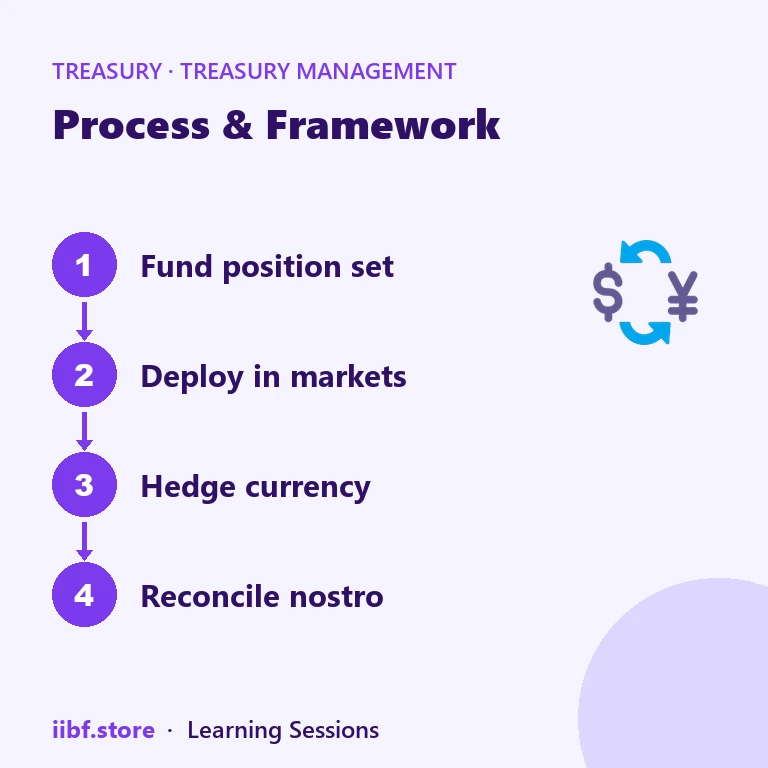
Strictly speaking, three related terms are often used together but mean different things. Call money is lending or borrowing for one working day (overnight). Notice money covers tenors from two to fourteen days, where either party can recall or repay the funds by giving prior notice. Term money extends beyond fourteen days up to a year, though in practice most treasury desks rarely go beyond three months in this uncollateralized segment.
Because there is no collateral backing these deals, a bank's call-money limit with any given counterparty is a pure credit exposure, sanctioned and monitored the same way a loan sanction would be — except the "loan" matures the next morning.
| Segment | Tenor | Collateral | Typical Use |
|---|---|---|---|
| Call money | Overnight (1 day) | ❌ None | Same-day cash squaring |
| Notice money | 2 to 14 days | ❌ None | Short liquidity gaps with recall option |
| Term money | 15 days to 1 year | ❌ None | Slightly longer funding, used sparingly |
| Repo / TREPS | Overnight to short tenor | ✅ G-Secs | Collateralized alternative for the same need |
💰 Role in Treasury Liquidity Management
Every bank's treasury runs a daily cash reconciliation exercise, netting inflows (repayments, government transactions, clearing settlements) against outflows (disbursements, remittances, statutory reserve maintenance). The call money desk is where the resulting surplus or deficit gets squared off within the day.
A bank running a temporary cash surplus lends in the call market rather than letting funds sit idle in its current account with RBI, earning at least a modest overnight return. A bank facing a shortfall — often because of an unexpected large debit or a reserve-maintenance crunch — borrows overnight rather than defaulting on a settlement obligation or falling short on its reserve requirement for that reporting day.
This function is inseparable from the treasury's day-to-day liquidity management. Dealers track the bank's projected cash position hour by hour, and the call desk is typically the last lever pulled before the books are closed for the day. Activity spikes are routine around reporting Fridays and financial year-end, when system-wide liquidity tightens and the call rate tends to move away from its usual band.
💡 Exam Tip: Call money is one of the very few money-market instruments where the transaction itself — not a security — is the underlying; there is no paper to value or mark to market, only a repayment obligation.
📈 Pricing: WACR and the LAF Corridor
The rate at which call money trades is a live, transaction-based number — not administered by RBI. It moves purely on demand and supply of overnight rupee funds among banks. The volume-weighted average of all call money deals struck on a given day is published as the Weighted Average Call Rate (WACR), and this is the operating target RBI's Monetary Policy Committee actually steers under the Liquidity Adjustment Facility (LAF) framework — the policy repo rate is the anchor, but WACR is what the operating framework tries to keep close to it.
RBI keeps WACR inside a corridor bounded by the Standing Deposit Facility rate at the floor and the Marginal Standing Facility rate at the ceiling, with the repo rate sitting between the two. When system liquidity is comfortable, WACR trades close to the repo rate; when liquidity turns tight, it drifts toward the ceiling, signalling that banks are bidding up for overnight funds.
Treasury dealers watch WACR every day because it is a real-time barometer of systemic liquidity, and because term-money and short-tenor deposit pricing are often benchmarked off it. A sudden, sustained rise in WACR relative to the repo rate is usually the first sign that durable liquidity has tightened before any formal RBI liquidity operation is announced.
🖥️ Participants, Limits and the Dealing-Room Process
Access to the call money market has been progressively narrowed since the late 1990s reforms. Today only scheduled commercial banks (excluding regional rural banks for lending, per the applicable eligibility norms), co-operative banks and primary dealers can both lend and borrow. Non-bank entities such as mutual funds, insurance companies and corporates — once active participants — were phased out and now operate mainly through the collateralized repo and TREPS segments instead.
Within a bank, the dealing room operates under counterparty exposure limits fixed by the Asset-Liability Management Committee: a maximum amount that can be lent to, or borrowed from, any single counterparty bank, reviewed periodically against that counterparty's credit standing. Dealers negotiate and confirm trades on the NDS-CALL platform, RBI's screen-based system for call, notice and term money, which replaced the older telephone-market and broker-driven process with an auditable, straight-through electronic trail.
Settlement happens the same day through the RBI's RTGS system, since call money by definition cannot wait for a T+1 cycle. The back office independently confirms every deal booked by the front office before funds move, which is the basic segregation-of-duties check that keeps a same-day, unsecured market safe to operate in.
⚠️ Common Mistake: Students often assume corporates or NBFCs can still lend or borrow in the call money market. They cannot — only banks, co-operative banks and primary dealers are eligible participants today.
🛡️ Risks and the Regulatory Framework
The dominant risk in call money lending is counterparty credit risk, since the exposure is entirely unsecured — if the borrowing bank were to fail before repayment, the lending bank has no collateral to fall back on. This is exactly why exposure ceilings, counterparty limits and daily monitoring by the treasury mid-office matter so much in this market, even though tenors are extremely short.
A second, more routine risk is rate volatility: because WACR is purely market-determined, it can swing sharply around quarter-end, advance-tax outflow dates and reserve-maintenance Fridays, and a treasury caught needing funds on such a day can end up paying well above the corridor midpoint.
RBI's regulatory architecture for this market sits within its broader money-market directions, which prescribe eligible participants, reporting formats and prudential limits, and are reviewed periodically to keep pace with system needs. Because the segment is unsecured and systemically sensitive, RBI has consistently nudged volumes toward the collateralized repo and TREPS markets over the years, while keeping call money open as the shock-absorber banks need for genuine overnight mismatches.
📌 Remember: Call money is unsecured; repo and TREPS are the collateralized alternatives for the same overnight liquidity need. Exam questions frequently test this distinction.
🧠 Practice MCQs: Call Money Market Operations
Q1. In the call money market, "call money" specifically refers to funds lent or borrowed for a tenor of: (a) Overnight (one working day) (b) 2 to 14 days (c) 15 to 90 days (d) Up to one year
Answer: (a) — Call money is strictly overnight; 2-14 days is notice money and beyond that up to a year is term money.
Q2. Notice money, as distinct from call money, covers a tenor of: (a) Only one day (b) 2 to 14 days (c) 15 to 30 days (d) 91 to 364 days
Answer: (b) — Notice money runs from two to fourteen days, with repayment triggered by prior notice from either party.
Q3. The rate that RBI's Monetary Policy Committee operationally targets to stay close to the repo rate under the LAF framework is the: (a) MCLR (b) EBLR (c) Weighted Average Call Rate (WACR) (d) 3-month T-Bill yield
Answer: (c) — WACR, the volume-weighted average rate on call money deals, is the operating target of the LAF framework.
Q4. Which of the following can currently both lend and borrow in the call money market? (a) Corporates and NBFCs (b) Mutual funds and insurance companies (c) Scheduled commercial banks and primary dealers (d) Retail individual depositors
Answer: (c) — Only banks, co-operative banks and primary dealers remain eligible; non-bank participants were phased out of this segment.
Q5. Call, notice and term money deals are negotiated and reported through which RBI electronic platform? (a) NDS-OM (b) CCIL forex settlement segment (c) NDS-CALL (d) Positive Pay System
Answer: (c) — NDS-CALL is RBI's screen-based negotiated dealing platform dedicated to the call, notice and term money segment.
Want chapter-wise mock tests with 100+ MCQs? Start practising free →
❓ Frequently Asked Questions
Is call money a secured or unsecured instrument?
Call money is entirely unsecured. There is no collateral backing the deal, which is why it is restricted to banks, co-operative banks and primary dealers, and run under strict counterparty exposure limits.
What is the difference between call money and repo?
Call money is an unsecured interbank loan for overnight or short tenors, while repo is a collateralized borrowing arrangement backed by government securities. Both meet similar overnight liquidity needs, but repo carries lower counterparty risk because of the collateral.
Why does the call rate spike around reporting Fridays?
Reporting Fridays are when banks must maintain their average cash reserve position for the fortnight. Demand for overnight funds rises sharply as banks scramble to meet the requirement, pushing WACR up within its corridor.
Who monitors counterparty limits for call money deals in a bank?
The treasury's mid-office, working off limits approved by the Asset-Liability Management Committee, monitors and enforces counterparty exposure ceilings for every bank the dealing room lends to or borrows from.
Building your treasury dealing-room foundations
Call money is where treasury theory meets the daily cash grind — get the tenor definitions, WACR mechanics and participant rules right, and a large share of scoring questions on this topic fall into place. Pair this with the broader Treasury Management PPT and the Treasury Operations – The Global Scenario chapter for the fuller dealing-room picture, then work through practice questions on swap points in forex treasury deals, cross currency swap in bank treasury and concurrent audit of treasury to round out the Treasury Management paper. If you are also revising Rural Banking, the article on the interest subvention scheme for crop loans is a useful cross-subject refresher. For RBI's own framing of money-market operations and the LAF corridor, see the Reserve Bank of India website. Browse more topics on the Treasury Management tag hub, or head to the CAIIB course page to plan your full syllabus.
Prefer revising from a printed book?
Chapter-wise books with MCQs after every chapter — minimal pages, complete coverage, delivered anywhere in India. Every book has a free sample to read first.
Learning Sessions · Ashish Sir
132 pages · 225 MCQs
Learning Sessions · Ashish Sir
188 pages · 435 MCQs
Learning Sessions · Ashish Sir
117 pages · 236 MCQs
Learning Sessions · Ashish Sir
Learning Sessions · Ashish Sir
118 pages · 299 MCQs
Learning Sessions · Ashish Sir
Learning Sessions · Ashish Sir
Learning Sessions · Ashish Sir
115 pages · 255 MCQs
Learning Sessions · Ashish Sir
Learning Sessions · Ashish Sir
334 pages · 936 MCQs
Learning Sessions · Ashish Sir
Learning Sessions · Ashish Sir
115 pages · 344 MCQs
Learning Sessions · Ashish Sir
107 pages · 240 MCQs
Learning Sessions · Ashish Sir
90 pages · 150 MCQs
Learning Sessions · Ashish Sir
Learning Sessions · Ashish Sir
131 pages · 672 MCQs
Learning Sessions · Ashish Sir
221 pages · 831 MCQs
Learning Sessions · Ashish Sir
128 pages · 524 MCQs
Learning Sessions · Ashish Sir
107 pages · 445 MCQs
Learning Sessions · Ashish Sir
148 pages · 478 MCQs
Learning Sessions · Ashish Sir
151 pages · 465 MCQs
Learning Sessions · Ashish Sir
148 pages · 375 MCQs
Learning Sessions · Ashish Sir
216 pages · 895 MCQs
Learning Sessions · Ashish Sir
109 pages · 300 MCQs
Learning Sessions · Ashish Sir
104 pages · 360 MCQs
Learning Sessions · Ashish Sir
82 pages · 297 MCQs
Learning Sessions · Ashish Sir
151 pages · 600 MCQs
Learning Sessions · Ashish Sir
98 pages · 282 MCQs
Learning Sessions · Ashish Sir
Practice this topic
Take a free mock test, download chapter PDFs, or watch a video class — all included on iibf.store.