Swap Points in Forex Treasury Deals: IIBF Treasury Guide
Every forward foreign exchange deal a bank books starts from the spot rate and then applies swap points in forex treasury deals to arrive at the forward rate that a customer, or the interbank market, actually pays. These points are not a guess about where the exchange rate is headed — they mechanically capture the interest-rate gap between the two currencies for the exact period of the deal. For IIBF Treasury Management candidates, knowing how a dealing room derives, quotes and covers swap points is central to questions on forward pricing, buy-sell swaps and treasury risk control.
💱 What Are Swap Points in a Forex Treasury Deal
Swap points are the difference between the forward rate and the spot rate for a currency pair, usually quoted in pips or paise rather than as a full exchange rate. Added to spot, they give the forward rate at a premium; subtracted, they give a forward rate at a discount. Crucially, swap points are not a forecast of the future spot rate — they are an arbitrage-free number derived entirely from the interest-rate differential between the two currencies for that tenor.
Take USD/INR. When domestic money-market rates run above US dollar rates, the dollar trades forward at a premium to the rupee — the forward quote sits above spot. If that gap narrows or reverses, the premium shrinks or even flips to a discount. A treasury's front office builds a full swap-points curve — cash, tom, spot, and standard tenors out to a year — and this curve feeds directly into merchant card rates, a topic covered in depth under Interest Rate Quotations and Market Terminology.
📈 How Swap Points Are Calculated
The underlying logic is covered interest rate parity: the forward rate must equal the spot rate adjusted for the ratio of the two currencies' money-market rates over the deal period, so no risk-free arbitrage is possible between borrowing in one currency, investing in the other at spot, and covering back through the forward market. In dealing-room shorthand, swap points are approximately the spot rate multiplied by the interest-rate differential and the tenor in days.
💡 Exam Tip: Remember the direction rule as "higher-interest currency trades at a forward discount, lower-interest currency trades at a forward premium" — apply it to whichever currency has the higher domestic rate, not always to INR.
Dealers use observable money-market benchmarks as proxies for each leg — domestic call money, CDs and Treasury Bills for the rupee leg, the relevant offshore benchmark for the foreign leg — feeding a swap-points curve the front office marks fresh through the day.
🏦 Reading a Swap Points Quote: Premium and Discount
Swap points are quoted two-way, for example "45/48," and the convention that tells a dealer whether to add or subtract is the ordering of the two numbers, not their sign. If the bid is smaller than the offer, the currency is at a premium and the points are added to spot for both legs. If the bid is larger than the offer, the currency is at a discount and the points are subtracted. Getting this reversed is one of the most common errors candidates make under exam pressure.
⚠️ Common Mistake: Candidates often assume swap points are always added to spot. Whether they are added or subtracted depends entirely on which currency carries the higher interest rate — always check premium versus discount before applying the points.
An illustrative, not live, swap points ladder fixes the pattern used in dealing rooms:
| Tenor | Spot Rate | Swap Points | Forward Rate | Premium / Discount |
|---|---|---|---|---|
| Spot | 83.00 | — | 83.00 | — |
| 1 Month | 83.00 | +18 paise | 83.18 | ✅ Premium |
| 3 Month | 83.00 | +52 paise | 83.52 | Premium |
| 6 Month | 83.00 | +95 paise | 83.95 | Premium |
| Hypothetical inverted curve | 83.00 | -20 paise | 82.80 | ❌ Discount |
🔄 Swap Points in Buy-Sell and Sell-Buy Swaps
A forex swap combines two simultaneous legs — typically a spot deal and an offsetting forward, or two forwards of different maturities — in the same currency pair. A "buy-sell" swap buys the near leg and sells the far leg; a "sell-buy" swap does the reverse. Treasury desks use these constantly to fund a temporary nostro shortfall, park surplus foreign currency, or roll over an existing forward contract to a later value date without disturbing the underlying commercial exposure, a mechanic explored further under the Swap chapter.
Because both legs execute against the same counterparty, a forex swap carries no net currency exposure — the bank is neither long nor short the foreign currency once both legs settle. What it does carry is swap risk: the cost or gain is fixed entirely by the points applied to the near and far legs, so rolling a forward book at unfavourable points absorbs that cost straight into the trading result, a mechanic reinforced by the dealing-room discipline behind straight through processing in treasury.
⚖️ Swap Points, Cover Operations and Treasury Risk Management
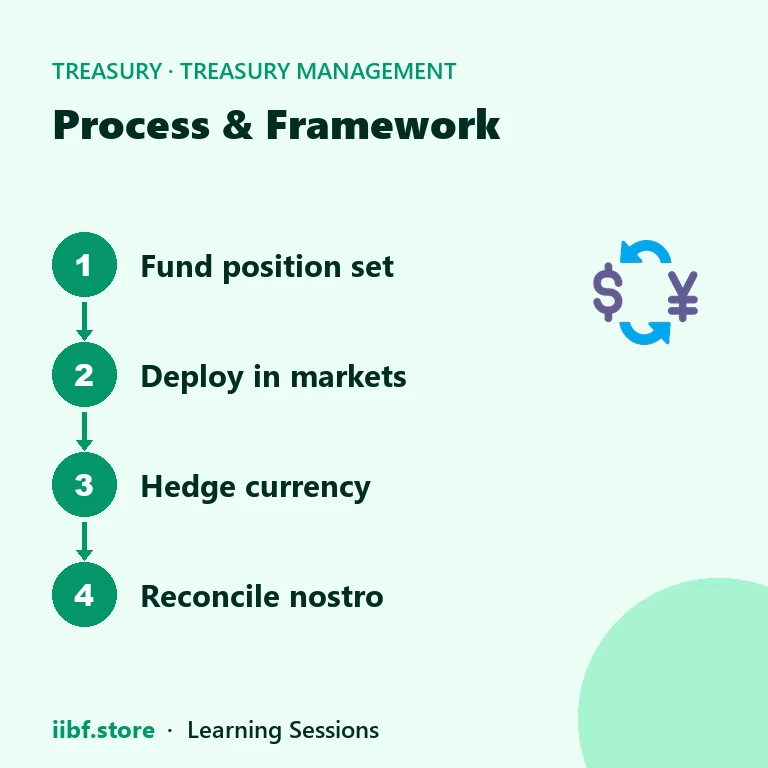
When the front office quotes a forward rate to a corporate customer, the merchant rate is built as spot plus (or minus) swap points plus a dealing margin. Once the deal is struck, treasury covers the resulting exposure in the interbank market — through CCIL's forex-swap segment or bilaterally — at the swap points prevailing at that moment. Any gap between the rate quoted to the customer and the rate at which the position is actually covered becomes the treasury's realised profit or loss on that transaction.
📌 Remember: Swap points measure an interest-rate differential, not a currency view — a treasury desk running an uncovered forward book is really running an interest-rate mismatch, not a speculative FX position.
Middle office monitors the swap-points curve for volatility and gap risk across maturity buckets, and every deal must sit within board-approved treasury risk limits and be reported per RBI and FEDAI conventions on value dates, a governance layer detailed under Regulations, Supervision and Compliance of Treasury Operations. RBI's own framework for inter-bank forex dealings is set out in its Master Directions on foreign exchange.
🧠 Practice MCQs: Swap Points in Forex Treasury Deals
Q1. Swap points in a forex treasury deal primarily represent: (a) A forecast of future spot rate movement (b) The bid-ask spread of the interbank market (c) The interest-rate differential between the two currencies for the deal tenor (d) A regulatory margin fixed by FEDAI
Answer: (c) — Swap points are derived from covered interest rate parity and reflect only the interest-rate gap between the two currencies, not a market view on direction.
Q2. If the swap points quote for a currency pair is "20/24" and the bid is smaller than the offer, the currency is trading at: (a) A forward discount, points subtracted (b) A forward premium, points added (c) Par, no adjustment needed (d) A speculative markup set by the dealer
Answer: (b) — When the bid is smaller than the offer, the currency is at a premium and the swap points are added to the spot rate to derive the forward rate.
Q3. In a "buy-sell" forex swap, the near leg and far leg of the deal are: (a) Both purchases, at different rates (b) A purchase followed by a sale of the same currency pair (c) Unrelated deals with different counterparties (d) Always settled on the same value date
Answer: (b) — A buy-sell swap buys the currency on the near value date and sells the same amount back on the far value date, with the cost/gain set by the swap points.
Q4. A treasury desk that books a forward cover for a customer and later covers it in the interbank market at different swap points than quoted will show: (a) No impact, since the currency position is squared (b) A realised profit or loss driven purely by the swap-points gap (c) A regulatory violation requiring RBI reporting (d) An automatic adjustment through CCIL settlement
Answer: (b) — Since both legs neutralise the currency exposure, only the difference between the quoted and covered swap points drives the treasury's trading result.
Q5. Swap points for a currency are least likely to be influenced by: (a) Domestic money-market interest rates (b) Offshore benchmark interest rates for the foreign currency (c) The tenor of the forward contract (d) The customer's stated reason for booking the forward
Answer: (d) — Swap points are a function of interest-rate differentials and tenor; the commercial purpose behind a customer's forward booking has no bearing on the points applied.
Want chapter-wise mock tests with 100+ MCQs? Start practising free →
❓ Frequently Asked Questions
Are swap points the same as a forward premium or discount?
Yes — "forward premium" and "forward discount" simply describe the direction in which swap points are applied. Premium means the points are added to spot; discount means they are subtracted.
Why does a treasury need to cover a forward deal in the interbank market?
Quoting a forward to a customer creates a currency and interest-rate exposure for the bank. Covering the deal in the interbank market at prevailing swap points squares that exposure, leaving only the margin the bank earned on the quote.
Do swap points change during the trading day?
Yes. Because they are derived from money-market interest rates for both currencies, swap points move whenever the underlying domestic or offshore rates move, so dealing rooms re-mark them continuously.
How are swap points different from an outright forward rate?
The outright forward rate is the full exchange rate a customer sees on the deal. Swap points are only the adjustment component — the outright rate equals the spot rate plus or minus the swap points for that tenor.
Master the treasury forex curve — one chapter at a time
Swap points sit at the intersection of money markets, forex dealing and treasury risk control — exactly the linkage IIBF exams test. For a broader view, see cross currency swap in bank treasury and overnight indexed swap in India, or step outside treasury to compare with job evaluation methods in banks from the HRM elective. Browse every article in this area on the Treasury Management tag hub, and for live reference rates while you revise, check RBI rates.
Prefer revising from a printed book?
Chapter-wise books with MCQs after every chapter — minimal pages, complete coverage, delivered anywhere in India. Every book has a free sample to read first.
Learning Sessions · Ashish Sir
132 pages · 225 MCQs
Learning Sessions · Ashish Sir
188 pages · 435 MCQs
Learning Sessions · Ashish Sir
117 pages · 236 MCQs
Learning Sessions · Ashish Sir
Learning Sessions · Ashish Sir
118 pages · 299 MCQs
Learning Sessions · Ashish Sir
Learning Sessions · Ashish Sir
Learning Sessions · Ashish Sir
115 pages · 255 MCQs
Learning Sessions · Ashish Sir
Learning Sessions · Ashish Sir
334 pages · 936 MCQs
Learning Sessions · Ashish Sir
Learning Sessions · Ashish Sir
115 pages · 344 MCQs
Learning Sessions · Ashish Sir
107 pages · 240 MCQs
Learning Sessions · Ashish Sir
90 pages · 150 MCQs
Learning Sessions · Ashish Sir
Learning Sessions · Ashish Sir
131 pages · 672 MCQs
Learning Sessions · Ashish Sir
221 pages · 831 MCQs
Learning Sessions · Ashish Sir
128 pages · 524 MCQs
Learning Sessions · Ashish Sir
107 pages · 445 MCQs
Learning Sessions · Ashish Sir
148 pages · 478 MCQs
Learning Sessions · Ashish Sir
151 pages · 465 MCQs
Learning Sessions · Ashish Sir
148 pages · 375 MCQs
Learning Sessions · Ashish Sir
216 pages · 895 MCQs
Learning Sessions · Ashish Sir
109 pages · 300 MCQs
Learning Sessions · Ashish Sir
104 pages · 360 MCQs
Learning Sessions · Ashish Sir
82 pages · 297 MCQs
Learning Sessions · Ashish Sir
151 pages · 600 MCQs
Learning Sessions · Ashish Sir
98 pages · 282 MCQs
Learning Sessions · Ashish Sir
Practice this topic
Take a free mock test, download chapter PDFs, or watch a video class — all included on iibf.store.