The Compliance Function in Banks: RBI's Framework Explained
The compliance function in banks is the independent control that ensures an institution obeys laws, regulations, supervisory directions and its own internal codes. In an era of heavy penalties, reputational risk and complex regulation, the RBI has elevated this function from a back-office checklist to a board-level discipline. For candidates pursuing the Certified Banking Compliance Professional and other IIBF qualifications. Understanding the compliance function in banks, the role of the Chief Compliance Officer, and the RBI's compliance framework is foundational.
This article explains how the function is structured, what compliance risk means, and the governance scaffolding the RBI mandates to keep it independent and effective.
Why compliance matters in modern banking
Banks operate under a dense web of statutes such as the Banking Regulation Act 1949. The RBI Act 1934, the Prevention of Money Laundering Act 2002 and a continuous stream of RBI master directions. A lapse in any of these can trigger monetary penalties, business restrictions, or reputational damage that erodes depositor trust. The compliance function in banks exists precisely to anticipate and prevent such failures rather than merely react to them.
Compliance is sometimes confused with audit, but the two differ. Audit reviews controls after the fact; compliance is a forward-looking, day-to-day function embedded in business processes that interprets new regulation, advises management, and ensures policies translate into practice. A strong compliance culture, set by the tone at the top, reduces the likelihood of mis-selling, regulatory breaches and conduct failures. The RBI views compliance as a core element of corporate governance, not a discretionary overhead. Keep abreast of fresh circulars through the IIBF news and updates page.
RBI's compliance framework and the CCO
In September 2020. The RBI issued a comprehensive circular on the compliance function and the role of the Chief Compliance Officer (CCO) in banks, harmonising practices across the system. Under this framework, every bank must have an independent compliance function headed by a CCO of sufficient seniority. The compliance function in banks must be adequately staffed, resourced and insulated from business pressures.
Key features of the framework include:
- Independence: the CCO reports to the MD and CEO or to the board/board committee, and the function is separate from business lines.
- Fixed tenure: the CCO is appointed for a minimum tenure (not less than three years) and can be removed only with board approval and, in some cases, prior intimation to the RBI.
- Seniority and stature: the CCO should be at least two levels below the CEO and possess the standing to challenge business decisions.
- No conflicting duties: the CCO should not be given responsibilities, such as business targets, that compromise independence.

Responsibilities of the compliance department
The day-to-day work of the compliance function in banks spans a wide canvas. It identifies and assesses the compliance risk the bank faces. Advises senior management on regulatory developments, and drafts or vets internal policies to align them with external rules. It disseminates regulatory changes across the organisation, conducts compliance testing of high-risk areas, and tracks the timely submission of statutory and regulatory returns.
The department also serves as the principal point of contact with the regulator, coordinating inspections and ensuring that supervisory observations are remediated. It maintains a compliance manual, runs training and awareness programmes, and reports periodically to the board on the bank's compliance health, including breaches, near-misses and remedial action. Increasingly, compliance officers leverage technology (RegTech) to monitor transactions and flag anomalies at scale, automating the surveillance of large volumes of accounts that no manual team could review in full. Aspiring compliance professionals can build this skill set through the CAIIB course and gauge their progress with targeted mock tests.
Compliance risk and its management
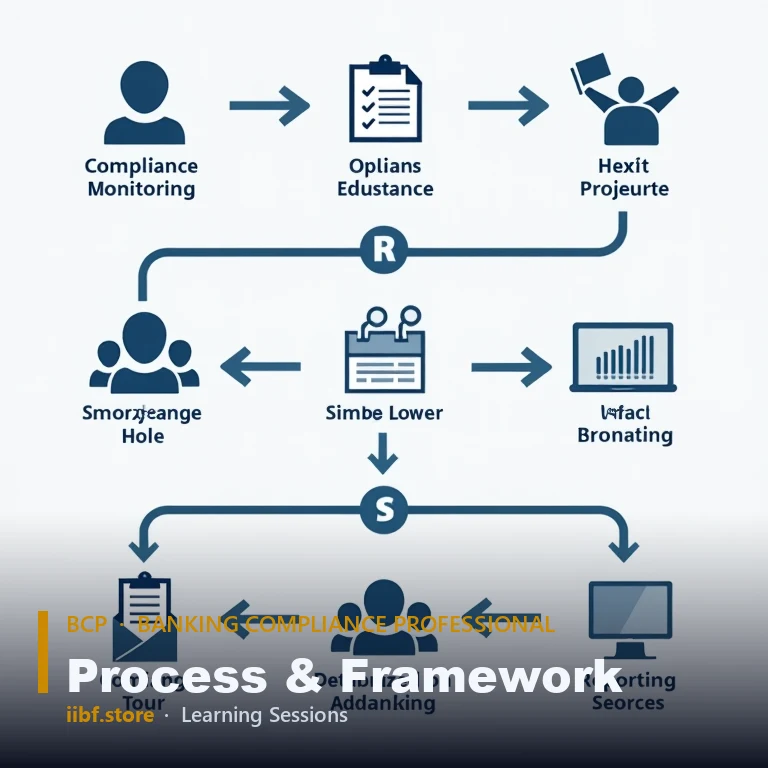
Compliance risk is the risk of legal or regulatory sanctions. Material financial loss, or reputational damage a bank may suffer from failing to comply with laws, regulations and codes of conduct. Managing it follows a continuous cycle: identify applicable obligations. Assess the inherent and residual risk, monitor through testing and key risk indicators, report to management and the board, and remediate gaps.
A robust compliance risk framework is documented in a board-approved policy, refreshed at least annually, and supported by a compliance risk assessment that prioritises high-impact areas such as anti-money laundering, KYC, customer protection and fair-practices codes. The compliance function in banks works closely with risk management and audit under the well-known "three lines of defence" model, where business owns risk in the first line, compliance and risk form the second, and internal audit provides independent assurance in the third. The authoritative source for these expectations is the RBI itself at rbi.org.in.

Building a compliance culture for the exam and the branch
Examiners often probe the difference between compliance and audit, the independence safeguards for the CCO, and the elements of compliance risk. A practical way to retain these distinctions is active recall: use the match-the-concept game to pair each duty with the right function, and read scenario explainers on the iibf.store blog. In the branch, the same principles translate into vigilant KYC, accurate regulatory reporting and prompt escalation of any breach, all of which protect both the customer and the institution. A useful mental model is to treat every new product, process or circular as a compliance checkpoint: ask which laws apply, who owns the control, and how a breach would be detected and reported. Banks that embed this habit at every level rarely face the large enforcement actions that make headlines, because problems are caught and fixed while they are still small and inexpensive to remedy.
Conclusion
The compliance function in banks, anchored by an independent Chief Compliance Officer and the RBI's 2020 framework, is central to sound governance and to the IIBF compliance syllabus. Master the structure, responsibilities and risk cycle, and you will be equipped both to clear the exam and to strengthen compliance in practice. Remember that the regulator increasingly judges a bank not only by whether it broke a rule but by whether its compliance function was independent, resourced and proactive enough to have prevented the breach. Start sharpening now with the full question bank at iibf.store/tests.
What is the compliance function in banks?
It is an independent control function that ensures the bank adheres to all applicable laws, regulations, supervisory directions and internal codes. It is forward-looking, advising management and embedding compliance into daily operations rather than merely auditing after the fact.
Who is the Chief Compliance Officer (CCO)?
The CCO is the senior executive heading the compliance function. Appointed under RBI's 2020 framework for a minimum tenure of three years, reporting to the MD/CEO or board, and insulated from business targets to preserve independence.
How does compliance differ from internal audit?
Compliance is a forward-looking, day-to-day function that interprets regulation and prevents breaches, while audit is an independent, after-the-fact review of controls. In the three-lines model, compliance is the second line and audit the third.
What is compliance risk?
Compliance risk is the risk of legal or regulatory penalties. Financial loss or reputational damage arising from a failure to comply with laws, regulations and codes of conduct. It is managed through a cycle of identify, assess, monitor, report and remediate.
Free Revision PDFs — One-Liners & True/False
Printable last-minute revision sheets for The Compliance Function in Banks: RBI's Framework Explained: 20 quick-fire one-liners and 20 true/false questions, each with answers & explanations. Free to download and share.
Practice this topic
Take a free mock test, download chapter PDFs, or watch a video class — all included on iibf.store.
Keep reading