BPLR to Base Rate to MCLR to EBLR: The Lending Rate Story

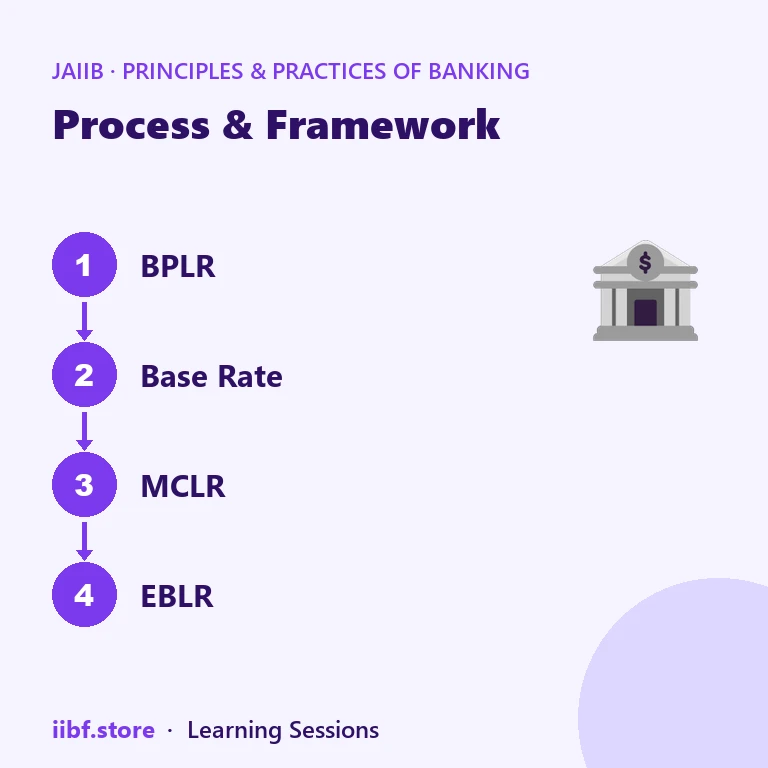
Four names, roughly twenty years, one unresolved problem. India has cycled through four generations of lending rate benchmarks - BPLR, Base Rate, MCLR and now EBLR - and each generation was introduced because the previous one was being worked around. Learn the sequence as a story of failures rather than a list of definitions and the whole topic becomes almost impossible to forget, which is exactly what you want the night before the exam.
EBLR, Base Rate and BPLR · Watch on YouTube
Generation one: the Benchmark Prime Lending Rate
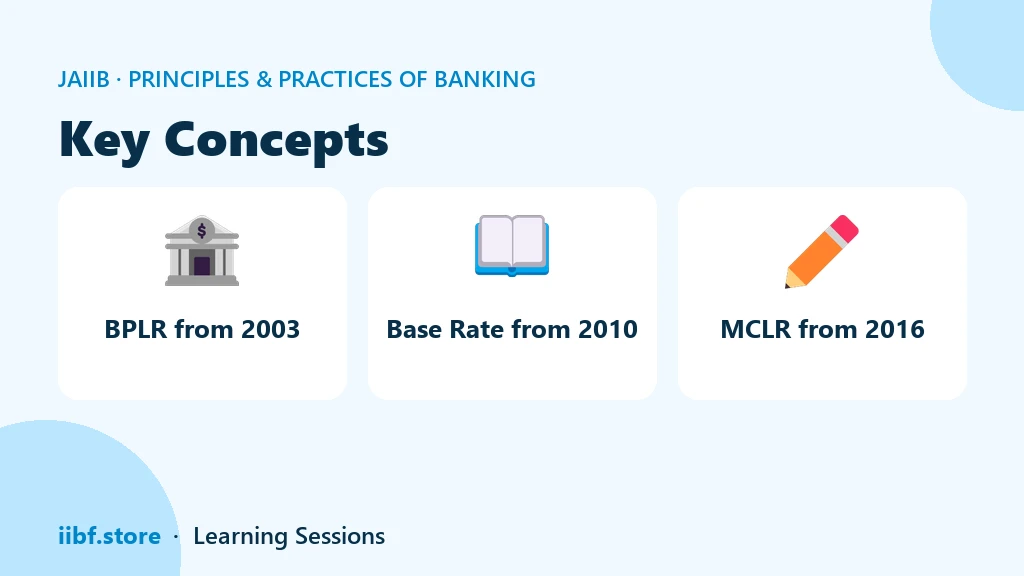
The BPLR system arrived in 2003. The idea was that each bank would declare a single prime rate for its most creditworthy borrowers, and everyone else would be priced above it. Clean in theory.
In practice it collapsed almost immediately, because banks were permitted to lend below BPLR. Sub-BPLR lending grew until the majority of a typical bank's loan book sat under the declared prime rate, which made the prime rate meaningless as a reference point. Two consequences followed. Small borrowers, who had no negotiating power, ended up cross-subsidising large corporates who did. And because the headline number no longer described real pricing, nobody could tell whether a policy rate cut had actually been passed on.
Generation two: the Base Rate
The Base Rate system took effect from 1 July 2010, and it fixed the one obvious flaw: it became a genuine floor. No bank could lend below its declared Base Rate except for a short list of specified exemptions - staff loans, loans against a bank's own deposits, and certain government-sponsored schemes among them.
Its components were the cost of funds, operating expenses, the negative carry on the CRR and SLR balances, and a profit margin. Note the word "average" hiding in the cost-of-funds calculation - banks generally used average cost, which is slow-moving by construction. A cut in the policy rate touches new deposits first and takes quarters to work through an average. That single design choice is why the Base Rate transmitted so poorly, and it is the reason the third generation exists.
Generation three: MCLR
From 1 April 2016, all floating rate rupee loans sanctioned by banks had to be priced off the marginal cost of funds based lending rate. The fix was surgical: replace average cost of funds with marginal cost of funds - the cost of the next rupee the bank raises, which reacts to policy changes far more quickly.
MCLR is assembled from four elements. The marginal cost of funds itself, weighted 92 per cent to the marginal cost of borrowings and 8 per cent to the return on net worth. The negative carry on the CRR. Operating costs. And a tenor premium, which is uniform across borrowers and is why banks publish MCLR separately for overnight, one-month, three-month, six-month and one-year tenors.
It transmitted better than the Base Rate. It still did not transmit well enough, and it was still a number the bank computed about itself. The RBI's Internal Study Group, whose report was released in October 2017 for public comment, concluded that internal benchmarks including the Base Rate and MCLR had failed to deliver effective transmission, and recommended moving to an external benchmark in a time-bound manner.
Generation four: EBLR
RBI circular DBR.DIR.BC.No.14/13.03.00/2019-20 dated 4 September 2019 required banks to link new floating rate personal or retail loans and floating rate loans to micro and small enterprises, sanctioned from 1 October 2019, to an external benchmark. Medium enterprises were brought in from 1 April 2020.
The permitted benchmarks are the RBI policy repo rate, the Government of India three-month or six-month Treasury Bill yield published by FBIL, or any other benchmark market interest rate published by FBIL. The benchmark must be reset at least once in three months. The spread is the bank's, but the credit risk premium can move only on a substantial change in the borrower's credit assessment, and the remaining spread components only once in three years.
The break with the past is structural rather than arithmetical. For the first time the reference rate is published by somebody other than the lender, so a borrower can verify it without taking the bank's word for anything.
All four generations at a glance
| Generation | Effective from | Core basis | Fatal weakness |
|---|---|---|---|
| BPLR | 2003 | Bank-declared prime rate | Below-BPLR lending made the benchmark meaningless |
| Base Rate | 1 July 2010 | Average cost of funds; a hard floor | Average cost moves too slowly to transmit policy |
| MCLR | 1 April 2016 | Marginal cost of funds plus tenor premium | Still internal; long reset intervals of up to a year |
| EBLR | 1 October 2019 | External benchmark plus a constrained spread | Passes rate hikes on as fast as cuts |
Read the table downwards and the direction of travel is unmistakable. Each generation of lending rate benchmarks moved control a little further away from the lender and a little closer to something observable. Today's policy rates are published on the RBI website and mirrored on our rates reference page.
How this is examined
Questions on lending rate benchmarks appear in JAIIB Principles and Practices of Banking and again in CAIIB when transmission and interest rate risk come up. From experience, four things are worth memorising cold:
- The four effective dates: 2003, 1 July 2010, 1 April 2016, 1 October 2019.
- Base Rate uses average cost of funds; MCLR uses marginal cost. One-word difference, frequent question.
- The 92:8 split inside the marginal cost of funds.
- EBLR reset is "at least once in three months" - a maximum lag, not a fixed schedule.
Everything else can be reconstructed from the story. Then drill it: our chapter tests carry the numerical variants, and the study planner will fit this module around the heavier chapters if you are targeting the December attempt.
Frequently asked questions
Are BPLR and Base Rate loans still around?
A small residue remains on the books of some banks, mostly older accounts that were never migrated. The RBI has repeatedly urged migration to the current framework, but the legacy accounts are what keep all four generations of lending rate benchmarks alive in the syllabus.
What was the single biggest problem with BPLR?
Banks could lend below it. Sub-BPLR lending became the norm, so the declared prime rate stopped describing actual pricing, and small borrowers effectively subsidised large ones.
Why did MCLR replace the Base Rate so soon?
Because the Base Rate relied on the average cost of funds, which moves slowly by construction. MCLR switched to the marginal cost - the cost of the next rupee raised - which responds to policy rate changes much faster.
Is EBLR the final answer?
It is the current framework and the most transparent of the lending rate benchmarks so far, but it is not costless. Because transmission is symmetric, borrowers feel rate hikes just as quickly as cuts, which is why the RBI's August 2023 instructions require banks to offer options, including a fixed rate switch, at the time of reset.
Quick quiz on this topic
5 exam-style questions from our free test bank — check yourself before you move on.
Practice this topic
Take a free mock test, download chapter PDFs, or watch a video class — all included on iibf.store.
Keep reading