EBLR Benchmark Rate: How Your Floating Loan Reprices
Most people can recite that their home loan is "linked to repo", and then stop. The interesting question is the mechanical one: once the RBI announces a cut, what exactly has to happen inside the bank before your EMI changes? The EBLR benchmark rate answers that, and it answers it with a rulebook rather than a promise. Understanding how the EBLR benchmark rate reprices is the difference between knowing a definition and being able to explain a loan account to a customer standing in front of you.
EBLR benchmark rate kaise kaam karta hai · Watch on YouTube
The two halves of every EBLR loan
Every externally benchmarked loan is built from exactly two pieces, and keeping them separate in your head solves most of the confusion. There is the benchmark, which the bank does not control and cannot smooth, and there is the spread, which the bank sets once and then may adjust only under tightly defined conditions. Your lending rate is simply the sum of the two.
The framework arrived through RBI circular DBR.DIR.BC.No.14/13.03.00/2019-20 dated 4 September 2019. It applied to new floating rate personal or retail loans and to floating rate loans to micro and small enterprises sanctioned on or after 1 October 2019, and was extended to medium enterprises with effect from 1 April 2020. Before that, banks priced these loans off internal benchmarks that they themselves computed.
The four permitted benchmarks
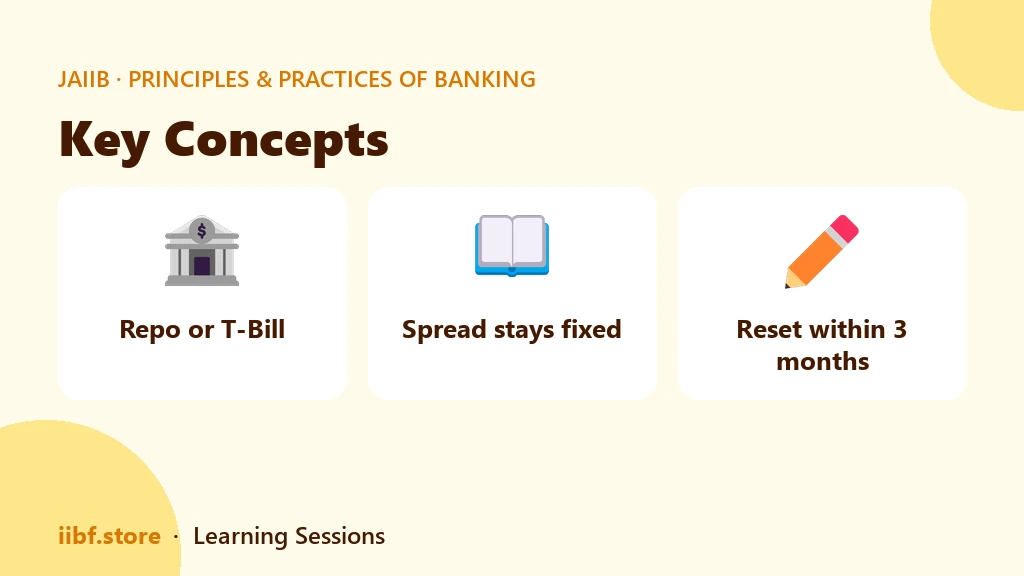
A bank cannot invent its own external benchmark. The circular lists four options, and a bank must choose from them:
- The RBI policy repo rate.
- The Government of India three-month Treasury Bill yield published by Financial Benchmarks India Private Limited (FBIL).
- The Government of India six-month Treasury Bill yield published by FBIL.
- Any other benchmark market interest rate published by FBIL.
In practice the overwhelming majority of Indian retail loans sit on the repo rate, which is why "repo linked lending rate" and EBLR are used almost interchangeably in branch conversation. Strictly they are not synonyms - RLLR is one species of the wider EBLR benchmark rate family.
One more requirement is easy to miss and frequently examined: a bank must adopt a uniform external benchmark within a loan category. It cannot price one home loan off repo and the next off a T-Bill yield because the customer negotiated harder.
What the spread can and cannot do
The spread is where a bank expresses its own economics - operating cost, business strategy and, most importantly, the credit risk premium reflecting how risky this particular borrower is. At sanction the bank is free to decide it. After that, two locks apply:
- The credit risk premium may be changed only when the borrower's credit assessment undergoes a substantial change, and the loan contract must spell out what counts as substantial.
- The other components of the spread, including operating cost, may be altered only once in three years.
Read those two rules together and the design intent becomes obvious. Without them a bank could neutralise every repo cut by quietly widening the spread, and the whole reform would be cosmetic. This is the single most important structural point about the EBLR benchmark rate, and it is the one candidates most often skip.
The reset clock
The benchmark must be reset at least once in three months. Note the wording carefully - it sets a maximum lag, not a fixed schedule. A bank may reset monthly if it chooses; it may not reset half-yearly.
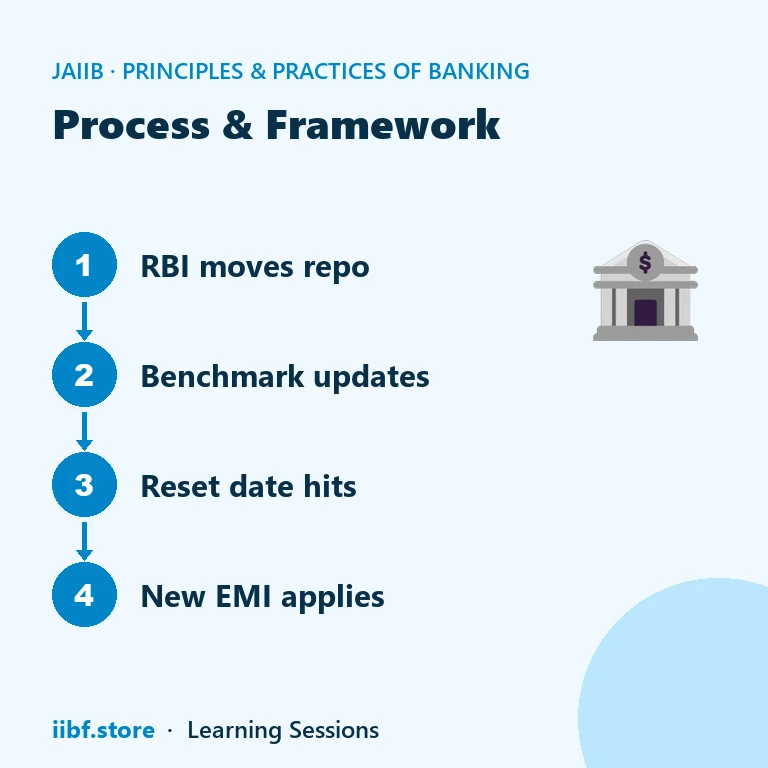
What actually happens on a reset date is arithmetic, not judgement. The bank picks up the benchmark value as on the reset date, adds the unchanged spread, and applies the new rate. Depending on the loan terms, the impact flows either into the EMI amount or into the residual tenor. Since the RBI's August 2023 instructions on the reset of floating interest rates on EMI-based personal loans, banks must give borrowers a clear option at the time of reset - including switching to a fixed rate - along with transparent disclosure of the impact on tenor and EMI.
A worked example
As at 31 July 2026 the policy repo rate stood at 5.25 per cent. Assume a borrower on repo plus a spread of 2.60 per cent, with quarterly resets falling on 1 January, 1 April, 1 July and 1 October.
| Date | Repo | Spread | Applicable rate | What happened |
|---|---|---|---|---|
| 1 July | 5.25% | 2.60% | 7.85% | Rate set at the reset date |
| Mid-August | 4.75% | 2.60% | 7.85% | RBI cuts 50 bps - loan rate does not move yet |
| 1 October | 4.75% | 2.60% | 7.35% | Next reset picks up the cut in full |
Two lessons sit inside that table. First, transmission is complete but not instant - the maximum lag is one reset cycle. Second, the spread column never moves. If a candidate shows you a numerical question where the spread has drifted between two reset dates without any change in the borrower's credit assessment, something in the question is wrong. You can cross-check the live policy rates on our RBI rates page or directly at the Reserve Bank of India.
Where this appears in the syllabus
This sits squarely in JAIIB Principles and Practices of Banking and reappears in CAIIB wherever monetary transmission, asset-liability management or interest rate risk is discussed. Expect short numerical questions on computing the applicable rate, and one-line conceptual questions on the reset interval and the three-year spread rule. Work through the module's practice tests before the attempt, and use the study planner to slot the revision in without displacing the heavier modules.
Frequently asked questions
Is RLLR the same as EBLR?
Not exactly. RLLR - repo linked lending rate - is an EBLR benchmark rate that happens to use the RBI policy repo rate. EBLR is the broader framework, which also permits FBIL-published Treasury Bill yields and other FBIL benchmarks.
How quickly must a repo cut reach my loan?
By the next reset, and the reset must occur at least once in three months. So the maximum lag is one quarter. Banks may reset more frequently if their policy provides for it.
Which loans are outside the EBLR mandate?
The mandate covers new floating rate personal and retail loans and floating rate loans to micro, small and medium enterprises. Fixed rate loans, and categories outside that scope, may still be priced off MCLR or other internal benchmarks.
Does a reset change my EMI or my tenor?
Either, depending on the loan terms. Following the RBI's August 2023 instructions on floating rate EMI-based personal loans, the bank must disclose the impact and offer the borrower options at reset, including switching to a fixed rate.
Quick quiz on this topic
5 exam-style questions from our free test bank — check yourself before you move on.
Practice this topic
Take a free mock test, download chapter PDFs, or watch a video class — all included on iibf.store.
Keep reading