CAIIB BFM Derivative Products: Chapters 20C and 21C
Chapters 20C and 21C are where a lot of candidates stall. Not because the mathematics is heavy — it rarely is at this level — but because four instruments get introduced in quick succession and start blurring together. CAIIB BFM derivative products are best learned as answers to one question: what exposure is this contract trying to neutralise, and who bears the risk if the market moves the wrong way? Answer that for each instrument and the chapter organises itself.
The session below covers both chapters with the 2026 updates. The write-up after it is the revision version.
BFM 20C and 21C Derivative Products · Complete 2026 Updates for CAIIB · Watch on YouTube
What a derivative actually is
A derivative has no value of its own. It derives value from something else — an exchange rate, an interest rate, a commodity price, a security. That single sentence explains why banks use them: a derivative lets you transfer a price risk without moving the underlying asset. A bank with a dollar receivable in three months does not want to sell dollars today; it wants certainty about what those dollars will fetch. A forward contract gives it exactly that and nothing more.
Three motives appear in every question. Hedging reduces an existing exposure. Speculation creates a new one in the hope of profit. Arbitrage exploits a price difference between two markets with no net exposure at all. Exam questions frequently describe a scenario and ask which motive it represents, so read for whether an underlying exposure exists before you answer.
Forwards versus futures: the comparison that carries marks
These two are economically similar and operationally very different. The differences are what get examined.
| Feature | Forward | Future |
|---|---|---|
| Where traded | Over the counter, bilateral | Recognised exchange |
| Contract terms | Customised to the client | Standardised size and expiry |
| Counterparty risk | Borne by the two parties | Novated to the clearing corporation |
| Margin | Usually none | Initial margin plus daily mark to market |
| Settlement | Typically on maturity | Daily settlement of gains and losses |
| Liquidity or exit | Cancel or roll over with the same counterparty | Square off in the market any day |
The daily mark to market is the practical difference that matters most. A futures position can demand cash from you long before maturity, which is why a treasury that is fully hedged on paper can still face a liquidity problem. This is a favourite discussion point and a common source of application-style questions.
Options and swaps
An option is a right without an obligation, which is why the buyer pays a premium. A call gives the right to buy at the strike price; a put gives the right to sell. The asymmetry is the entire point: the buyer's maximum loss is the premium paid, while the writer's loss is open-ended in exchange for the premium received. Any question describing unlimited downside is describing a writer, not a buyer.
Learn the moneyness vocabulary as a pair of definitions rather than a table. A call is in the money when the market price exceeds the strike; a put is in the money when the market price is below the strike. At the money means the two are equal. Intrinsic value can never be negative — an option that is out of the money simply has zero intrinsic value and whatever time value remains.
Swaps are the fourth family and the one candidates under-prepare. In a plain vanilla interest rate swap, one party pays fixed and receives floating while the other does the reverse, on an agreed notional principal. The notional is never exchanged in an interest rate swap; only the net interest difference changes hands on each reset date. In a currency swap, by contrast, principal amounts in two currencies may genuinely be exchanged at the start and returned at maturity. Mixing these two up is one of the most common errors in this chapter.
A solved hedging example
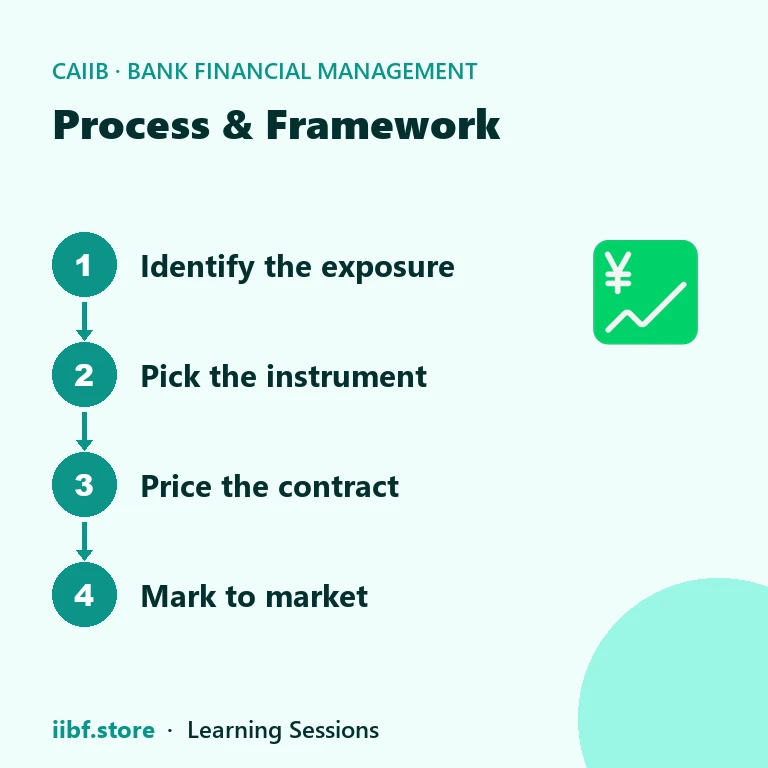
An importer must pay USD 1,00,000 in three months. The spot rate is ₹88.00 and the three-month forward is ₹88.90. The importer books a forward at ₹88.90, fixing the outflow at ₹88,90,000.
If the spot rate on maturity is ₹90.20, the importer would have paid ₹90,20,000 unhedged. The hedge saved ₹1,30,000. If instead the spot settles at ₹87.50, the unhedged cost would have been ₹87,50,000 and the hedge cost ₹1,40,000 more. Both outcomes are correct hedging. The purpose was certainty, not profit — a point examiners test by asking whether a hedge that ended up more expensive was a failure. It was not.
The regulatory frame you should be able to cite
Derivatives in India are permitted within limits, not at will. The governing framework sits in the Reserve Bank's Master Directions on risk management and inter-bank dealings, and the recurring principle is that a hedge should be commensurate with a genuine underlying exposure: the notional should not exceed the actual exposure, the tenor should not exceed the tenor of the exposure, and if the exposure is cancelled the hedge should be cancelled too. In the exchange-traded currency derivatives segment, a domestic participant taking a position above USD 10 million must establish the existence of an underlying exposure. Verify the current text on rbi.org.in before your attempt, because this framework is amended more often than the textbook is reprinted.
For revision, pair these chapters with the treasury chapters rather than studying them alone — CAIIB BFM derivative products only make sense against the balance sheet positions they hedge. The full paper structure is on the CAIIB course pages, and the risk-management overlap with Advanced Bank Management is worth a single combined pass. When you are ready to test recall rather than recognition, work a mixed set on the CAIIB practice tests.
Approach the topic this way and CAIIB BFM derivative products stop being four things to memorise and become one framework applied four times. That is also how the paper tends to ask about them: a short scenario, an exposure, and a question about which instrument fits and who carries the residual risk.
Frequently asked questions
Is the notional principal exchanged in an interest rate swap?
No. In an interest rate swap the notional is only a reference amount for computing interest; the parties settle the net difference. Principal exchange can occur in a currency swap, which is a different instrument.
What is the maximum loss for an option buyer?
The premium paid. The buyer holds a right and can simply let the option lapse. The writer, who has an obligation, faces a much larger potential loss and is compensated by the premium.
Why does a futures contract need daily margin when a forward does not?
Because the exchange clearing corporation stands between the parties and must contain its own credit exposure. Daily mark to market settles gains and losses as they arise instead of letting them accumulate to maturity.
Do I need an underlying exposure to use a derivative?
For hedging under the RBI framework, yes — the contract should be commensurate with a genuine exposure in amount and tenor. In the exchange-traded currency derivatives segment, positions above the prescribed threshold require the underlying exposure to be established. Always check the current Master Direction.
Quick quiz on this topic
5 exam-style questions from our free test bank — check yourself before you move on.
Practice this topic
Take a free mock test, download chapter PDFs, or watch a video class — all included on iibf.store.
Keep reading