CAIIB BFM Treasury Products 2026: Commercial Paper, CD and Repo Updates
If you are revising CAIIB BFM treasury products from a file you downloaded a year ago, some of what you are carefully memorising is now wrong. That is the uncomfortable message behind the crash-course session below, which walks through the treasury products chapter of Module C with the 2026 changes marked. Commercial paper rules moved. The buyback window moved. CBLO is gone and TREPS took its place. This article pulls those updates into one written reference so you can check your notes line by line instead of hoping.
Treasury Products | CAIIB BFM Latest Updates 2026 · Watch on YouTube
Why this chapter punishes stale material
Treasury products sit at an awkward intersection for exam writers. The concepts — discount instruments, collateralised borrowing, haircuts — barely change. The parameters attached to them change constantly, because they live inside RBI master directions that get reissued. So the examiner gets to ask a conceptually stable question with a numerically current answer, and that is precisely the kind of question that separates candidates who revised from candidates who revised recently.
The practical consequence for anyone studying CAIIB BFM treasury products: treat every number as provisional and every definition as permanent. Learn why commercial paper is issued at a discount once, and learn it properly. Re-check what the minimum rating and buyback window are every single cycle.
Commercial paper: what actually changed
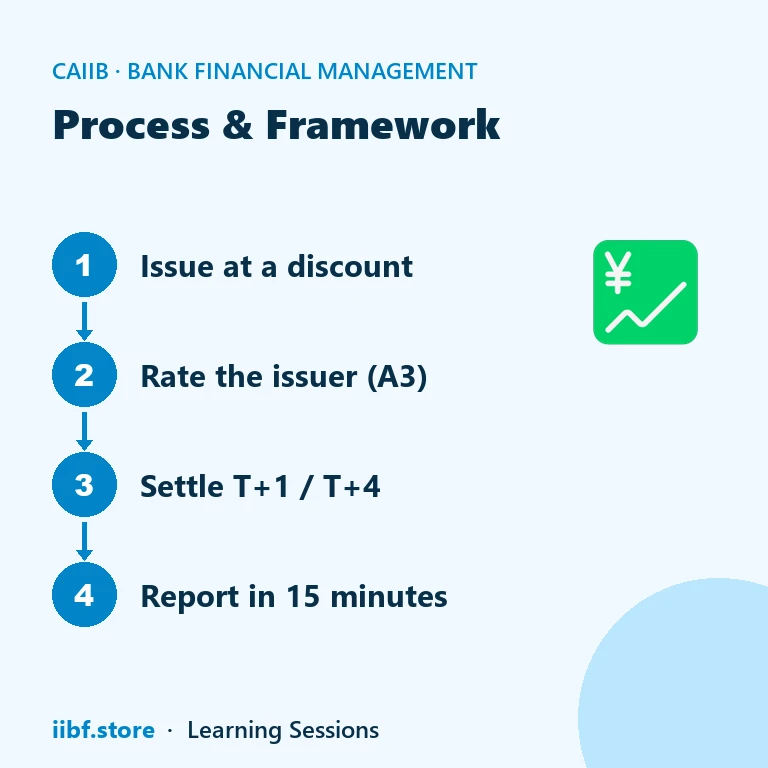
Commercial paper is an unsecured money market instrument issued in the form of a promissory note, and it is issued at a discount to face value — you pay less than the face amount today and receive the full face amount at maturity. That much has not moved. What has moved sits inside the RBI's Commercial Paper and Non-Convertible Debentures Directions, 2024, in force from 1 April 2024 and available on the Reserve Bank of India website.
The two-rating rule is gone. Older material says that an issue of ₹1,000 crore or more requires ratings from two credit rating agencies. That requirement no longer applies. The minimum credit rating of A3 from a SEBI-registered agency still does.
Buyback moved from 30 days to 7. Commercial paper can now be bought back after seven days from the date of issue, not thirty. This is the single most likely one-mark question from the whole update list, because it is a clean numeric change to a previously stable figure — exactly what an examiner wants when testing whether you studied this year.
Denomination. Minimum denomination is ₹5 lakh and in multiples of ₹5 lakh thereafter. Be careful here: this is a spot where paraphrased notes routinely garble the multiple.
| Parameter | Current position | What older notes often say |
|---|---|---|
| Minimum denomination | ₹5 lakh, in multiples of ₹5 lakh | Frequently mis-stated as ₹10 lakh multiples |
| Minimum credit rating | A3 from a SEBI-registered agency | Unchanged |
| Two rating agencies for large issues | Not required | Required above ₹1,000 crore |
| Buyback permitted after | 7 days from issue | 30 days from issue |
| Tenor | Not less than 7 days, not more than 1 year | Unchanged |
| Form of issue | Dematerialised only | Unchanged |
Most questions on CAIIB BFM treasury products are simply one cell of a table like the one above. Two further points from the directions are worth carrying into the hall: commercial paper carries no call or put option, and a buyback must happen at the prevailing market price. Eligible issuers include companies, NBFCs, all-India financial institutions, InvITs and REITs, and body corporates with a net worth of ₹100 crore or more.
CBLO is dead — know TREPS instead
The Collateralised Borrowing and Lending Obligation was discontinued and replaced by the Triparty Repo, universally written as TREPS. If your notes still explain CBLO as a live product, that section needs rewriting rather than updating. A triparty repo inserts a third-party agent between borrower and lender to handle collateral selection, custody and valuation, which is precisely why it displaced the older instrument.
While you are in this section, make sure the haircut concept is genuinely clear rather than merely familiar. A haircut is the discount applied to the market value of collateral when deciding how much can be borrowed against it: higher perceived risk means a bigger haircut and therefore less cash in hand. Examiners like to test this as a reasoning question rather than a definition, so understand the direction of the relationship, not just the word.
Settlement and reporting: the details that quietly carry marks
Primary issue settlement for commercial paper happens on a basis no later than T+4. Secondary market over-the-counter trades may settle on T+0 or T+1. Reporting of secondary market transactions must happen within fifteen minutes of the trade under the applicable trade reporting framework.
Individuals and Hindu Undivided Families may participate in a primary issue, but their combined allotment is capped at 25% of the issue size. On a ₹100 crore issue, that is ₹25 crore — a favourite calculation-flavoured question that requires no real calculation, only that you remembered the cap exists.
The other live area in this chapter is external commercial borrowings and overseas direct investment, where limits have been revised. Rather than commit a figure to memory from any secondary source, verify it against the current RBI framework before the exam. This is a section where being approximately right scores exactly zero.
How to revise this chapter without drowning
A one-page grid is the fastest honest revision of CAIIB BFM treasury products you can build. Start with a single parameter sheet. One row per instrument, one column per attribute — denomination, tenor, rating, form, buyback, settlement. Most questions from this chapter are simply a cell in that grid. Reading the chapter three times will not produce the grid; building it once will, and the act of building it is most of the revision.
Then test it. The CAIIB course modules and the paper-wise CAIIB mock tests both let you attack a single module in isolation, which is what you want when one chapter carries this much numeric surface area. If you would rather drill definitions until they are automatic, the matching game is faster than re-reading, and it is much better at exposing the terms you only half-know.
One last habit worth forming: when you write down a number from this chapter, write the date you verified it beside the number. In a chapter that gets reissued this often, an undated note is a note you cannot trust three months from now.
Can commercial paper still be bought back only after 30 days?
No. Under the 2024 RBI directions, buyback of commercial paper is permitted after seven days from the date of issue. The earlier thirty-day restriction no longer applies, and any buyback must be at the prevailing market price.
Do large commercial paper issues still need two credit ratings?
No. The earlier requirement of ratings from two credit rating agencies for issues of ₹1,000 crore or more has been removed. A minimum rating of A3 from a SEBI-registered credit rating agency continues to apply to all issues regardless of size.
What replaced CBLO in the Indian money market?
The Triparty Repo, commonly written as TREPS, replaced the Collateralised Borrowing and Lending Obligation. It works through a triparty agent that handles collateral selection, custody and valuation between the borrower and the lender.
How much of a commercial paper issue can individuals subscribe to?
Individuals and Hindu Undivided Families can participate in the primary issue, but their aggregate share is capped at 25% of the issue size. On a ₹100 crore issue that works out to a maximum of ₹25 crore across all such investors.
Quick quiz on this topic
5 exam-style questions from our free test bank — check yourself before you move on.
Practice this topic
Take a free mock test, download chapter PDFs, or watch a video class — all included on iibf.store.
Keep reading