EXIM Bank, FEMA & LRS: CAIIB BFM Chapter 8 (Free PDF)
Cross-border trade is the artery of a modern economy, and a banker sits at almost every junction of it — financing the exporter, remitting for the traveller, quoting a rate to the importer and reporting each flow to the regulator. Module A, Chapter 8 of CAIIB Bank Financial Management binds four pillars into one connected system: EXIM Bank, India's apex export-finance institution; FEMA, 1999 and the RBI's exchange-control architecture; the Liberalised Remittance Scheme (LRS) and everyday forex facilities for residents; and the FEDAI Rules that govern how authorised dealers price and settle foreign-exchange transactions. This guide walks through all four, flags the outdated figures that still circulate in old notes, and gives you the full chapter as a free PDF.
Almost every recent revision matters for the exam: new EXIM Bank products, the electronic EDPMS/IDPMS reporting regime, the Overseas Investment Rules, 2022, the FEDAI Rules 10th Edition (amendment dated 5 April 2024) and fresh currency-export rules for Nepal and Bhutan. The paper rewards the candidate who knows the current rule and the exact figure — not the legacy one.
Download the full chapter PDF
CAIIB BFM Module A Chapter 8 — EXIM Bank, FEMA, Exchange Control & FEDAI Rules — the complete Learning Sessions study chapter, exam-ready with latest updates, key terms, exam traps and revision tables. Free to download, print and share.
Key terms you must fix before anything else
Every later section leans on these definitions, so lock them in first.
| Term | What it means |
|---|---|
| Authorised Dealer (AD) | A bank or entity licensed by RBI under FEMA to deal in foreign exchange. Your branch acts as an AD when it sells travel forex or remits money abroad. |
| Full-Fledged Money Changer (FFMC) | Authorised to buy foreign exchange from residents/visitors and sell it for private and business travel abroad — but not to do general remittances. |
| Current account transaction | Any cross-border transaction that is not a capital account transaction. Generally permitted unless expressly restricted. |
| Capital account transaction (Sec 2(e)) | A transaction that alters assets or liabilities, including contingent liabilities, outside India of a resident, or in India of a non-resident. Generally restricted unless expressly permitted. |
| LRS | The window under which a resident individual may remit up to USD 250,000 per financial year for permissible current and capital account transactions combined. |
| NTP (Normal Transit Period) | The FEDAI-notified average number of days a bill in transit takes to be realised, used to fix interest recovery on export bills. It is a notional period, not the actual transit time. |
| ODI / OPI | Under the Overseas Investment Rules, 2022: Overseas Direct Investment (10%+ stake or control) and Overseas Portfolio Investment (all other permitted overseas securities). |
Part 1 — EXIM Bank: role, functions and facilities
The Export-Import Bank of India was established in 1981 under the Export-Import Bank of India Act, 1981, and began operations in March 1982. It is the country's principal financial institution for financing, facilitating and promoting India's foreign trade — working alongside commercial banks, not in place of them.
Its core objectives are to make Indian exports internationally competitive through finance at competitive rates, to develop alternate and innovative financing solutions for exporters and overseas buyers, to provide data and advisory support on new export opportunities, to support selective production and marketing so Indian products can compete globally, and to pursue exporters' problems at policy level with the Government and RBI.
The current product suite
EXIM Bank's product menu has been modernised, and the exam expects the current suite rather than legacy schemes. For exporters and importers: pre-shipment and post-shipment credit (including in foreign currency at internationally competitive rates); supplier's credit and buyer's credit; project-export finance, funded and non-funded, for engineering, turnkey and construction contracts; overseas investment finance consistent with the Overseas Investment Rules, 2022; export factoring and trade-receivables financing; import finance for export-related imports; and sustainable-finance programmes for green and climate-aligned export projects.
Two flagship programmes deserve special mention. The Ubharte Sitaare Programme (USP) identifies and nurtures potential export champions among mid-sized companies through a mix of equity, debt and technical assistance. The Trade Assistance Programme (TAP) enhances credit capacity by extending guarantees and risk participation to support trade transactions with select overseas geographies.
For commercial banks, EXIM Bank offers refinance and lines of credit for export-oriented lending, participation in guarantees (advance-payment, performance, retention-money and bid-bond), and support for banks' export-credit portfolios. For foreign governments and importers, it extends Buyer's Credit under the National Export Insurance Account (BC-NEIA), credit lines to overseas financial institutions, and Government-supported Lines of Credit (GOI-LOC) that back India's economic diplomacy.
Exam trap. Treat SSI Export Bills Rediscounting, the universal 180-day export-bill rediscounting ceiling, refinance up to 100% of term loans, the Export Marketing Fund (EMF) and the Export Vendor Development Lending Programme (EVDLP) as legacy schemes. Lead instead with Buyer's Credit, TAP, USP and Government-supported Lines of Credit.
Deferred-payment and project exports
A deferred-payment export is one where the contract lets the overseas buyer pay over an extended period. A turnkey project is the supply of equipment together with design, engineering, civil construction, erection and commissioning, so the buyer receives a ready-to-operate plant; a construction contract covers civil and structural works with associated supply of materials and equipment.
Exam trap. The old rule — "proceeds received beyond six months = deferred payment export" — is stale. The current general export-realisation period is nine (9) months from the date of export per RBI's Master Direction on Export of Goods and Services, except where a different period or extension applies. The 15-month window was only a temporary relaxation for specified exports up to 31 July 2020. If an MCQ offers 6 months, it is wrong. See our deeper note on the export realisation period under FEMA.
Exam trap. The legacy condition that a project-financed unit had to be an EOU in an Export Processing Zone exporting a minimum 25% of annual sales is outdated. EPZs were folded into the SEZ framework, and an EOU today must achieve a positive Net Foreign Exchange (NFE) cumulatively over the block period — there is no flat 25%-of-sales test.
Part 2 — RBI, exchange control and FEMA
The Foreign Exchange Regulation Act, 1973 (FERA) was repealed and replaced by the Foreign Exchange Management Act, 1999 (FEMA), in force from 1 June 2000. FEMA's stated objective is to facilitate external trade and payments and to promote the orderly development and maintenance of the foreign-exchange market in India — a facilitative, management-oriented statute, in deliberate contrast to FERA's prohibitive, control-oriented character.
Under Section 11(1), the Reserve Bank of India may give any direction to authorised persons regarding payments or acts relating to foreign exchange, to secure compliance with FEMA. Under Section 11(3), for contravening an RBI direction or failing to file a prescribed return, RBI may impose on the authorised person a penalty up to ₹10,000, plus an additional penalty up to ₹2,000 per day for a continuing contravention.
Exam trap. Those ₹10,000 / ₹2,000-per-day figures are the Section 11(3) penalty on an authorised person — not FEMA's general penalty for every contravention, which falls under Section 13 (up to thrice the sum involved). Also avoid stating flatly that "any FEMA violation is dealt with under civil law only": FEMA is primarily a civil economic law, but failure to pay an imposed penalty and certain enforcement defaults can bring further legal consequences.
Reporting to RBI — the modern electronic regime
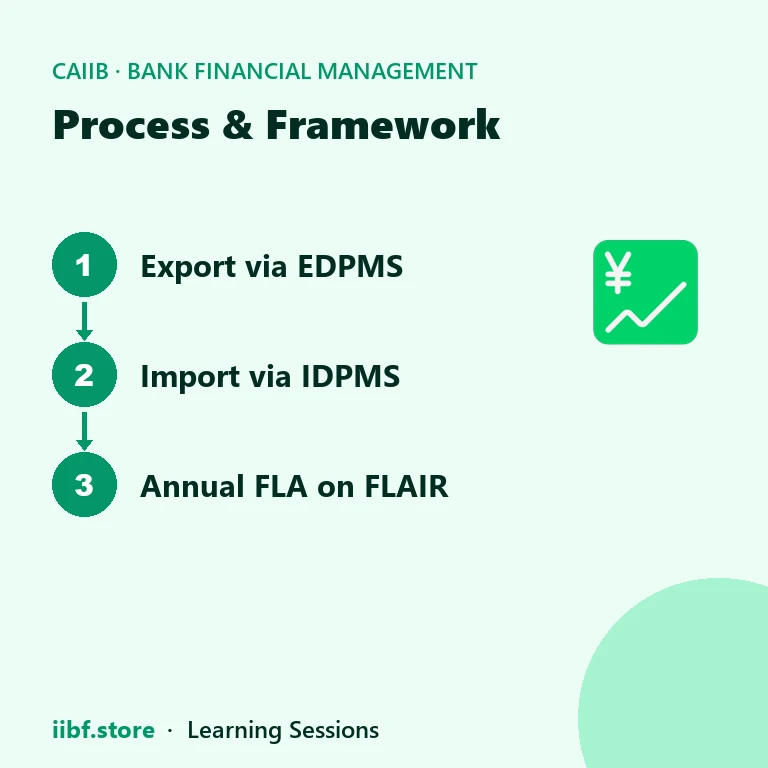
The old paper-and-manual returns (R Return, BAL Statement, STAT 5/STAT 8, NRDCSR, XOS, BEF, FEMIS, the old monthly LRS format) have largely been superseded by portal-based reporting. Lead with the current framework:
| System | What it tracks | Replaced |
|---|---|---|
| EDPMS | Export Data Processing and Monitoring System — export transactions and outstanding export bills | the old XOS regime |
| IDPMS | Import Data Processing and Monitoring System — imports and evidence of import | the old Bill-of-Entry / BEF regime |
| FLAIR | Foreign Liabilities and Assets Information Reporting — the online system for the annual FLA return | the manual FLA return |
Always take the applicable return from RBI's latest reporting framework, not from a legacy list. XBRL-based regulatory reporting and RBI's data-submission portals cover ECB, trade-credit and overseas-investment returns.
Part 3 — Forex facilities for residents and the LRS
The Liberalised Remittance Scheme is the master window for a resident individual's outward remittances: USD 250,000 per resident individual per financial year (April–March), combining permissible current and capital account transactions. Minors are eligible, with the declaration countersigned by a guardian.
The single most-tested LRS trap. The USD 250,000 limit is for a resident individual only. Any statement that a trust, company or partnership firm may remit USD 250,000 as a gift or donation under LRS is wrong — entities remit under the Current Account Transaction Rules and their AD bank's delegated authority. Likewise, an employee's overseas business trip funded by the company does not run through the individual's LRS.
All facilities below sit within that single ceiling: private visits abroad (except Nepal and Bhutan), gift or donation, going abroad on employment, emigration, maintenance of close relatives abroad, business trips, medical treatment and studies abroad. Medical treatment and studies may exceed USD 250,000 only where the hospital or university so requires, supported by an estimate and subject to AD verification. For a fuller treatment see our guide to the Liberalised Remittance Scheme for CAIIB BFM.
Cash, currency notes and the ₹50,000 rule
When a resident buys foreign exchange, the rupee equivalent of less than ₹50,000 may be paid in cash. Where it is ₹50,000 or more, the entire payment must ordinarily go through permitted banking or card channels.
Exam trap. Crossing ₹50,000 does not require RBI approval — it merely changes the permitted mode of payment. It is about how you pay, not about regulatory permission.
| Destination / case | Foreign-currency notes & coins per visit |
|---|---|
| General (most countries) | Up to USD 3,000; balance via permitted non-cash instruments |
| Iraq & Libya | Up to USD 5,000 in notes/coins |
| Iran, Russian Federation & other CIS republics | Up to full permitted entitlement |
| Haj / Umrah pilgrimage | Full entitlement, or the Haj-Committee cash limit |
Exam trap. Nepal and Bhutan are not part of the Iraq/Libya/Iran/Russia cash-exception group. Travel there is governed by the Indian-currency rules, and forex facilities for private visits exclude Nepal and Bhutan.
Under the Foreign Exchange Management (Export and Import of Currency) (Amendment) Regulations, 2025 — Notification No. FEMA 6(R)/(4)/2025-RB dated 28 November 2025 — Indian currency notes of ₹100 and lower may be carried without limit to and from Nepal and Bhutan, while for denominations above ₹100 the aggregate limit is ₹25,000 per person. Citizens of Pakistan and Bangladesh are barred from carrying Indian notes above ₹100.
Exam trap. Drop every reference to the ₹2,000 note here — it was withdrawn from circulation by RBI on 19 May 2023 and is no longer issued, though notes tendered remain legal tender. The old "₹500 and ₹2,000 up to ₹25,000" phrasing is stale.
Declaration, utilisation and surrender
A person may bring any amount of foreign exchange into India, but a Currency Declaration Form (CDF) is required where the aggregate (notes, banknotes and TCs) exceeds USD 10,000, or where foreign-currency notes alone exceed USD 5,000. Form A2 is the application-cum-declaration for an outward remittance; the AD bank acts on the purpose declared and certifies FEMA conformity.
Foreign exchange purchased but not used must generally be repatriated or surrendered within 180 days. Unspent travel forex must be surrendered within 180 days of return, except that a resident may retain up to USD 2,000 in foreign-currency notes and TCs; foreign coins may be retained without ceiling. Retained balances may be held in an RFC(Domestic) account or reconverted to rupees at the customer's choice.
How to revise this chapter for the exam
Chapter 8 is figure-heavy, and the figures are exactly where candidates lose marks. Build a one-page sheet of the numbers that repeat: 1981 and March 1982 for EXIM Bank, 1 June 2000 for FEMA, nine months for export realisation, USD 250,000 for LRS, ₹50,000 for the cash mode-of-payment switch, USD 3,000 for general travel notes, USD 10,000 and USD 5,000 for the CDF, 180 days and USD 2,000 for surrender and retention, and ₹25,000 for above-₹100 notes to Nepal and Bhutan.
Then drill the traps. Most wrong options in this chapter are old correct answers — six months instead of nine, the 25%-of-sales EOU test, the ₹2,000 note, LRS extended to companies. Practise on the CAIIB mock tests, revise the wider syllabus from the CAIIB course hub, and keep an eye on current RBI rates and updates because this chapter moves with regulation.
Frequently asked questions
What is the current export realisation period under FEMA?
Nine months from the date of export under RBI's Master Direction on Export of Goods and Services, unless a different period or an extension applies. The older six-month rule and the temporary 15-month relaxation (which ran only up to 31 July 2020) are both outdated for exam purposes.
Can a company or trust use the USD 250,000 LRS limit?
No. LRS is available only to a resident individual. Companies, partnership firms, HUFs and trusts remit under the Current Account Transaction Rules through their AD bank's delegated authority.
Does paying more than ₹50,000 for forex need RBI approval?
No. Crossing ₹50,000 only changes the permitted mode of payment — the amount must go through banking or card channels instead of cash. It is not a regulatory permission threshold.
How much Indian currency can be carried to Nepal and Bhutan?
Notes of ₹100 and lower without limit; for denominations above ₹100 the aggregate limit is ₹25,000 per person, under the FEMA (Export and Import of Currency) (Amendment) Regulations, 2025.
Download the full chapter PDF above for the complete treatment — including the EXIM Bank facility tables, the LRS entitlement grid and every exam trap in one printable file.
Prefer revising from a printed book?
Chapter-wise books with MCQs after every chapter — minimal pages, complete coverage, delivered anywhere in India. Every book has a free sample to read first.




Quick quiz on this topic
5 exam-style questions from our free test bank — check yourself before you move on.
Practice this topic
Take a free mock test, download chapter PDFs, or watch a video class — all included on iibf.store.