Variable Rate Repo Auctions: RBI's Liquidity Tool for CAIIB
Variable rate repo auctions are the Reserve Bank of India's principal instrument for injecting rupee liquidity into the banking system at a rate discovered through competitive bidding, rather than at a rate fixed in advance. Banks bid for funds against government securities, the RBI allots up to a notified amount, and the cut-off rate that emerges tells the market exactly how tight cash conditions really are.
For the CAIIB Central Banking elective this is high-yield territory. Examiners rarely ask you to recite a rate; they ask you to distinguish one liquidity facility from another, identify the operating target, and explain why the central bank switched from a fixed-rate window to an auction. This guide covers the mechanics, the corridor context, the treasury impact and the exact phrasings that show up in the paper.
🏦 What a Variable Rate Repo Auction Actually Is
A repo is a collateralised loan dressed as a sale and repurchase. The bank sells eligible government securities to the RBI and simultaneously agrees to buy them back on a fixed future date at a slightly higher price; the difference is the interest. In a variable rate repo (VRR) auction, that interest rate is not announced beforehand. The RBI announces only the notified amount and the tenor, and lets banks bid.
This matters because a fixed-rate window is passive. Whatever the system asks for at the announced rate, it gets. An auction is active: the central bank decides how much liquidity to release and forces the price of that liquidity to be discovered by the market. The RBI therefore controls quantity, and the banking system reveals its own desperation through the bids it submits.
The collateral pool is SLR-eligible paper — dated central government securities, Treasury Bills and State Development Loans — valued after a haircut. Settlement runs through the RBI's e-Kuber platform, and eligible counterparties include scheduled commercial banks (other than regional rural banks and small finance banks in some operations) and standalone primary dealers. If the plumbing behind this feels unfamiliar, work through the chapter on liquidity management in the system before attempting past papers, because almost every numerical in this module assumes you already know how repo settlement works.
💡 Exam Tip: A repo injects liquidity; a reverse repo absorbs it. If the question says "variable rate reverse repo (VRRR)", the RBI is mopping up surplus cash, not supplying it. Read the direction word before reading the numbers.
⚖️ Fixed-Rate Repo Versus the Auction Route
The cleanest way to hold this topic in memory is a side-by-side map of the whole facility set. Each instrument differs on three axes: who decides the rate, whether the bank has to pledge securities, and whether access is on tap or by allotment.
| Facility | Rate determined by | Bank pledges G-Secs? | Access | Typical tenor |
|---|---|---|---|---|
| Fixed-rate repo (LAF) | RBI announces the policy repo rate | ✅ | On tap during window hours | Overnight |
| Variable rate repo auction | Competitive bidding, cut-off emerges | ✅ | By allotment, notified amount capped | Overnight to 14 days and longer |
| Marginal Standing Facility | RBI announces; forms corridor ceiling | ✅ | Standing facility, on demand | Overnight |
| Standing Deposit Facility | RBI announces; forms corridor floor | ❌ (uncollateralised) | Standing facility, on demand | Overnight |
| Variable rate reverse repo | Competitive bidding, cut-off emerges | ❌ (RBI gives collateral) | By allotment, notified amount capped | Overnight to 14 days and longer |
Two rows repay careful reading. The Standing Deposit Facility is the only absorption tool in the set that requires no security leg at all, which is precisely why it was introduced — the RBI's stock of securities no longer limits how much surplus it can absorb. And the Marginal Standing Facility is a standing facility, so a bank short of cash at the end of the day can always reach it without waiting for an auction. Current levels for each of these are revised by the Monetary Policy Committee and are best checked against the live RBI policy rates page rather than memorised from a coaching note. For the primary source, the RBI's own central bank website carries every LAF auction notification and result.
📊 Auction Mechanics: Bidding, Cut-Off and Allotment
The sequence is worth learning as a five-step drill, because questions are often set on a single step.
- Notification. The RBI announces the notified amount, tenor, auction window and settlement date, usually the same morning.
- Bidding. Eligible participants submit bids stating an amount and a rate, in the rupee-crore lot sizes specified in that auction's notification.
- The floor rule. In a VRR auction, no bid may be below the policy repo rate — the repo rate acts as the floor. In a VRRR auction the same rate acts as the ceiling, and no bid above it is permitted.
- Allotment. Bids are ranked and accepted from the most attractive downwards for the RBI until the notified amount is exhausted, producing a cut-off rate.
- Result and settlement. The RBI publishes the notified amount, amount bid, amount accepted, cut-off rate and weighted average rate.
The published bid-to-cover ratio — total bids received divided by the notified amount — is the number analysts watch. A ratio far above one, with a cut-off well clear of the repo rate, signals genuine scarcity of cash. An undersubscribed auction signals the opposite. The RBI has used both multiple-price and uniform-price allotment formats across different operations, so answer such questions on the framework rather than assuming one fixed method.
Standalone primary dealers matter here as the market's shock absorbers, since they warehouse government paper and bid actively. Their role in the auction ecosystem is covered in detail in this companion piece on primary dealers in government securities.
🎯 Where the Auction Sits Inside the LAF Corridor
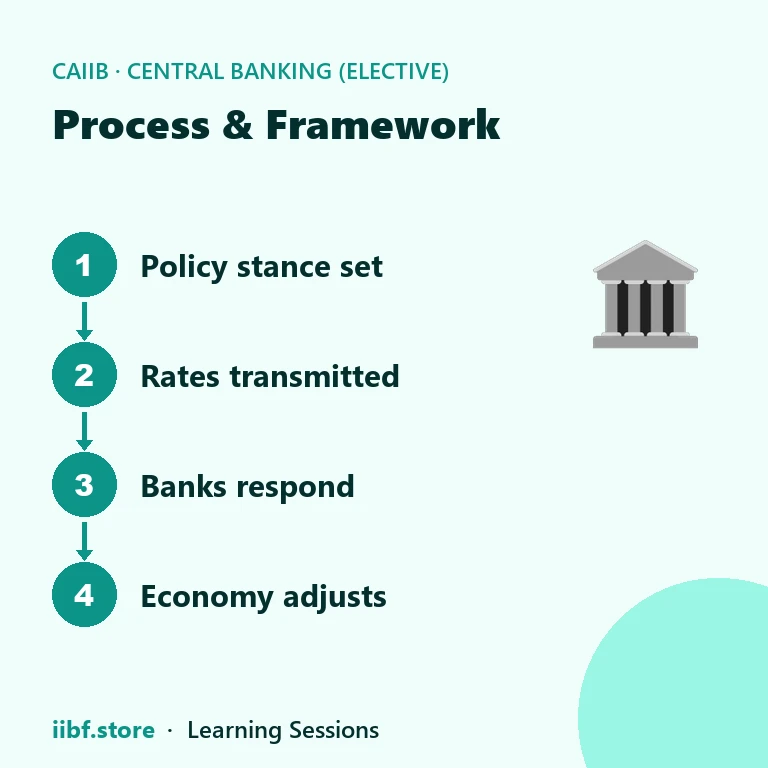
The Liquidity Adjustment Facility is a corridor, not a single rate. The Standing Deposit Facility rate forms the floor, the Marginal Standing Facility rate forms the ceiling, and the policy repo rate sits between them as the reference. The whole architecture exists to steer one number: the weighted average call rate (WACR), which is the RBI's declared operating target in the overnight uncollateralised money market.
Variable rate operations are how the RBI nudges the WACR back towards the repo rate when it drifts. If the call rate is drifting up towards the MSF ceiling, the RBI announces a VRR auction and supplies cash. If it is sagging towards the SDF floor, a VRRR auction drains the surplus. Under the revised framework announced in February 2020, the 14-day main operation was designated the primary liquidity management tool, supported by fine-tuning operations of shorter and longer tenor as conditions demand.
Set this against the older toolkit and the design logic becomes obvious. The legacy penal rate that once did this job is explained in our note on the bank rate in india, which today survives largely as a reference rate aligned to the MSF. The broader theory of why a central bank targets a short-term rate at all is developed in the chapter on functions of central banks.
⚠️ Common Mistake: Candidates write that the RBI "fixes" the cut-off rate in a variable rate auction. It does not. The RBI fixes the quantity; the market produces the rate. Only the floor or ceiling is administratively set.
🏛️ What It Means for a Bank's Treasury Desk
For a treasury, variable rate auctions convert liquidity management from a queuing exercise into a pricing decision. The desk must judge how much to bid and at what rate, knowing that bidding too conservatively risks no allotment and a scramble in the call market at a worse price, while bidding too aggressively raises the cost of funds on borrowed money that may not be needed.
Three practical constraints shape those bids. First, the securities pledged must be surplus to the bank's SLR requirement or drawn from the permitted carve-out, so the available collateral pool is finite. Second, tenor selection interacts with the bank's asset-liability profile — a 14-day repo funds a fortnight of outflows, an overnight repo funds one night. Third, the accounting treatment of the pledged securities and the associated interest cost flows into the net interest margin, which is exactly where supervisory attention lands.
That supervisory dimension is not incidental. Liquidity behaviour is monitored through the RBI's inspection machinery, whose structure is set out in this explainer on the Board for Financial Supervision. Access to these facilities is also not uniform across the banking system — cooperative banks, small finance banks and rural institutions face different eligibility rules, a point worth reading alongside the piece on regional rural banks structure. For the institutional grounding behind all of it, revise the chapter on the Reserve Bank of India, and browse more notes in the Central Banking elective tag hub.
🧠 Practice MCQs: Variable Rate Repo Auctions
Q1. In a variable rate repo auction conducted by the RBI, a bid submitted at a rate below the policy repo rate is: (a) allotted first, being the cheapest for the RBI (b) allotted at the policy repo rate instead (c) not permitted, as the policy repo rate is the floor for VRR bids (d) allotted only if submitted by a standalone primary dealer
Answer: (c) — In a VRR auction the policy repo rate is the minimum permissible bid rate; in a VRRR auction the same rate acts as the maximum.
Q2. The declared operating target of the RBI's monetary policy framework is: (a) the weighted average call rate (b) the 91-day Treasury Bill yield (c) the 10-year benchmark G-Sec yield (d) the marginal standing facility rate
Answer: (a) — The weighted average call rate in the overnight uncollateralised market is the operating target the LAF corridor is designed to steer.
Q3. Which of the following liquidity facilities requires no pledge of government securities by the participating bank? (a) Marginal Standing Facility (b) Variable rate repo auction (c) Fixed-rate repo under LAF (d) Standing Deposit Facility
Answer: (d) — The Standing Deposit Facility absorbs liquidity on an uncollateralised basis, which is why it removed the constraint of the RBI's securities holdings.
Q4. Under the liquidity management framework revised in February 2020, the main operation was designated as the: (a) overnight fixed-rate repo (b) 14-day variable rate repo or reverse repo auction (c) outright open market purchase (d) marginal standing facility drawdown
Answer: (b) — The 14-day main operation became the primary tool, with fine-tuning operations of other tenors used as conditions require.
Q5. The bid-to-cover ratio published with an RBI variable rate repo auction result is best interpreted as a measure of: (a) the haircut applied to pledged collateral (b) the spread between the MSF and SDF rates (c) demand for liquidity relative to the notified amount (d) the proportion of bids received from primary dealers
Answer: (c) — It compares total bids received with the amount the RBI notified, and a high ratio alongside a firm cut-off signals genuine cash scarcity.
Want chapter-wise mock tests with 100+ MCQs? Start practising free →
❓ Frequently Asked Questions
Why did the RBI move from fixed-rate to variable rate repo operations?
A fixed-rate window lets the system draw whatever it wants at an announced price, so the central bank loses control of the quantity of liquidity supplied. An auction reverses that: the RBI caps the amount and lets the market set the rate, which both rations liquidity and produces a market signal about how tight conditions are.
Can a bank access both a variable rate repo auction and the MSF on the same day?
Yes. The auction is a discretionary operation with a capped notified amount, while the Marginal Standing Facility is a standing facility available on demand within its operating window. A bank that receives less than it bid for in the auction can still meet a residual shortfall at the MSF, at the corridor ceiling rate.
What securities are eligible as collateral for a variable rate repo?
SLR-eligible government paper — dated central government securities, Treasury Bills and State Development Loans — valued after the applicable haircut. The securities must be free of other encumbrance, which is why the size of a bank's surplus SLR portfolio effectively caps how much it can bid for.
How is the cut-off rate different from the weighted average rate in an auction result?
The cut-off is the marginal rate at which the last accepted bid was allotted, so it is the boundary of the accepted range. The weighted average rate is the average of all accepted bids weighted by amount, and it sits inside that range. Both are published with every result.
🚀 Revise This Before the Exam
Master three things and this topic is done: the direction of each facility, who sets the rate, and what the corridor is steering. Everything else in a question is decoration. Then test yourself under time pressure with the full CAIIB Central Banking elective course and chapter-wise mocks on iibf.store tests.
Prefer revising from a printed book?
Chapter-wise books with MCQs after every chapter — minimal pages, complete coverage, delivered anywhere in India. Every book has a free sample to read first.
98 pages · 282 MCQs
Learning Sessions · Ashish Sir
148 pages · 478 MCQs
Learning Sessions · Ashish Sir
151 pages · 465 MCQs
Learning Sessions · Ashish Sir
148 pages · 375 MCQs
Learning Sessions · Ashish Sir
216 pages · 895 MCQs
Learning Sessions · Ashish Sir
109 pages · 300 MCQs
Learning Sessions · Ashish Sir
104 pages · 360 MCQs
Learning Sessions · Ashish Sir
82 pages · 297 MCQs
Learning Sessions · Ashish Sir
151 pages · 600 MCQs
Learning Sessions · Ashish Sir
131 pages · 672 MCQs
Learning Sessions · Ashish Sir
221 pages · 831 MCQs
Learning Sessions · Ashish Sir
128 pages · 524 MCQs
Learning Sessions · Ashish Sir
107 pages · 445 MCQs
Learning Sessions · Ashish Sir
132 pages · 225 MCQs
Learning Sessions · Ashish Sir
188 pages · 435 MCQs
Learning Sessions · Ashish Sir
117 pages · 236 MCQs
Learning Sessions · Ashish Sir
Learning Sessions · Ashish Sir
118 pages · 299 MCQs
Learning Sessions · Ashish Sir
Learning Sessions · Ashish Sir
Learning Sessions · Ashish Sir
Learning Sessions · Ashish Sir
115 pages · 255 MCQs
Learning Sessions · Ashish Sir
Learning Sessions · Ashish Sir
334 pages · 936 MCQs
Learning Sessions · Ashish Sir
Learning Sessions · Ashish Sir
115 pages · 344 MCQs
Learning Sessions · Ashish Sir
107 pages · 240 MCQs
Learning Sessions · Ashish Sir
90 pages · 150 MCQs
Learning Sessions · Ashish Sir
Learning Sessions · Ashish Sir
Quick quiz on this topic
5 exam-style questions from our free test bank — check yourself before you move on.
Practice this topic
Take a free mock test, download chapter PDFs, or watch a video class — all included on iibf.store.