CAIIB BRBL Module D: Previous Year Questions Decoded
Module D is the part of Banking Regulations and Business Laws that most candidates leave for the last weekend, and then discover it is the module the paper leans on hardest. It is not banking regulation at all — it is the Indian Contract Act, the Sale of Goods Act, partnership, companies, property and a cluster of special statutes, all asked through a banking lens. This class walks through previous year questions from exactly that module.
CAIIB BRBL Module D previous year questions and exam pattern · Watch on YouTube
The official title tells you what you are dealing with. In the IIBF Rules & Syllabus, CAIIB BRBL Module D is "Commercial & Other Laws with Reference to Banking Operations". Every word of that matters. These are commercial laws, and they are examined with reference to banking operations — which is exactly why reading a bare law summary does not prepare you for the questions.
What Module D actually contains
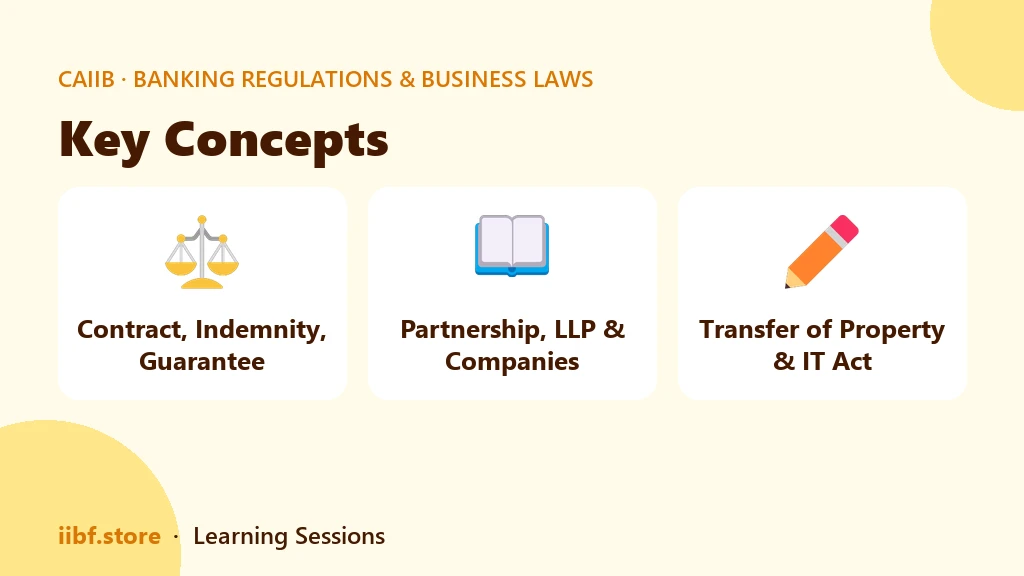
Break the syllabus into three clusters and the module stops looking like a wall of statutes.
Cluster one — the Contract Act family. Meaning and essentials of a contract, contracts of indemnity, contracts of guarantee, bailment, pledge and agency. This is the densest and most heavily examined block. Guarantee alone carries a long list of sub-topics: liability of the surety, continuing guarantee, death of surety, variance in terms, discharge of the principal debtor, forbearance to sue, release of one co-surety, and revocation of a continuing guarantee.
Cluster two — business entities. Sale of Goods Act 1930 (conditions and warranties, the unpaid seller's rights), the Partnership Act (relations of partners to one another and to third parties, minors admitted to the benefits of partnership, dissolution, effect of non-registration), the Limited Liability Partnership Act 2008, and company law — types of companies, memorandum and articles, the doctrines of ultra vires, constructive notice and indoor management, membership, prospectus and directors.
Cluster three — property and special statutes. The Transfer of Property Act 1882 with its mortgage types and enforcement routes, the Right to Information Act 2005, the Information Technology Act 2000, and the Prevention of Corruption Act 1988.
How previous year questions are actually built
Read enough past papers and the construction becomes obvious. The examiner takes one legal proposition and wraps it in a two-line branch scenario. Your job is to strip the scenario back to the proposition.
| Question style | What is really being tested | Where to look |
|---|---|---|
| "Bank released one of two co-sureties. Is the other discharged?" | Release of one co-surety does not discharge the other | Contract of Guarantee |
| "Goods kept in bank godown, keys with bank. What is created?" | Pledge versus hypothecation — possession is the test | Contract of Pledge |
| "Borrower deposited title deeds in a notified town." | Equitable mortgage by deposit of title deeds | Transfer of Property Act |
| "Unregistered firm sues to recover from a customer." | Effect of non-registration on the right to sue | Partnership Act |
| "Outsider dealt with a director acting beyond internal limits." | Doctrine of indoor management | Company law |
Notice what is not being tested: section numbers for their own sake. The Institute does publish an appendix of important provisions and sections, and knowing a handful of the famous ones helps, but the marks sit in applying the rule, not in reciting the number.
The distinctions that decide most answers
Four pairs come up again and again, and getting them clean is worth more than an extra reading of the whole module.
Indemnity versus guarantee. Indemnity has two parties and the liability is primary and contingent on a loss. Guarantee has three parties — creditor, principal debtor and surety — and the surety's liability is co-extensive with the principal debtor's unless the contract says otherwise. Every bank guarantee question turns on this.
Pledge versus hypothecation. Pledge requires delivery of possession to the pledgee; hypothecation leaves possession with the borrower and creates only a charge. When a question mentions who holds the keys, who has the stock, or who can remove goods, it is asking this.
Sale versus agreement to sell. In a sale, property in the goods passes immediately; in an agreement to sell, it passes at a future time or on a condition. This drives the unpaid seller's remedies.
Memorandum versus articles. The memorandum sets the company's relationship with the outside world and its objects; the articles govern internal management. Ultra vires the memorandum is void and cannot be ratified; a breach of the articles can often be cured internally.
A worked example
"A firm's partner, without the knowledge of the others, borrowed from a bank in the firm's name for a purpose unconnected with the business. Is the firm bound?"
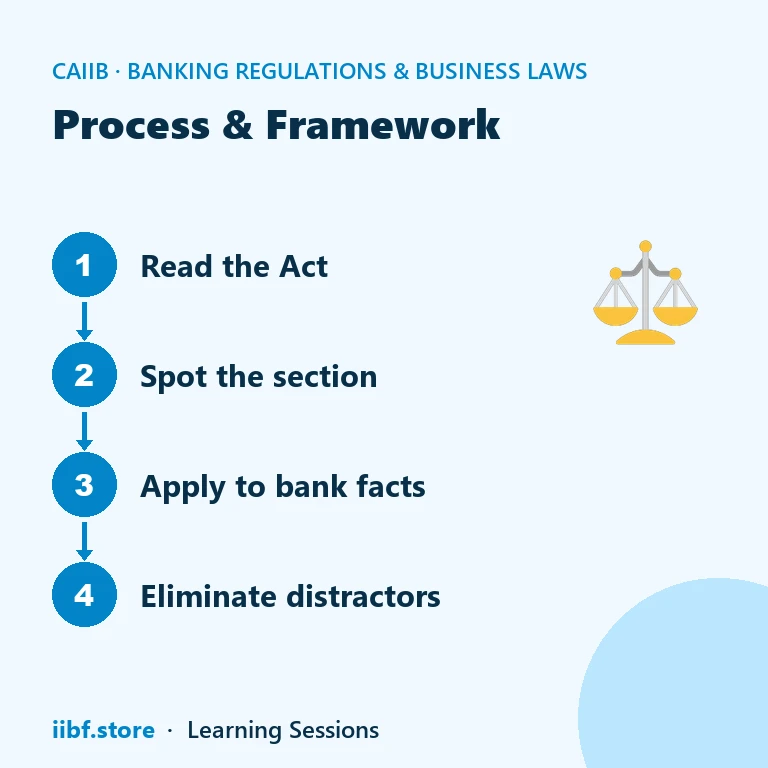
Step one, name the topic: relations of partners to third parties. Step two, name the rule: a partner is an agent of the firm, and the firm is bound by acts done within the partner's implied authority. Step three, apply: implied authority extends to acts done to carry on the business of the firm in the usual way. A borrowing for a purpose unconnected with the business falls outside it. Step four, eliminate: options that say "always bound" or "never bound" are both wrong, because the answer is conditional. The firm is not bound unless the other partners ratified the act or the bank can show the borrowing was within the usual course of that business.
That four-step loop — topic, rule, apply, eliminate — works on almost every Module D question, and it is faster than trying to recall a paragraph verbatim under exam pressure.
How to fit Module D into your remaining time
Do the Contract Act cluster first and do it properly; it is the base that guarantee, pledge and agency questions all sit on. Then take partnership and companies together, because the examiner likes contrasting them. Property and the special statutes come last and can be handled with a focused list rather than a full read, since RTI, the IT Act and the Prevention of Corruption Act are examined narrowly on definitions, penalties and appeal routes.
Remember the wider arithmetic while you do it. The pass mark is 50 out of 100 in a subject, with the alternative route of at least 45 in every subject and a 50% aggregate in a single attempt. This module can very comfortably be the block that moves you from 46 to 52 in BRBL, which is why leaving out CAIIB BRBL Module D is a worse bet than most candidates realise.
Work through the chapter notes in the CAIIB course library, then pressure-test yourself on the BRBL practice tests rather than re-reading. If you want the legal distinctions to stick without another read-through, the matching game drills exactly the pairs listed above. And confirm the syllabus against the official IIBF rules and syllabus documents before you plan, because module names and coverage are revised periodically.
What is CAIIB BRBL Module D called in the official syllabus?
It is titled "Commercial & Other Laws with Reference to Banking Operations" in the IIBF CAIIB Rules & Syllabus. It covers the Contract Act family, Sale of Goods, Partnership and LLP, company law, Transfer of Property, RTI, the IT Act and the Prevention of Corruption Act.
Do I need to memorise section numbers for Module D?
Not exhaustively. Questions overwhelmingly test application of the rule to a banking scenario. Know the handful of famous provisions the Institute's appendix highlights, and spend the rest of your time on distinctions like indemnity versus guarantee and pledge versus hypothecation.
How much of the BRBL paper comes from Module D?
IIBF does not publish a fixed module-wise weightage, so treat any specific percentage circulating online as unverified. What is reliable is that this is one of four modules in the paper and is examined every session, which makes skipping it a poor trade.
Is 50 marks enough to pass BRBL?
Yes. The minimum for a pass in a CAIIB subject is 50 out of 100. There is also an aggregate route: at least 45 marks in each subject with a 50% aggregate across all subjects in a single attempt is treated as having completed the examination.
Quick quiz on this topic
5 exam-style questions from our free test bank — check yourself before you move on.
Practice this topic
Take a free mock test, download chapter PDFs, or watch a video class — all included on iibf.store.
Keep reading