Asset Reconstruction Companies Under SARFAESI: CAIIB Guide
For CAIIB BRBL candidates, understanding the role of asset reconstruction companies under SARFAESI is one of the more scoring topics in the paper. Banks do not always recover bad loans themselves — a large share of stressed assets is sold to specialised entities called Asset Reconstruction Companies (ARCs), which exist only because the SARFAESI Act 2002 gave them a statutory framework. This article walks through what ARCs are, how they are regulated, how the securitisation and reconstruction process works, and where this fits against other recovery routes bankers already know, such as the DRT and the IBC.
📜 What Are Asset Reconstruction Companies?
An Asset Reconstruction Company is a specialised financial institution that buys non-performing assets (NPAs) from banks and other lenders and then works to recover value from them — either by restructuring the underlying business, selling the secured assets, or converting debt into equity. The concept was introduced by the Securitisation and Reconstruction of Financial Assets and Enforcement of Security Interest (SARFAESI) Act, 2002, which for the first time gave Indian lenders a legal route to enforce security interests without going to court, and simultaneously created the ARC as a distinct category of entity.
Before SARFAESI, banks either pursued civil suits, approached the Debt Recovery Tribunal, or wrote off bad loans. ARCs changed the economics of NPA resolution: a bank can now sell a pool of stressed loans to an ARC at a negotiated price, clean up its balance sheet immediately, and let the ARC — which specialises in workouts — pursue recovery over a longer horizon. This is directly relevant to the NBFC chapter in BRBL, since ARCs are registered and regulated in a manner similar to non-banking financial companies, under a dedicated RBI framework.
🏛️ SARFAESI Act 2002 and the Legal Basis for ARCs
The SARFAESI Act has three functional pillars: securitisation of financial assets, asset reconstruction, and enforcement of security interest without court intervention. ARCs operate primarily under the first two pillars. Under the Act, an ARC can acquire financial assets from a bank or financial institution either by outright purchase or by issuing security receipts to the originating lender against a pool of assets.
Once an ARC acquires a financial asset, it effectively steps into the shoes of the original lender for enforcement purposes — it can invoke the same security-interest enforcement powers under Section 13 of the Act that a bank could. This is why the topic sits inside the broader legal framework of regulation of banks that BRBL candidates must know cold — ARCs are not outside the banking regulatory perimeter, they are a purpose-built extension of it.
💡 Exam Tip: Remember the three pillars of SARFAESI — securitisation, asset reconstruction, and enforcement of security interest — examiners frequently ask which pillar a given ARC activity falls under.
📋 RBI Registration and Ownership Norms for ARCs
No entity can carry on the business of securitisation or asset reconstruction in India without a certificate of registration from the Reserve Bank of India under Section 3 of the SARFAESI Act. The RBI's Master Directions for ARCs lay down minimum owned fund (net owned fund) requirements, sound corporate governance, fit-and-proper criteria for directors and shareholders, and a cap on sponsor shareholding to prevent an ARC from becoming a captive vehicle of the very bank whose assets it is meant to independently resolve.
The RBI also prescribes minimum investment norms — an ARC must retain a stake in the security receipts it issues against an acquired asset pool, so that its own recovery incentives stay aligned with the investors who hold the remaining receipts. This "skin in the game" requirement is a recurring exam point, along with the RBI's supervisory powers to inspect ARCs, call for information, and cancel registration for non-compliance.
⚠️ Common Mistake: Candidates often confuse ARC registration under SARFAESI with NBFC registration under the RBI Act — the two frameworks are related but the statutory basis and the specific Master Direction are different.
🔄 How Securitisation and Asset Reconstruction Work in Practice
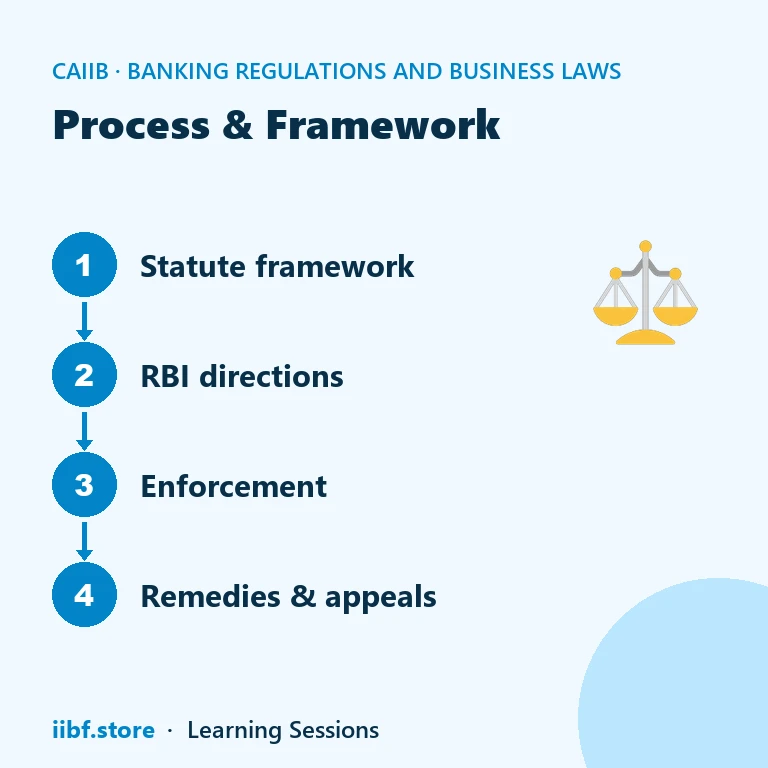
When a bank sells an NPA account to an ARC, the sale is typically structured as a transfer of the financial asset in exchange for cash, security receipts (SRs), or a mix of both. SRs represent an undivided interest in the underlying pool of assets and are typically subscribed to by qualified institutional buyers such as banks, insurance companies, and mutual funds — the ARC itself acts as trustee and asset manager for the trust holding the pool.
Once the assets are on its books, the ARC has several recovery levers under the Act: taking possession of secured assets and selling or leasing them, taking over management of the borrower's business, entering into a settlement, or converting a part of the debt into equity of the borrower company (subject to RBI-prescribed conditions). This flexibility is what distinguishes the ARC route from a straightforward SARFAESI enforcement action taken directly by the bank. An ARC does not simply "write off" debt — it acquires it at a discount and then actively works the recovery through possession, sale, restructuring, or equity conversion.
⚖️ ARC Route vs Other NPA Recovery Mechanisms
BRBL candidates are frequently tested on which recovery mechanism applies in a given fact pattern. The table below places the ARC/SARFAESI route alongside the other recovery mechanisms covered under regulation of banking business in the syllabus.
| Recovery Route | Who Drives Recovery | Governing Law | ARC Involved? |
|---|---|---|---|
| Direct SARFAESI enforcement | Bank/FI itself | SARFAESI Act, 2002 | ❌ No |
| Sale of NPA to an ARC | ARC, after acquiring the debt | SARFAESI Act, 2002 (securitisation & reconstruction provisions) | ✅ Yes |
| Debt Recovery Tribunal suit | Tribunal, on bank's application | Recovery of Debts and Bankruptcy Act, 1993 | ❌ No |
These routes are not mutually exclusive across a bank's NPA portfolio — a lender may pursue direct SARFAESI action on one account, sell another to an ARC, and refer a third for corporate insolvency resolution under the IBC, depending on which route maximises recovery and speed for that specific account.
🧾 Recent Trends and What Bankers Should Watch
The ARC industry has matured considerably since the SARFAESI Act was first notified, with amendments over the years strengthening RBI's supervisory powers, tightening related-party and sponsor norms, and pushing for greater transparency in how security receipts are valued and traded. For working bankers, the practical takeaway is that selling to an ARC is now a mainstream balance-sheet management tool, not a last resort — boards evaluate it alongside restructuring and IBC referral as part of routine NPA resolution strategy.
This also connects to broader financial-stability oversight: large-scale stressed-asset resolution through ARCs is one of the data points tracked under the Financial Sector Legislative Reforms and Financial Stability and Development Council chapter, since systemic NPA levels feed directly into FSDC's macro-prudential monitoring. Bankers should also keep an eye on the RBI's periodic Master Direction updates on ARCs, available on the RBI website, since registration norms and net owned fund thresholds are revised from time to time.
🧠 Practice MCQs: Asset Reconstruction Companies Under SARFAESI
Q1. Which Act provides the statutory basis for Asset Reconstruction Companies in India? (a) Banking Regulation Act, 1949 (b) SARFAESI Act, 2002 (c) Insolvency and Bankruptcy Code, 2016 (d) Recovery of Debts and Bankruptcy Act, 1993
Answer: (b) — The SARFAESI Act, 2002 created the statutory framework for securitisation, asset reconstruction, and enforcement of security interest, including the registration of ARCs.
Q2. Under SARFAESI, which authority grants the certificate of registration to an entity wishing to carry on asset reconstruction business? (a) SEBI (b) IBBI (c) Reserve Bank of India (d) Ministry of Corporate Affairs
Answer: (c) — Section 3 of the SARFAESI Act requires RBI registration before any entity can carry on the business of securitisation or asset reconstruction.
Q3. What are Security Receipts (SRs) as used by ARCs? (a) Fixed deposit certificates issued by ARCs (b) An undivided interest in the pool of financial assets acquired by an ARC (c) Equity shares of the borrower company (d) A guarantee issued by the originating bank
Answer: (b) — SRs represent an undivided interest of the SR holder in the underlying pool of assets held by the ARC as trustee.
Q4. When an ARC acquires a financial asset from a bank, what enforcement power does it typically obtain? (a) None, it can only negotiate settlements (b) The same Section 13 security-interest enforcement powers the original lender held (c) The power to initiate criminal prosecution against the borrower (d) Only the power to sell the asset at auction after five years
Answer: (b) — Once it acquires the asset, the ARC steps into the shoes of the original lender and can invoke Section 13 enforcement powers under SARFAESI.
Q5. Which of the following is NOT among the recovery options available to an ARC after acquiring a stressed asset? (a) Taking possession and selling the secured asset (b) Taking over management of the borrower's business (c) Converting part of the debt into equity, subject to RBI conditions (d) Directly initiating a criminal trial against the promoter for non-payment
Answer: (d) — Non-payment of a commercial debt is not by itself a criminal offence; ARC recovery tools are civil/commercial in nature (possession, sale, management takeover, restructuring, or equity conversion).
Want chapter-wise mock tests with 100+ MCQs? Start practising free →
Frequently Asked Questions
Are ARCs the same as NBFCs?
No. ARCs are registered under Section 3 of the SARFAESI Act and follow a dedicated RBI Master Direction, whereas NBFCs are registered under the RBI Act. Both are RBI-regulated non-bank entities, but the statutory basis, permitted activities, and prudential norms differ.
Can a bank sell any NPA account to an ARC?
In principle yes, subject to the bank's board-approved policy, RBI norms on sale of stressed assets, and the pricing/valuation being commercially justified. Certain categories of borrowers and asset classes may have additional conditions attached.
What happens to a borrower once their loan is sold to an ARC?
The ARC becomes the new creditor and can pursue the same enforcement and recovery routes the original lender could, including SARFAESI action, settlement negotiations, or restructuring. The borrower's underlying repayment obligation does not change merely because the lender changed.
How does the ARC route differ from referring an account to the IBC?
The ARC route is a bilateral commercial sale of the debt outside any tribunal, while the IBC route is a formal, time-bound insolvency resolution process before the NCLT involving a committee of creditors. Banks choose between the two — or use both across different accounts — based on which is likely to maximise recovery.
Asset reconstruction companies are now a core part of how Indian banks manage stressed assets, and BRBL examiners test this topic from multiple angles — the statutory basis, RBI registration norms, and how the ARC route compares with DRT and IBC recovery. For a deeper dive into related recovery mechanisms, see our guide on lok adalat for loan recovery, and if PSL-linked stressed accounts come up in your reading, our note on priority sector lending certificates is a useful cross-reference from the Rural Banking elective. For the compliance angle on onward reporting once an ARC takes over an account, see PMLA reporting obligations for bankers. If you are revising the full module, our CAIIB BRBL Module D previous-year-questions roundup is a good companion read, and you can browse every article in this area on the Banking Regulations and Business Laws tag hub. Ready to test yourself? Try full-length mock tests on the CAIIB course page and lock in this topic before exam day.
Quick quiz on this topic
5 exam-style questions from our free test bank — check yourself before you move on.
Practice this topic
Take a free mock test, download chapter PDFs, or watch a video class — all included on iibf.store.
Keep reading