CAIIB BRBL Study Plan: 28 Days While Working Full Time
It is 9:40 pm. The branch closed late, the audit queries are still open in your head, and the CAIIB books are on the table. Banking Regulations and Business Laws looks like the worst of the lot: Act after Act, section after section, and a syllabus that seems to have no end. If that is you, this CAIIB BRBL study plan is written for you, not for a full-time student with six free hours a day.
The plan below assumes about 60 to 90 minutes on weekdays and a longer block on weekends. It works whether or not you buy any book, because the method matters more than the material. Take it, adapt it to your own shifts, and start tonight.
Why BRBL feels harder than it is
Most bankers do not struggle with BRBL because the ideas are difficult. They struggle because the paper is wide. There are regulation chapters, a long run of statutes, and a full commercial-law module, and each one has its own vocabulary. When everything looks equally heavy, the brain refuses to start.
The fix is to see the paper as four blocks and treat each block differently:
- Regulation block: who regulates banks and how. You already meet this in daily work, so it reads faster than you expect.
- Statute block: Acts that you have heard of but rarely read, such as PMLA, the Negotiable Instruments Act, FEMA, SARFAESI and the Recovery of Debts law. Here you need definitions, who-does-what and the key procedures.
- Commercial law block: contract, guarantee, bailment, pledge, agency, sale of goods, partnership and companies. This is classic law and rewards understanding the logic, not rote.
- Newer-law block: RTI, the Information Technology Act, the Prevention of Corruption Act and similar chapters that are short but easy to forget.
Once you see four blocks, the paper stops being one giant wall. You can finish a block, tick it off and feel progress, which is exactly what a tired mind needs.
Ground rules for your CAIIB BRBL study plan
Fix a slot, not a mood
Do not wait to feel fresh. Pick one fixed slot, for example 9:30 to 10:45 pm, and treat it like a branch deadline. Consistency beats intensity in a 28-day run.
Read first, then test the same day
Law is easy to forget and easy to confuse. The best protection is to attempt MCQs on the same chapter on the same day, while it is fresh. Wrong answers show you what you really did not understand, which is far more useful than a second reading.
Keep an error list
Keep one page, physical or on your phone, where you write every question you got wrong and the one-line reason. In the last week you revise this list, not the whole book. For a law paper, this single habit saves more time than anything else.
What the printed book gives you
If you prefer to study from paper, away from the phone that keeps buzzing with branch messages, the CAIIB BRBL printed book follows the same four-module structure used in this plan. The facts, so you can judge for yourself:
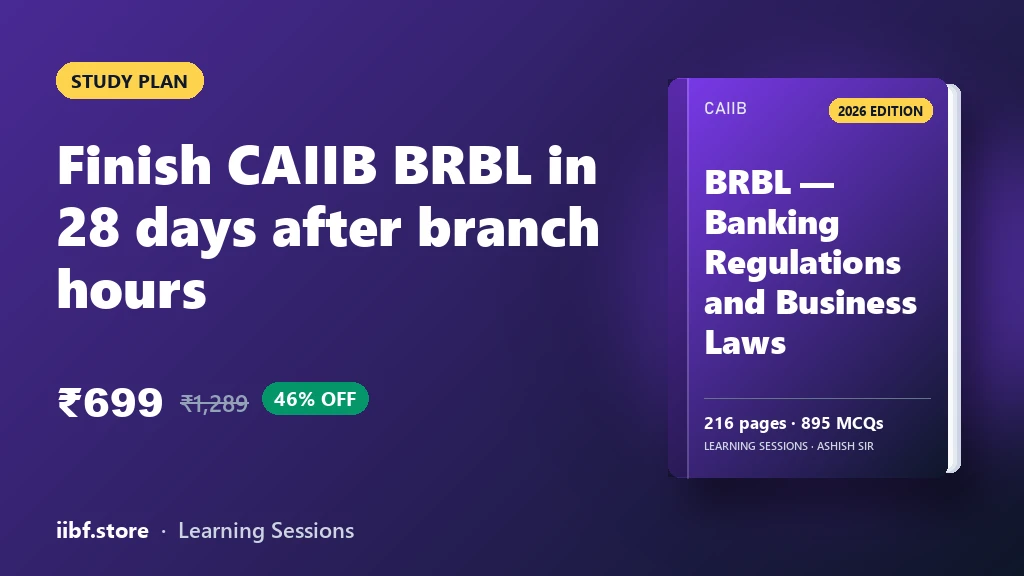
- 216 pages in the 2026 edition
- 62 chapters across Modules A to D
- 895 questions for practice
- 100 case studies, with 400 questions, as an extra
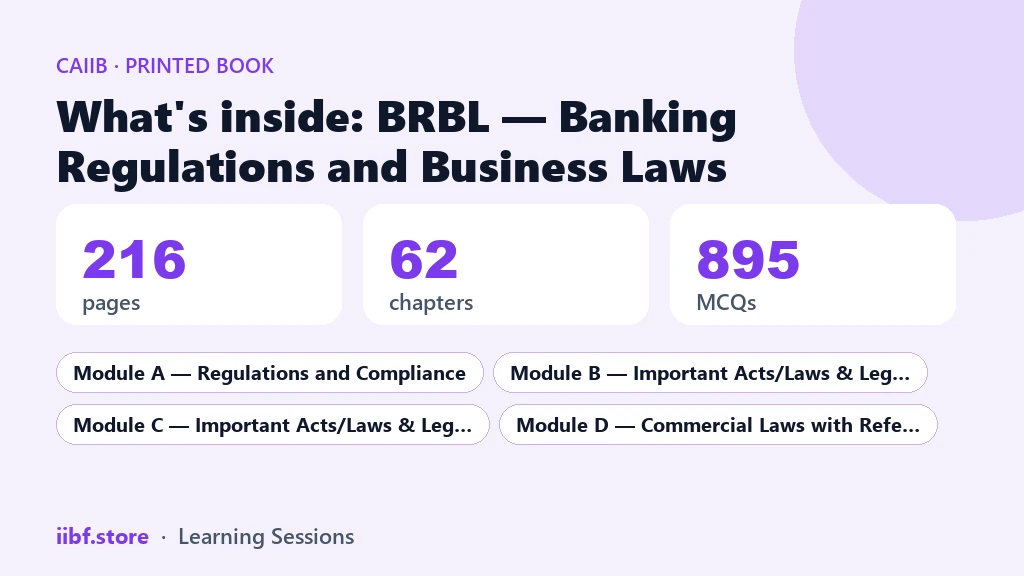
The modules run like this: Module A on regulations and compliance (7 chapters), Module B on important Acts and legal aspects of banking operations (6 chapters), Module C, the second part of those Acts (21 chapters), and Module D on commercial laws with reference to banking operations (28 chapters). Those chapter counts are the backbone of the schedule below.
Prices can change, so check the book page for the current figure. At the time of writing it is listed at ₹699 against an MRP of ₹1,289.
The 28-day CAIIB BRBL study plan
Here is the whole plan in one view. The MCQ numbers are rough averages (895 questions over 62 chapters is roughly 14 per chapter), so some days will have more and some less. Treat them as targets, not rules.
| Days | What to read | Chapters | MCQ target |
|---|---|---|---|
| 1 to 3 | Module A: legal framework, control over organisation, regulation of banking business, returns and inspection, bank types, NBFCs, financial sector reforms | 7 | about 100 |
| 4 to 5 | Module B: PMLA, Negotiable Instruments Act, FEMA, Payment and Settlement Systems Act, securities and charges | 6 | about 85 |
| 6 to 14 | Module C: Ombudsman scheme, MSME Act, SARFAESI, Recovery of Debts, IBC, Bankers Books Evidence Act, Lok Adalats, Consumer Protection, Limitation, Tax laws | 21 | about 300 |
| 15 to 25 | Module D: contract, indemnity, guarantee, bailment, pledge, agency, sale of goods, partnership, companies, LLP, TPA, RTI, IT Act, Prevention of Corruption | 28 | about 400 |
| 26 to 28 | Error list, weak chapters, full mock tests | revision | timed mocks |
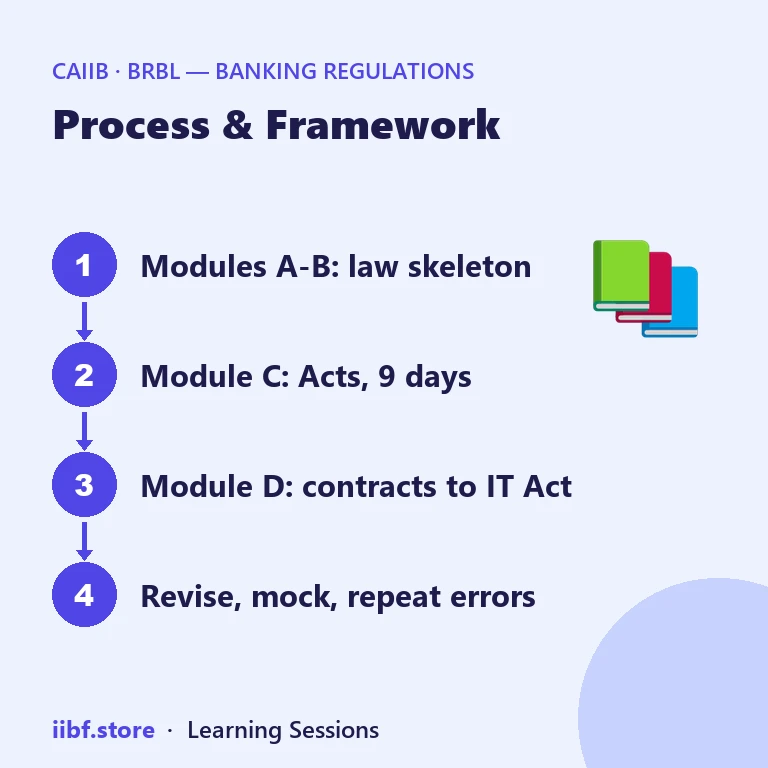
Days 1 to 3: Module A, the skeleton
Start with regulation because it connects to your work. Read two to three chapters a day, and write a four-line summary of each in your own words. By the end of day 3 you should be able to explain, without looking, who controls bank licensing, what returns banks file and how different bank types are regulated. Do the chapter MCQs the same night.
Days 4 and 5: Module B, the Acts you meet at work
Six chapters in two days is fast, but you already know the ground from branch life: cheque dishonour, KYC, foreign exchange, payment systems, charges on security. Focus on definitions, time limits and who can do what. Anything you cannot recall goes straight into the error list.
Days 6 to 14: Module C, the long middle
This is where most candidates lose steam, so give it nine days. Take roughly two to three chapters a day. A sensible split:
- Days 6 to 7: Ombudsman scheme, MSME Act and the opening SARFAESI chapters.
- Days 8 to 10: the rest of SARFAESI: definitions, securitisation regulation, enforcement of security interest, Central Registry, offences and penalties.
- Days 11 to 12: Recovery of Debts and Bankruptcy Act: tribunals, powers, procedure, recovery, followed by the Insolvency and Bankruptcy Code introduction.
- Days 13 to 14: Bankers Books Evidence Act, Lok Adalats, Consumer Protection Act, Limitation and tax laws.
Do not skip the small Acts. A short chapter often supplies two or three easy marks that long chapters cannot guarantee.
Days 15 to 25: Module D, commercial law
Module D has the most chapters, 28 in all, but they are short and logical. Group them: contract basics, indemnity, guarantee, bailment, pledge and agency in the first three or four days; sale of goods in one or two; partnership in two; company law in three; and the last block of LLP, Transfer of Property, RTI, IT Act and Prevention of Corruption in the final two days.
Guarantee, pledge and bailment deserve extra time because they link directly to lending and security. Understanding why a rule exists helps you answer an application question even if you do not remember the exact wording.
The nightly routine that fits a tired brain
For a 75-minute weekday slot, this split works well:
- 10 minutes: look over yesterday's error list.
- 35 minutes: read today's chapters actively, with a pencil in hand.
- 25 minutes: attempt the chapter MCQs without peeking.
- 5 minutes: note wrong answers and the reason.
On weekends, add one block of 90 minutes to revisit the week's weakest chapters. If you miss a day, do not try to double up. Slide the plan forward by a day and keep going; the last three days are a buffer for exactly this reason.
You can also use the free resources on iibf.store to support this routine: the free mock tests for timed practice and the free study material for quick revision notes. Our CAIIB course page lists the other papers if you are planning the whole cycle.
Days 26 to 28: close the CAIIB BRBL study plan with mocks
The last three days are for consolidation, not new reading. Spend day 26 on your error list and the chapters you rated weak. On day 27 take a timed mock test in one sitting, and on day 28 review every wrong answer and re-read only those topics.
Here is the honest limit: reading plus chapter MCQs builds knowledge, but it does not by itself give you exam-hall speed. That only comes from timed mocks, so do not skip them. Use the BRBL book for the reading and practice, and the mocks for pace.
Also check the official schedule and syllabus notices before you fix your dates. Exam dates, fees, attempt rules and syllabus details change from cycle to cycle, so rely on the IIBF website for the upcoming exam cycle and not on anyone's memory, including ours.
Common mistakes that break a CAIIB BRBL study plan
- Reading the whole Act: you need the chapter-level essentials, not every section.
- Delaying MCQs until the end: by then you have forgotten what the first modules said.
- Spending a week on Module A: it feels familiar, so it quietly eats time that Module C needs.
- Ignoring the case studies: application questions reward people who have practised reading a short fact pattern and picking the legal rule.
- Studying only on weekends: two long days cannot replace twenty short ones for retention.
Putting it together
Four modules, 62 chapters, one fixed nightly slot and an error list. That is the whole CAIIB BRBL study plan, and it is deliberately modest because modest plans survive busy branch weeks. Start with Module A tonight, finish the chapter MCQs before you sleep, and repeat. If you want to pair the plan with a printed companion, the book page has the current price and a free sample; for more articles like this, browse the iibf.store blog or see the full range at iibf.store/books.
Frequently asked questions
Can I really finish BRBL in 28 days with a full-time job?
For many people, yes, at around 60 to 90 minutes a day, if you have read some of the subject before. If you are starting from zero or your job is demanding, stretch the plan to 40 days by giving Module C and Module D more days. The order stays the same.
Should I read the chapters in book order?
Yes. The book is built Module A to Module D, and the plan follows it. Regulations first gives you the context that the later Acts build on, and commercial law at the end is easier once you have seen banking statutes.
How many MCQs should I do each day?
Aim for roughly 14 per chapter, which is what 895 questions across 62 chapters averages out to. On a two-chapter day that is about 28 questions. Some chapters will have more and some less, so go by the book rather than a fixed number.
Is a printed book enough, or do I need mock tests as well?
Use both. A book gives structure and practice questions, but timed mock tests build the speed and exam-hall habit that reading alone cannot. Check the book page for the current price and the free sample before you decide.
Prefer revising from a printed book?
Chapter-wise books with MCQs after every chapter — minimal pages, complete coverage, delivered anywhere in India. Every book has a free sample to read first.
216 pages · 895 MCQs
Learning Sessions · Ashish Sir
148 pages · 478 MCQs
Learning Sessions · Ashish Sir
151 pages · 465 MCQs
Learning Sessions · Ashish Sir
148 pages · 375 MCQs
Learning Sessions · Ashish Sir
109 pages · 300 MCQs
Learning Sessions · Ashish Sir
104 pages · 360 MCQs
Learning Sessions · Ashish Sir
82 pages · 297 MCQs
Learning Sessions · Ashish Sir
151 pages · 600 MCQs
Learning Sessions · Ashish Sir
98 pages · 282 MCQs
Learning Sessions · Ashish Sir
131 pages · 672 MCQs
Learning Sessions · Ashish Sir
221 pages · 831 MCQs
Learning Sessions · Ashish Sir
128 pages · 524 MCQs
Learning Sessions · Ashish Sir
107 pages · 445 MCQs
Learning Sessions · Ashish Sir
132 pages · 225 MCQs
Learning Sessions · Ashish Sir
188 pages · 435 MCQs
Learning Sessions · Ashish Sir
117 pages · 236 MCQs
Learning Sessions · Ashish Sir
Learning Sessions · Ashish Sir
118 pages · 299 MCQs
Learning Sessions · Ashish Sir
Learning Sessions · Ashish Sir
Learning Sessions · Ashish Sir
Learning Sessions · Ashish Sir
115 pages · 255 MCQs
Learning Sessions · Ashish Sir
Learning Sessions · Ashish Sir
334 pages · 936 MCQs
Learning Sessions · Ashish Sir
Learning Sessions · Ashish Sir
115 pages · 344 MCQs
Learning Sessions · Ashish Sir
107 pages · 240 MCQs
Learning Sessions · Ashish Sir
90 pages · 150 MCQs
Learning Sessions · Ashish Sir
Learning Sessions · Ashish Sir
Quick quiz on this topic
5 exam-style questions from our free test bank — check yourself before you move on.
Practice this topic
Take a free mock test, download chapter PDFs, or watch a video class — all included on iibf.store.