CAIIB Rural Banking Study Plan for Working Bankers: 21 Days
It is 8:45 pm. You have closed the branch, travelled home, eaten something, and you have perhaps ninety minutes of real attention left. The Rural Banking elective looks huge: demographics, agriculture, credit institutions, priority sector, microfinance, technology. If this is how you feel, a good CAIIB Rural Banking study plan is not about heroic six-hour weekends. It is about small, repeatable evenings in the right order.
This article gives you that plan, built around the four modules of the paper. Even if you never buy any book, you can take the table, the method and the revision loop and use them with whatever material you already have.
Why Rural Banking feels harder than it is
Most bankers who postpone this elective are not scared of difficult concepts. They are scared of breadth. There are no long numerical derivations like some other electives; instead there is a lot of descriptive material, many institutions with similar names, and policies that you half-know from branch work but have never studied in sequence.
The fix is to stop treating it as one big subject. It is four modules, and each one has a different job:
- Module A builds the background: rural India, its society, economy, infrastructure, agriculture and the policies around them.
- Module B is the credit machinery: regulation, institutions, agriculture finance, non-farm sector, SME finance and project appraisal.
- Module C is where schemes and targets live: priority sector lending, poverty alleviation programmes, housing and education loans, and RBI initiatives on financial inclusion.
- Module D looks ahead: emerging trends, technology in financial inclusion, and micro credit with Self Help Groups.
Once you see this shape, the paper stops being a fog. You always know which of the four boxes you are in, and a CAIIB Rural Banking study plan simply walks through the boxes in order.
The method that works after a full day at the branch
A tired brain does not need a clever technique. It needs a small, fixed routine that survives a bad day. Use this for every chapter:
Read first, then test, then re-read only the misses
- Read the chapter once, without highlighting everything. Mark only names, numbers and lists that you could be asked directly.
- Attempt the end-of-chapter MCQs the same evening. Do not wait for the weekend. Memory fades fast, and testing is what makes it stick.
- Re-read only the paragraphs behind the questions you got wrong. This is where the real learning happens, and it takes ten minutes, not an hour.
Keep a single sheet of paper titled "things I keep forgetting". Institution names, scheme features and priority sector categories go here. You will read this sheet more often than any chapter.
Be honest about one limit: reading and chapter MCQs will give you knowledge, not exam-hall speed. Pair the plan below with full-length mock tests, which you can attempt free at iibf.store/tests, in the last week.
What is inside the Rural Banking book
If you want one printed reference to follow this plan, the CAIIB Elective Rural Banking book is organised exactly along the four modules above. Here are its facts, so you can judge whether it fits your style:
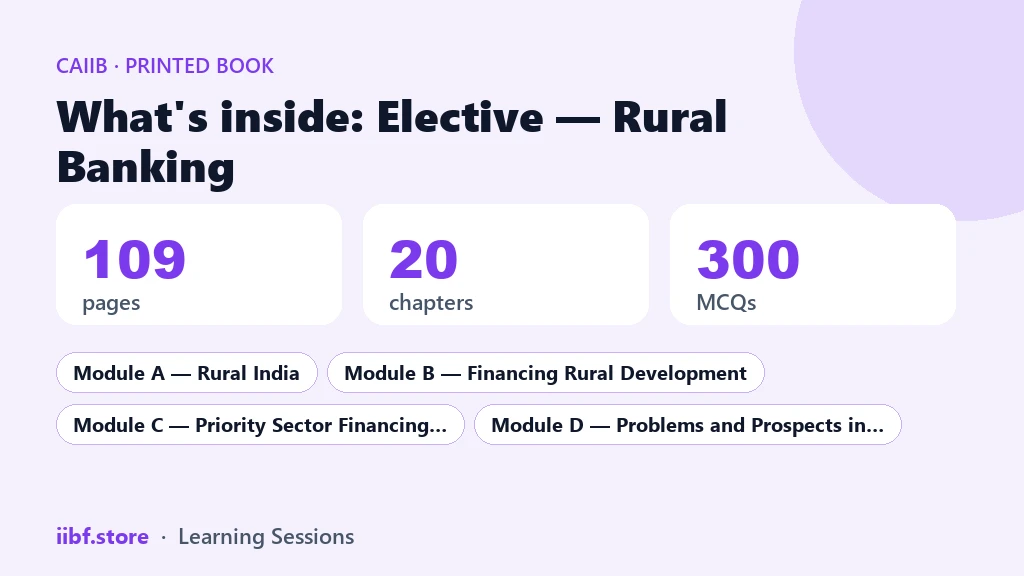
- 109 pages, 20 chapters, 300 questions, 2026 edition.
- Module A: Rural India (7 chapters, from Demographic Features to Issues Concerning Rural Areas).
- Module B: Financing Rural Development (6 chapters, from Regulation of Rural Financial Services to project formulation and appraisal).
- Module C: Priority Sector Financing and Government Initiatives (4 chapters).
- Module D: Problems and Prospects in Rural Banking (3 chapters).
- An extra set of 60 case studies (240 questions).
At 109 pages for 20 chapters, each chapter is short enough to finish in a single evening, which is exactly what a working banker needs. The list price is ₹1,289 and the current price is ₹699 (46% off); prices can change, so check the book page for today's figure.
The 21-day CAIIB Rural Banking study plan
The plan below gives each chapter roughly one evening, with the last day kept free for revision. The MCQ numbers are an average: 300 questions across 20 chapters is about 15 per chapter, so treat the counts as a guide, not a rule. If a chapter has fewer questions, finish them and move on; if it has more, do them all.
| Days | What to read | MCQs to attempt |
|---|---|---|
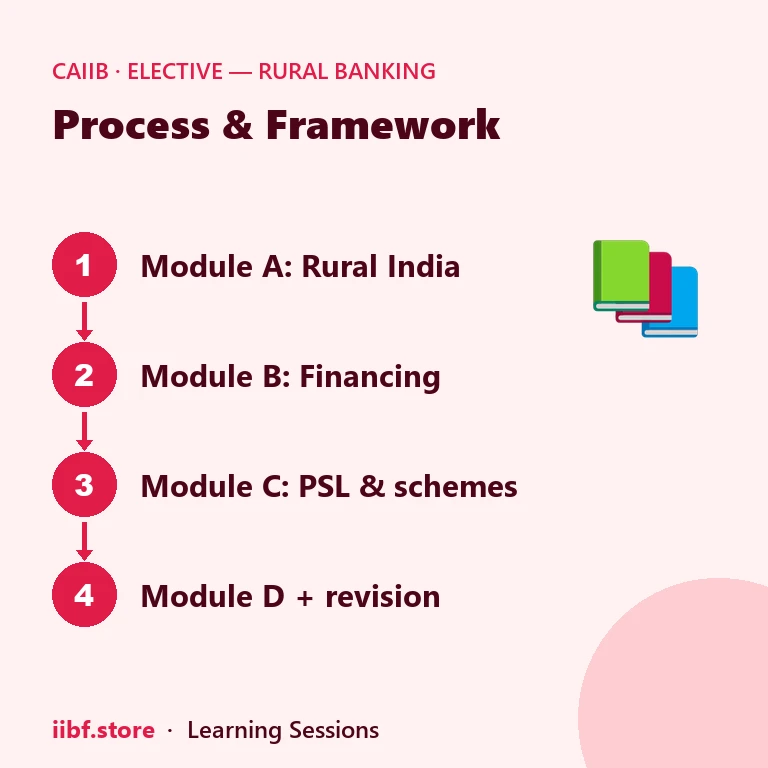
| Day 1 to 7 | Module A: Demographic Features, Characteristics of Rural Society, Economic Features, Infrastructure, Agriculture Economy, Rural Development Policies, Issues Concerning Rural Areas (one chapter per evening) | About 15 per chapter, around 100 in total |
| Day 8 to 13 | Module B: Regulation of Rural Financial Services, Rural Credit Institutions, Financing Agriculture and Allied Activities, Financing Rural Non-Farm Sector, SME Finance, Project Formulation and Appraisal | About 15 per chapter, around 90 in total |
| Day 14 to 17 | Module C: Priority Sector Lending, Poverty Alleviation Programs, Rural Housing and Education Loans, RBI Initiatives on Financial Inclusion and Financial Education | About 15 per chapter, around 60 in total |
| Day 18 to 20 | Module D: Emerging Trends in Rural Banking, Technology in Financial Inclusion, Micro Credit and Self Help Groups | About 15 per chapter, around 45 in total |
| Day 21 | Your "things I keep forgetting" sheet plus every MCQ you got wrong | Redo only the wrong ones |
How to use the weekend
Weekdays are for new chapters, 60 to 90 minutes each. If you miss a day, do not try to double up the next evening; that is how plans collapse. Instead, use Saturday or Sunday as your catch-up slot and keep the weekday routine untouched. A plan that bends is a plan that finishes.
Where to slow down
Some chapters deserve a second evening. Rural Credit Institutions and Priority Sector Lending have many names, categories and features that look alike, so give them extra time and extra passes over your forgetting sheet. Project formulation and appraisal in Module B is more conceptual, so read it slowly rather than skimming.
Using the case studies without panic
The book also includes 60 case studies with 240 questions. Do not touch them in the first pass. Finish all four modules first, then pick up a few case studies at a time in the last week. Case-based questions test whether you can apply a concept to a branch-like situation, and that is far easier once the chapters are fresh in your head. Treat each case as a small rehearsal: read the scenario, decide the answer yourself, and only then check it.
Free resources to use alongside the plan
You do not have to depend on one source. Pair the plan with these free pages on the site:
- Free study material and PDFs for extra revision notes.
- Free mock tests to build speed in the final week.
- The CAIIB course page to see how this elective fits with the other papers.
- The blog for more exam-preparation articles.
For the official schedule, syllabus and application details of the upcoming exam cycle, always check the IIBF website directly. Do not rely on forwarded messages for dates.
Making the plan stick
The best CAIIB Rural Banking study plan is the one you can repeat on your worst day. Fix the same hour every evening, keep the book and your forgetting sheet where you can see them, and tell one colleague what you are doing so someone asks you about it. Twenty-one short evenings are far more realistic than one impossible weekend.
If you prefer printed pages you can carry to the branch and read in a spare ten minutes, the Rural Banking printed book follows this exact module order, and you can read the free sample before ordering. You can also browse the full range at iibf.store/books. A book will not attempt the paper for you, so pair it with mock tests, but it does remove the biggest obstacle, which is not knowing what to read next.
Frequently asked questions
Can I really cover Rural Banking in 21 days while working?
For many people, yes, if you give it 60 to 90 minutes on most evenings and use weekends for catch-up. The paper is 20 chapters, so one chapter per evening is a workable pace. If your job is heavier, stretch the same plan to 30 days; the order stays the same.
Should I do the MCQs before or after reading the chapter?
After. Read once, then attempt the questions the same evening, then revisit only the parts behind your wrong answers. This is faster than re-reading the whole chapter.
Is the book enough on its own?
It gives you a structured read and 300 MCQs, but exam-hall speed comes from full-length mock tests. Use the free mocks in your last week and check the official IIBF site for the latest exam information.
What if the price changes?
The price quoted here is ₹699 against an MRP of ₹1,289, but prices can change. The book page always shows the current price.
Prefer revising from a printed book?
Chapter-wise books with MCQs after every chapter — minimal pages, complete coverage, delivered anywhere in India. Every book has a free sample to read first.
109 pages · 300 MCQs
Learning Sessions · Ashish Sir
148 pages · 478 MCQs
Learning Sessions · Ashish Sir
151 pages · 465 MCQs
Learning Sessions · Ashish Sir
148 pages · 375 MCQs
Learning Sessions · Ashish Sir
216 pages · 895 MCQs
Learning Sessions · Ashish Sir
104 pages · 360 MCQs
Learning Sessions · Ashish Sir
82 pages · 297 MCQs
Learning Sessions · Ashish Sir
151 pages · 600 MCQs
Learning Sessions · Ashish Sir
98 pages · 282 MCQs
Learning Sessions · Ashish Sir
131 pages · 672 MCQs
Learning Sessions · Ashish Sir
221 pages · 831 MCQs
Learning Sessions · Ashish Sir
128 pages · 524 MCQs
Learning Sessions · Ashish Sir
107 pages · 445 MCQs
Learning Sessions · Ashish Sir
132 pages · 225 MCQs
Learning Sessions · Ashish Sir
188 pages · 435 MCQs
Learning Sessions · Ashish Sir
117 pages · 236 MCQs
Learning Sessions · Ashish Sir
Learning Sessions · Ashish Sir
118 pages · 299 MCQs
Learning Sessions · Ashish Sir
Learning Sessions · Ashish Sir
Learning Sessions · Ashish Sir
Learning Sessions · Ashish Sir
115 pages · 255 MCQs
Learning Sessions · Ashish Sir
Learning Sessions · Ashish Sir
334 pages · 936 MCQs
Learning Sessions · Ashish Sir
Learning Sessions · Ashish Sir
115 pages · 344 MCQs
Learning Sessions · Ashish Sir
107 pages · 240 MCQs
Learning Sessions · Ashish Sir
90 pages · 150 MCQs
Learning Sessions · Ashish Sir
Learning Sessions · Ashish Sir
Quick quiz on this topic
5 exam-style questions from our free test bank — check yourself before you move on.
Practice this topic
Take a free mock test, download chapter PDFs, or watch a video class — all included on iibf.store.