CAIIB ABFM Study Plan for Working Bankers: 30 Days
It is 9:30 pm. The branch closed late, the audit queries are still open, and the ABFM syllabus on your table looks like four subjects stuffed into one paper. If you are looking for a CAIIB ABFM study plan that works around a full-time bank job, this article is written for exactly that evening. No heroic six-hour days. A plan you can actually keep.
I will give you a day-wise schedule, a way to decide what to read and what to skip on a bad day, and a simple routine for MCQs. All of it is usable with any material you already have. Where it helps, I will show how the 25 chapters of the CAIIB ABFM book map onto the plan.
Why a CAIIB ABFM study plan must fit your branch day
Most failed attempts are not failures of intelligence. They are failures of schedule. A plan that needs three free hours every evening collapses in the first week, and then guilt makes it harder to restart.
So start from your real day, not your ideal day:
- Weekday evenings: assume 60 to 90 minutes, and expect to lose two evenings a week to work or family.
- Saturday or Sunday: assume one solid block of 3 to 4 hours.
- Commute or lunch: 15 to 20 minutes you can use for revising formulas or definitions.
Add that up and you get roughly 8 to 10 hours a week. That is enough for ABFM if you spend it on a fixed order of chapters instead of jumping around.
What ABFM really asks of you
ABFM mixes two kinds of learning. Module A (the management process) is conceptual: you read, understand and recall. Modules B and C (financial management and valuation) are numerical: you must practise sums until the method is automatic. Module D (emerging business solutions) is newer, topic-based material that rewards clean revision. Treat these as three different study modes and the paper stops feeling endless.
The 30-day CAIIB ABFM study plan, module by module
The table below splits the paper into 30 days. It follows the chapter order of the book, gives the numericals more days than the theory, and keeps the last two days free for revision. MCQ counts are approximate, because the book has 375 questions across 25 chapters, which is about 15 per chapter on average.
| Days | What to read | MCQs to solve |
|---|---|---|
| 1 to 6 | Module A: Basics of Management, Planning, Organizing, Staffing, Directing, Controlling (one chapter a day) | About 90, solved the same evening |
| 7 to 14 | Module B: Sources of Finance, Leverages, Capital Investment Decisions, International Capital Budgeting, Risk and Uncertainty, Decision Making (numericals get two days) | About 90, redo every wrong sum next day |
| 15 to 21 | Module C: Corporate Valuations, DCF Valuation, Non-DCF models, Special cases, Mergers and Acquisitions, Deal Structuring | About 90, formula sheet at the end |
| 22 to 28 | Module D: Hybrid Finance, Start-up Finance, Private Equity and Venture Capital, Artificial Intelligence, Business Analytics, Green and Sustainable Financing, SPAC | About 105, one chapter a day |
| 29 to 30 | Revision: wrong-answer notebook, formula sheet, one full mock test | Only the questions you got wrong |
If your job eats a week, do not compress the plan. Just slide every date forward. A 40-day plan that you finish beats a 30-day plan that you abandon on day 11.
A daily rhythm that survives a tiring day
- First 40 minutes: read the chapter once, pen in hand, marking only definitions, formulas and lists.
- Next 30 minutes: solve that chapter's MCQs without looking at the text.
- Last 10 minutes: write every wrong answer and the reason in one line in a small notebook.
That is 80 minutes. On a day when you only have 30, do the middle step alone. Solving questions teaches more than rereading.
Before you commit to any plan, check the official syllabus and schedule for the upcoming exam cycle on the IIBF website, because your start date should be counted back from the exam, not guessed.
Where the CAIIB ABFM book fits into the plan
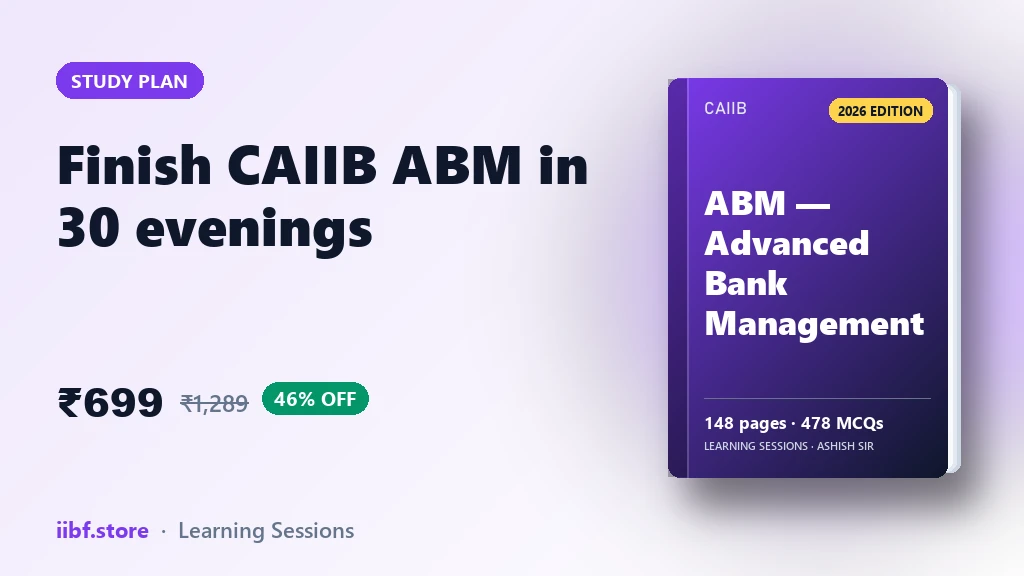
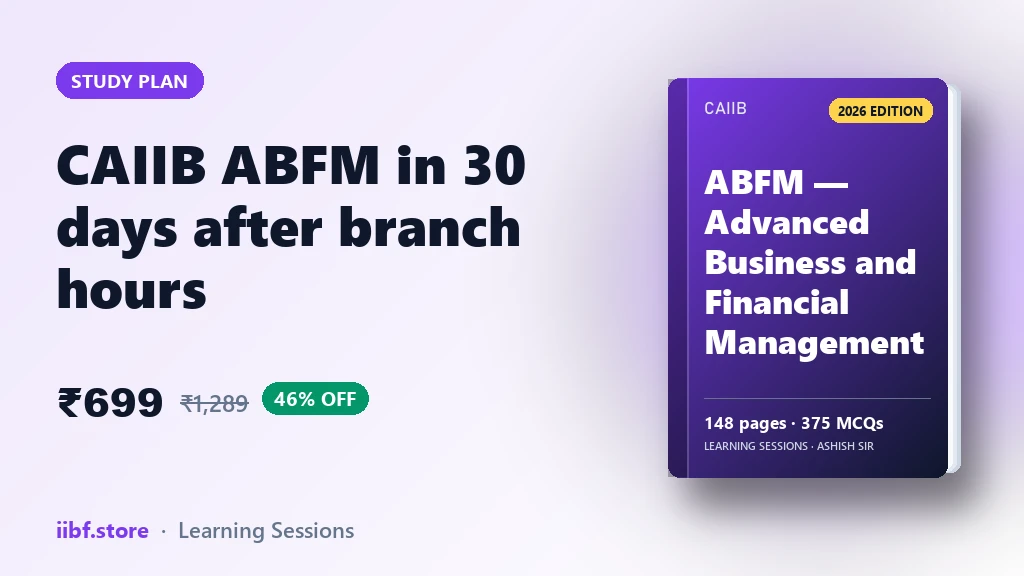
The CAIIB ABFM book is the 2026 edition printed study book for this paper: 148 pages, 25 chapters and 375 MCQs, arranged in the same four modules as the syllabus. The chapter sequence in the table above is simply the book's own order, so you never have to decide what comes next at 10 pm when your brain is switched off.
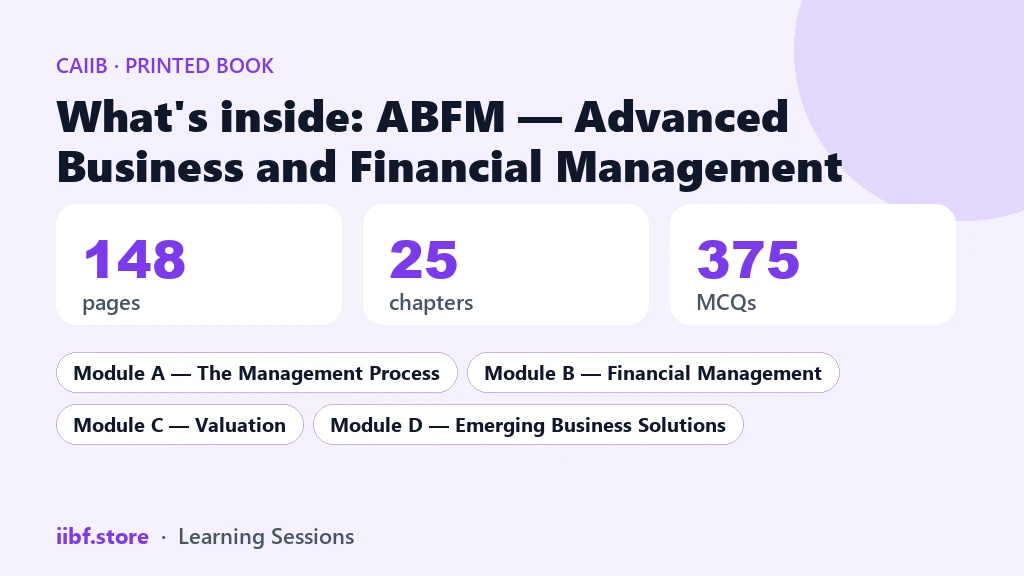
It also carries an extra set of 100 case studies with 400 questions. Keep these for the final week. Case-based questions need the concepts to be in place first, and the plan above builds those concepts module by module.
The price at the time of writing is ₹699 against an MRP of ₹1,289, but prices can change, so the book page is always the current source.
Turning the CAIIB ABFM study plan into a four-step routine
Every chapter, in every module, goes through the same four steps. The sameness is the point: when you are tired you should not have to think about how to study, only that you are studying.
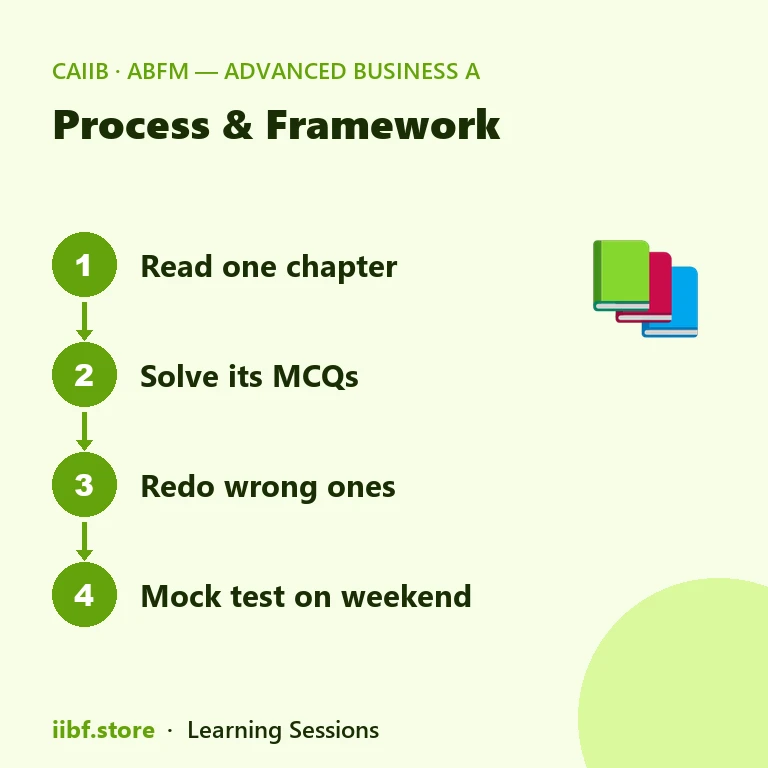
Step 1 and 2: read once, then solve
Read the chapter once, without trying to memorise. Then close it and attempt the MCQs. Your first attempt is a diagnosis, not an exam. A score of 8 out of 15 on the first try is normal and useful, because it shows exactly which paragraphs to reread.
Step 3: redo the wrong ones
Next evening, before starting the new chapter, spend ten minutes redoing yesterday's wrong answers. This one habit does more for retention than any extra hour of reading. For Modules B and C, redo the full working of each sum, not just the final answer.
Step 4: a weekend mock
Once a week, take a timed test. The free mock tests on iibf.store are a good place to start, and the free study material section has PDFs you can use for quick revision on the commute.
How to handle each module without burning out
Module A: management process
Six chapters, from Basics of Management to Controlling. These are the easiest to read and the easiest to forget. Make small comparison tables: planning versus controlling, staffing versus directing. Examiners love to test the difference between two neighbouring ideas.
Module B: financial management
This is where most working bankers lose marks, because sums need practice and practice needs time. Give leverages and capital investment decisions two evenings each. Write down the formula, then one solved example in your own handwriting. Capital budgeting, risk adjustment and decision making build on each other, so do not skip ahead.
Module C: valuation
Discounted cash flow is the spine. Once you are comfortable with it, the non-DCF models, special cases and the mergers and acquisitions chapters feel like variations rather than new subjects. Keep a one-page formula sheet that you refresh at the end of every chapter.
Module D: emerging business solutions
Hybrid finance, start-up finance, private equity, venture capital, artificial intelligence, business analytics, green financing and SPACs. These are topic-style chapters. Read them in one sitting each, and build a one-line summary for every chapter. They are quick marks if revised well.
Common mistakes that wreck a good plan
- Starting with the hardest module. Begin with Module A, so you build momentum in the first week.
- Reading all 25 chapters and solving questions at the end. By then you have forgotten the first ten chapters.
- Skipping the wrong-answer notebook. It is your personal revision guide and takes ten minutes a day.
- Studying only on weekends. Two short weekday sessions beat one long weekend binge.
- Collecting more material. One book finished twice is better than five books started.
One honest limit: a book alone will not give you exam-hall speed. Pair your reading with timed mock tests, and look at the CAIIB course page and the wider books collection if you are preparing the other papers as well.
Your first week, starting tonight
Do not wait for Monday. Open Module A tonight, read Basics of Management, and attempt its MCQs. Write your score in the notebook. That small act turns a plan into a habit.
A good CAIIB ABFM study plan is not the one with the most hours. It is the one you can still follow in week three, when work is heavy and motivation is low. Pick your start date, write the 30 days on a calendar, and protect your evening slot like you would protect a client meeting. For more preparation guides, browse the iibf.store blog.
Frequently asked questions
Can I follow a CAIIB ABFM study plan in less than 30 days?
Yes, if you can give more hours each day, but quality drops quickly. If your job is demanding, a longer schedule with the same order of chapters is safer than a rushed one.
How many MCQs should I solve every day?
Solve the MCQs of the chapter you read that day. With 375 questions across 25 chapters in the book, that works out to roughly 15 a day, plus a few from your wrong-answer notebook.
Which module should I study first?
Start with Module A, because it is the lightest and builds a daily habit. Move to the numerical Modules B and C once the routine is steady, and finish with Module D.
Is one book enough for ABFM?
One book studied properly, with repeated MCQs and weekly mock tests, is a sound base. Check the official syllabus on the IIBF website and use the book page to see exactly what is included before you decide.
Prefer revising from a printed book?
Chapter-wise books with MCQs after every chapter — minimal pages, complete coverage, delivered anywhere in India. Every book has a free sample to read first.
148 pages · 375 MCQs
Learning Sessions · Ashish Sir
148 pages · 478 MCQs
Learning Sessions · Ashish Sir
151 pages · 465 MCQs
Learning Sessions · Ashish Sir
216 pages · 895 MCQs
Learning Sessions · Ashish Sir
109 pages · 300 MCQs
Learning Sessions · Ashish Sir
104 pages · 360 MCQs
Learning Sessions · Ashish Sir
82 pages · 297 MCQs
Learning Sessions · Ashish Sir
151 pages · 600 MCQs
Learning Sessions · Ashish Sir
98 pages · 282 MCQs
Learning Sessions · Ashish Sir
131 pages · 672 MCQs
Learning Sessions · Ashish Sir
221 pages · 831 MCQs
Learning Sessions · Ashish Sir
128 pages · 524 MCQs
Learning Sessions · Ashish Sir
107 pages · 445 MCQs
Learning Sessions · Ashish Sir
132 pages · 225 MCQs
Learning Sessions · Ashish Sir
188 pages · 435 MCQs
Learning Sessions · Ashish Sir
117 pages · 236 MCQs
Learning Sessions · Ashish Sir
Learning Sessions · Ashish Sir
118 pages · 299 MCQs
Learning Sessions · Ashish Sir
Learning Sessions · Ashish Sir
Learning Sessions · Ashish Sir
Learning Sessions · Ashish Sir
115 pages · 255 MCQs
Learning Sessions · Ashish Sir
Learning Sessions · Ashish Sir
334 pages · 936 MCQs
Learning Sessions · Ashish Sir
Learning Sessions · Ashish Sir
115 pages · 344 MCQs
Learning Sessions · Ashish Sir
107 pages · 240 MCQs
Learning Sessions · Ashish Sir
90 pages · 150 MCQs
Learning Sessions · Ashish Sir
Learning Sessions · Ashish Sir
Quick quiz on this topic
5 exam-style questions from our free test bank — check yourself before you move on.
Practice this topic
Take a free mock test, download chapter PDFs, or watch a video class — all included on iibf.store.