CAIIB HRM Study Plan: 30 Days Alongside a Bank Job
It is 8:40 pm. You have closed the branch, finished the day's reconciliation, answered one last call from the regional office and eaten something quickly. Now you open the CAIIB syllabus and the Human Resources Management paper looks like a wall of theory: motivation models, industrial relations, discipline, green HRM, VUCA, AI in HR. You tell yourself you will start on Saturday. This article gives you a CAIIB HRM study plan that works on a tired weeknight, not on an imaginary free month.
The plan below is 30 days long, with about 60 to 90 minutes of study on working days and a little more on weekends. It is built around the order of the five modules, and it works with any decent material. Where it helps, we show how the CAIIB Elective HRM book fits in, because it is the tool we built for exactly this situation.
Why HRM feels harder than it is
HRM is a theory paper, and theory papers punish the wrong kind of study. Numerical papers let you practise until the method sticks. HRM asks you to remember who said what, which term belongs to which concept, and how one idea differs from its neighbour. Reading it once and hoping is the most common reason people postpone it.
Three habits usually sink working bankers here:
- Reading without testing. A chapter feels familiar after one read. Familiarity is not recall. You only find out what you really know when you answer questions.
- Starting at the end. Emerging topics like HR analytics and BANI look modern and interesting, so people read them first and run out of energy before Industrial Relations.
- Studying in one giant weekend block. Eight hours on Sunday and nothing on weekdays means you forget most of it by Thursday.
The fix is boring but it works: small daily reads, same-day questions, and one weekly look back at your mistakes.
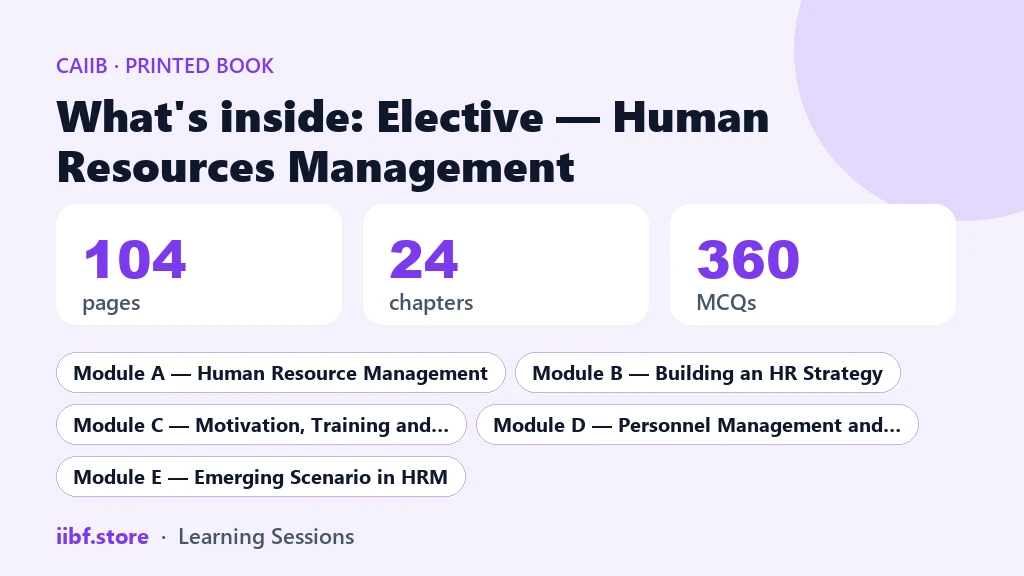
What you are actually studying: five modules, 24 chapters
Before you plan days, plan the territory. The paper is organised into five modules. In our book they are laid out like this:
- Module A, Human Resource Management (5 chapters): Fundamentals of HRM, Organisational Behaviour, Organisational Change, HRM in Indian Banks, Knowledge Management.
- Module B, Building an HR Strategy (5 chapters): HR as a Strategic Player, CEO and his-her Team, Communication, HR Functions, Performance Management.
- Module C, Motivation, Training and Skill Development (4 chapters): The Learning Process, Employee Motivation, Employee Development, Training Methodology.
- Module D, Personnel Management and Industrial Relations (4 chapters): Industrial Relations, Employee Discipline (Grievance Redressal and Discipline), Workers Participation in Management, Employee Discipline (Discipline Management).
- Module E, Emerging Scenario in HRM (6 chapters): Contemporary Practices in Employee Engagement, Organisational Culture and Creativity, Corporate Sustainability and Green HRM, HR Analytics, HR Entrepreneurship and AI-Based HR Solutions, Leading in VUCA and BANI Scenarios, and Business Ethics, Corporate Governance and CSR.
That is 24 chapters. The printed book covers them in 104 pages, which works out to roughly four pages per chapter on average. For a person reading after branch hours, that size is the point: one chapter fits into one evening, and you finish with energy left for questions.
Set up your evenings before Day 1
Spend ten minutes now, not ten days from now. Decide three things.
Your daily slot
Pick one fixed time, even if it is only 9:30 to 10:45 pm. A fixed slot beats a good intention. If your branch runs late, shrink the session, do not skip it. A chapter and five questions on a bad day still keeps the chain alive.
Your three-pass rhythm
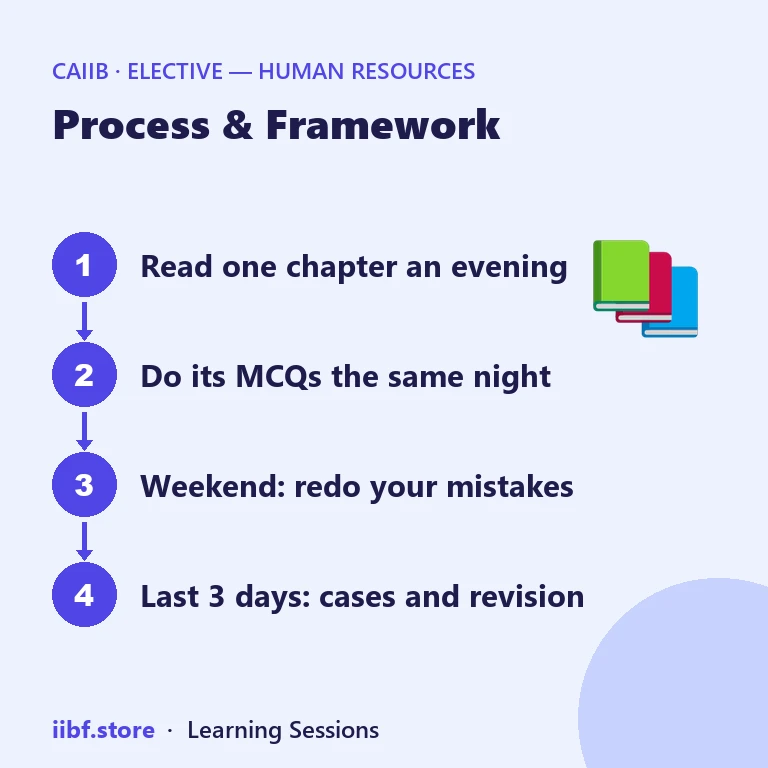
Each evening follows the same shape. First, read the chapter once, quickly, with a pencil. Second, close the book and attempt that chapter's MCQs. Third, go back only to the questions you got wrong or guessed, and write the correct idea in one line. This takes the same time as reading twice, but it sticks far better.
Your mistake page
Keep one sheet of paper for wrong answers. Do not copy the whole question. Write the concept in your own words. By the last week this single page becomes your revision material.
The 30-day CAIIB HRM study plan
Here is the day-wise schedule. It follows the module order, so the foundations in Module A support everything after them. The MCQ column is a target if the questions are spread evenly across chapters (360 questions over 24 chapters averages 15 a chapter). Adjust it to your own pace.
| Days | What to read | MCQ target |
|---|---|---|
| 1 to 6 | Module A: Fundamentals of HRM, Organisational Behaviour, Organisational Change, HRM in Indian Banks, Knowledge Management (day 6 is a buffer) | about 75 |
| 7 to 12 | Module B: HR as a Strategic Player, CEO and his-her Team, Communication, HR Functions, Performance Management (day 12 is a buffer) | about 75 |
| 13 to 17 | Module C: The Learning Process, Employee Motivation, Employee Development, Training Methodology (day 17 is a buffer) | about 60 |
| 18 to 22 | Module D: Industrial Relations, the two Employee Discipline chapters, Workers Participation in Management (day 22 is a buffer) | about 60 |
| 23 to 27 | Module E: six chapters, two lighter ones on a single evening where needed | about 90 |
| 28 to 30 | Mistake page, case studies, one timed mixed set | case-study questions plus a mock |
Notice the buffer day at the end of each block. Real life will eat at least one evening in every week: a branch audit, a family function, a headache. If you have no buffers, one missed day breaks the whole plan and you quit. With buffers, you simply use the spare evening and carry on.
How to use the end-of-chapter MCQs properly
The book carries 360 MCQs across its 24 chapters, and the questions are the part of this plan that does the heavy lifting. Use them in three ways.
- Same night, closed book. Attempt the questions straight after reading, without peeking. Mark any answer you were unsure of, even if it turned out right.
- Two-day revisit. Two days later, reattempt only the marked and wrong ones. This is when forgetting begins, and a quick retrieval resets it.
- Weekend sweep. On Saturday or Sunday, take the mistake page and read it end to end. It should take 20 minutes, not two hours.
HRM options are often close to each other, so the habit that pays off is asking why the other three options are wrong. If you can explain that, you have understood the concept and not just remembered a keyword.
Weekdays versus weekends
On weekdays, keep to one chapter and its MCQs. That is it. Resist the urge to read ahead when you feel good, because tomorrow's tired version of you needs the headroom.
On weekends, use the extra time for the things weekdays cannot hold: the mistake page, a second look at a difficult chapter such as Industrial Relations or Performance Management, and a few free practice questions from the free mock tests to check that the ideas hold up in a different question style.
The last three days
Days 28 to 30 are for the 60 case studies (240 questions) that come with the book. Case-style questions ask you to apply a concept to a situation, for example a grievance, an appraisal dispute or a training gap. If you have kept the mistake page, these days feel like consolidation rather than panic. Finish with one timed mixed set so that the exam-hall clock is not a surprise.
Where the book fits, and where it does not
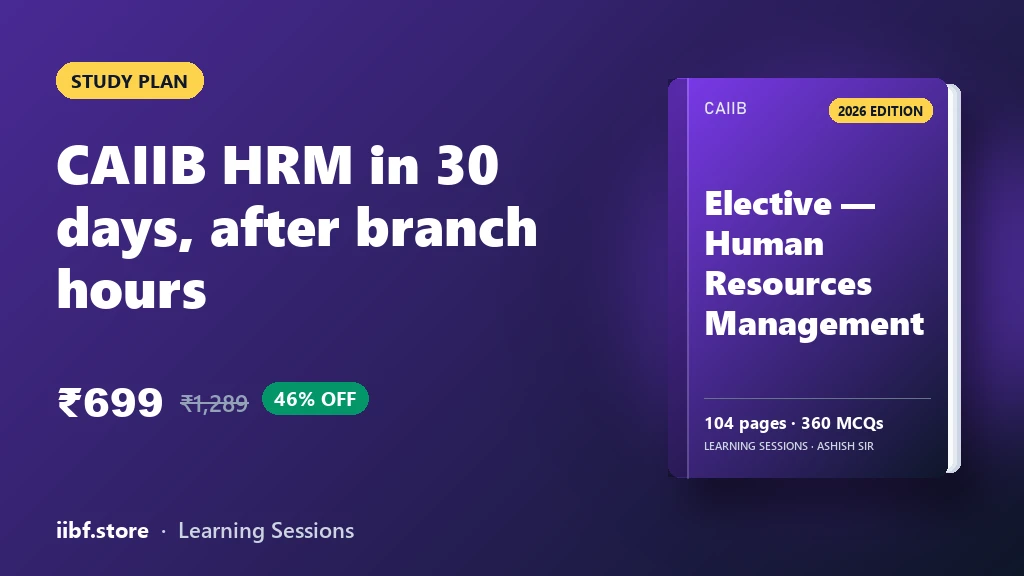
The CAIIB Elective HRM printed book is a 104-page, 2026-edition companion with 24 chapters in five modules, 360 MCQs and 60 case studies. It is priced at ₹699 against an MRP of ₹1,289 at the time of writing; prices can change, so the book page always has the current figure. If you want to judge the style first, the page also offers a free sample you can read before you decide.
One honest limit: a book, any book, will not give you exam-hall speed on its own. For that you need timed practice, so pair the reading with mocks and the free study material on the site. For the wider picture of the CAIIB papers, the CAIIB course page is a good place to start, and you can browse every title on the books page.
Always confirm the official syllabus, schedule and rules from the examining body at www.iibf.org.in. Whatever the upcoming exam cycle looks like, the structure of this CAIIB HRM study plan stays the same; only the start date moves.
If you fall behind
You will, at some point. A few rules keep a slip from becoming a collapse.
- Use the buffer day first. Do not compress two chapters into one night.
- If you lose more than three days, push the whole plan back instead of racing to catch up.
- Never skip the MCQs to save time. Reading without questions is the cheapest hour of the day and also the least useful.
- Protect sleep. A rested 60 minutes is worth more than a groggy 120.
Final word
HRM does not need genius; it needs a calm routine that survives a hard week at the branch. Thirty evenings, one chapter at a time, questions the same night and a single mistake page will take you through all five modules. Start with Module A tonight, even if it is only for forty minutes. That is the whole CAIIB HRM study plan: begin small, keep the chain unbroken and let the buffers absorb the bad days.
Frequently asked questions
Can I finish the HRM elective in less than 30 days?
Yes, if you can study two chapters a day, but it is risky for someone working full-time. Compressing the plan usually means skipping the same-night MCQs and the mistake page, which are the parts that build recall. Shorten the buffers before you shorten the testing.
How many hours a day should I study for CAIIB HRM?
About 60 to 90 minutes on working days is enough for this plan, with a longer session on weekends. Consistency matters more than the number of hours, so choose a slot you can protect.
Should I read the modules in order?
For most people, yes. Module A builds the vocabulary that Modules B to E depend on, and Module E is easier once you know the basics. If you are already confident in a topic, move it faster, but keep the order as a default.
Where can I check the official exam schedule?
The examining body publishes dates and rules on its website, www.iibf.org.in. Check it for the upcoming exam cycle rather than relying on any third-party article.
Prefer revising from a printed book?
Chapter-wise books with MCQs after every chapter — minimal pages, complete coverage, delivered anywhere in India. Every book has a free sample to read first.
104 pages · 360 MCQs
Learning Sessions · Ashish Sir
148 pages · 478 MCQs
Learning Sessions · Ashish Sir
151 pages · 465 MCQs
Learning Sessions · Ashish Sir
148 pages · 375 MCQs
Learning Sessions · Ashish Sir
216 pages · 895 MCQs
Learning Sessions · Ashish Sir
109 pages · 300 MCQs
Learning Sessions · Ashish Sir
82 pages · 297 MCQs
Learning Sessions · Ashish Sir
151 pages · 600 MCQs
Learning Sessions · Ashish Sir
98 pages · 282 MCQs
Learning Sessions · Ashish Sir
131 pages · 672 MCQs
Learning Sessions · Ashish Sir
221 pages · 831 MCQs
Learning Sessions · Ashish Sir
128 pages · 524 MCQs
Learning Sessions · Ashish Sir
107 pages · 445 MCQs
Learning Sessions · Ashish Sir
132 pages · 225 MCQs
Learning Sessions · Ashish Sir
188 pages · 435 MCQs
Learning Sessions · Ashish Sir
117 pages · 236 MCQs
Learning Sessions · Ashish Sir
Learning Sessions · Ashish Sir
118 pages · 299 MCQs
Learning Sessions · Ashish Sir
Learning Sessions · Ashish Sir
Learning Sessions · Ashish Sir
Learning Sessions · Ashish Sir
115 pages · 255 MCQs
Learning Sessions · Ashish Sir
Learning Sessions · Ashish Sir
334 pages · 936 MCQs
Learning Sessions · Ashish Sir
Learning Sessions · Ashish Sir
115 pages · 344 MCQs
Learning Sessions · Ashish Sir
107 pages · 240 MCQs
Learning Sessions · Ashish Sir
90 pages · 150 MCQs
Learning Sessions · Ashish Sir
Learning Sessions · Ashish Sir
Quick quiz on this topic
5 exam-style questions from our free test bank — check yourself before you move on.
Practice this topic
Take a free mock test, download chapter PDFs, or watch a video class — all included on iibf.store.