Cyber Security in Banking: CAIIB ITDB Guide 2026
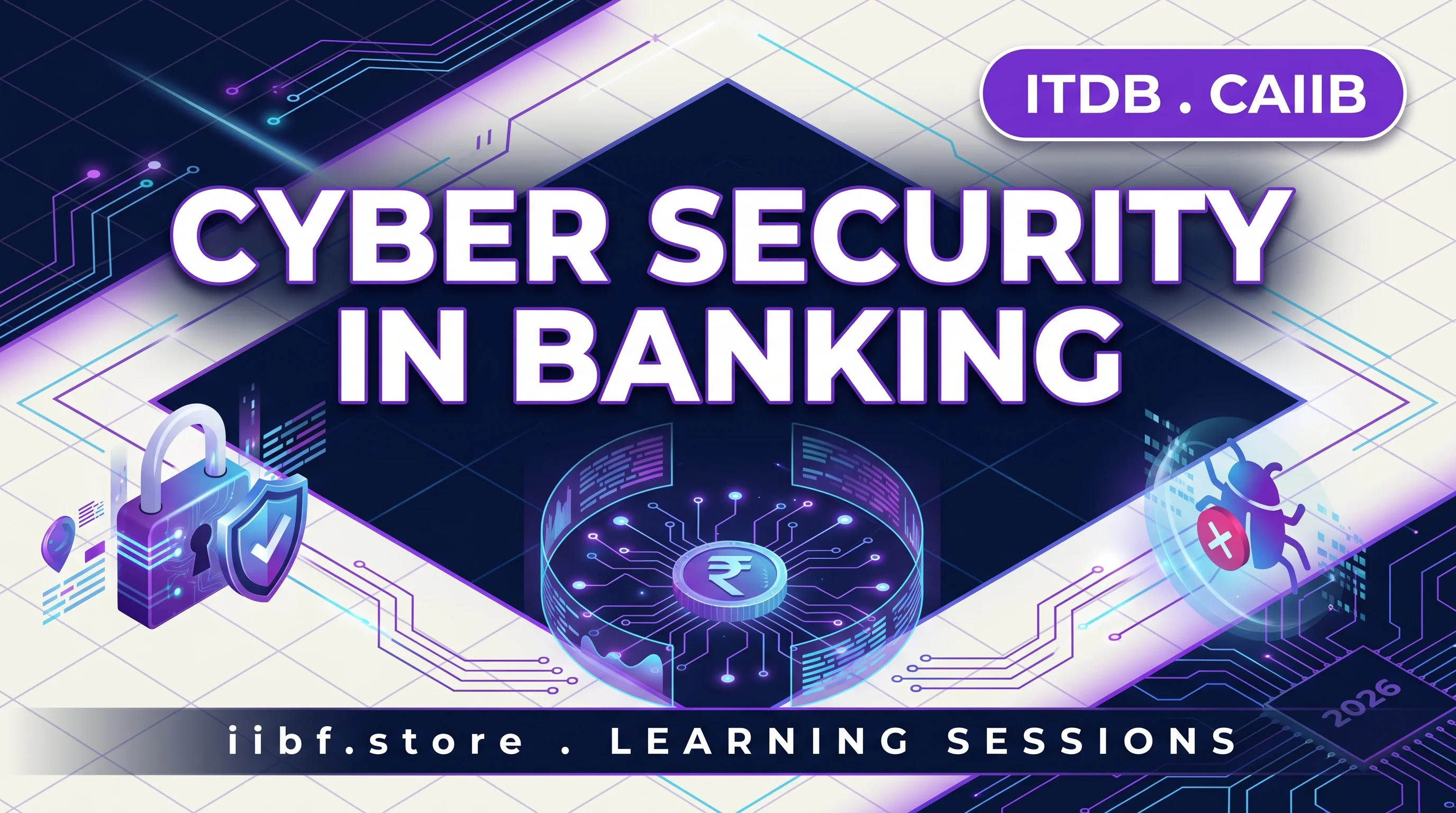
Cyber security in banking is no longer a back-office IT concern — it is the foundation on which every digital rupee, UPI payment and net-banking login now rests. For the CAIIB Information Technology and Digital Banking (ITDB) elective, this is one of the highest-yield topics you can master, because the examiner tests both the threat landscape and the RBI's defensive architecture that every Indian bank must follow.
This guide rebuilds the entire subject into clean, exam-ready blocks: the attacks you must name, the controls that stop them, the RBI Cyber Security Framework, and the incident-reporting and data-privacy duties that increasingly appear in ITDB question papers. Learn these well and a topic that sounds intimidatingly technical becomes some of the most reliable marks on your answer sheet.
Key takeaways
- Cyber security in banking rests on three legs together — technology, regulation and human awareness.
- The CIA triad (Confidentiality, Integrity, Availability) is the goal of every single control you study.
- The RBI Cyber Security Framework (2016) mandates a board-approved policy, a Cyber Crisis Management Plan and baseline controls scaled to each bank's risk.
- Significant incidents must be reported to the RBI and CERT-In within the prescribed window, and the DPDP Act, 2023 adds privacy obligations.
- Group your revision into four blocks — threats, CIA triad, controls, RBI framework + reporting — and practise matching each threat to its control.
Why Cyber Security in Banking Is a Supervisory Priority
Banks are the highest-value targets in any economy. A single successful breach can drain accounts, leak sensitive customer data, halt payment rails and destroy decades of public trust in a matter of minutes. The damage is rarely contained to one institution — interlinked systems mean one weak bank can become an entry point into the wider financial network.
The shift to digital has widened the attack surface dramatically. With UPI, internet banking, mobile apps and open APIs handling billions of transactions, there are now countless doors an attacker can try. The RBI therefore treats cyber resilience as a core supervisory priority rather than an optional add-on, and it expects every banker — not just the IT team — to understand the basics. Build your wider foundation through the CAIIB course hub while you work through this elective.
The Main Cyber Threats to Banks
Half the battle in this section is simply knowing the vocabulary cold. The threats most frequently tested in cyber security in banking questions are:
- Phishing, Vishing and Smishing — tricking customers into revealing credentials through fake emails, phone calls (vishing) or SMS (smishing) that look like they came from the bank.
- Malware and Ransomware — malicious software that steals data, or encrypts and locks systems until a ransom is paid.
- Man-in-the-Middle (MITM) attacks — secretly intercepting communication between the customer and the bank.
- Distributed Denial-of-Service (DDoS) — flooding servers with traffic to crash online services and lock out genuine users.
- SQL injection and card skimming — attacking back-end databases, and capturing card data at ATM or POS terminals.
- Social engineering — manipulating people rather than systems, often the first step in a larger attack.
Notice how many of these target the customer rather than the core banking system. That single observation explains why customer awareness is treated as a security control in its own right. Test your recall of these terms in the CAIIB practice tests before exam day.
The CIA Triad: The Goal Behind Every Control
Before memorising controls, understand what they protect. Every security measure in banking serves one of three goals, known collectively as the CIA triad. Examiners love this because it lets them ask you to classify any control under one of three headings.
| Principle | What it means | Example controls |
|---|---|---|
| Confidentiality | Data is seen only by authorised users | Encryption, access control, MFA |
| Integrity | Data is not altered without authorisation | Hashing, checksums, digital signatures |
| Availability | Systems are accessible whenever needed | Backups, redundancy, disaster recovery |
A useful exam insight: a ransomware attack damages availability and confidentiality at the same time — it locks you out of your own systems while potentially stealing data — which is exactly why it is so feared. Drill the triad and its mapped controls quickly using the CAIIB matching games.
Key Defensive Controls Banks Deploy
Banks never rely on a single safeguard. They layer multiple defences so that the failure of any one control is not fatal — a strategy called defence in depth. The core controls you must be able to name and explain are:
- Firewalls and IDS/IPS — filtering network traffic, and detecting or preventing intrusions.
- Encryption — protecting data both in transit and at rest so intercepted data is unreadable.
- Multi-Factor Authentication (MFA) — combining something you know, something you have and something you are.
- Two-Factor Authentication and OTPs — the everyday second layer on transactions.
- VAPT — regular Vulnerability Assessment and Penetration Testing to find weaknesses before attackers do.
- SOC — a Security Operations Centre monitoring threats round the clock.
The skill the examiner rewards here is mapping: matching a control to the specific risk it mitigates. Encryption defeats MITM interception; MFA blunts phishing; backups and DR restore availability after ransomware. Keep that linkage front of mind.
The RBI Cyber Security Framework
In 2016 the RBI issued a landmark Cyber Security Framework for Banks, and it remains the regulatory centre of gravity for this topic. Rather than dictating one rigid checklist, it demands a structured, board-owned approach with these pillars:
- A board-approved cyber security policy, kept distinct from the broader IT policy.
- A Cyber Crisis Management Plan (CCMP) built around the four stages of detect, respond, recover and contain.
- Continuous surveillance together with a baseline set of mandatory security controls.
- Arrangements scaled to the bank's risk profile and digital footprint — a small co-operative bank and a large universal bank are not held to identical complexity.
The RBI also operates supervisory mechanisms and requires banks to report unusual cyber incidents. For the authoritative circulars and any updates to the framework, treat the IIBF study material and the official regulator as your reference points — always confirm the latest position against the primary RBI notification rather than secondary summaries.

Incident Reporting and the DPDP Act, 2023
Speed of reporting is now a hard regulatory duty, not a courtesy. Banks must report significant cyber incidents to the RBI and to CERT-In within the prescribed reporting window. Because the exact timelines are revised from time to time, learn the principle firmly and verify the current window against the latest released regulatory notification.
On the privacy side, the Digital Personal Data Protection (DPDP) Act, 2023 casts banks as data fiduciaries. That role brings three headline obligations: obtaining valid customer consent, securing personal data, and reporting personal-data breaches. Taken together, cyber-incident reporting and DPDP compliance form the legal backbone of cyber security in banking — and both are appearing more often in ITDB papers. Revise them alongside the digital-payments material in your Information Technology and Digital Banking reading.
Exam tip: When a question lists an incident and asks "who must be informed?", the safe twin answer is almost always RBI and CERT-In. Pair that with the DPDP breach-notification duty if customer data is involved.
A Practical Study Plan for This Topic
This subject rewards organised recall far more than rote reading. Use a simple four-block structure over your revision week:
- Day 1 — Threats. Write each attack on a flashcard with a one-line definition. Test yourself until you can name all of them from a blank page.
- Day 2 — CIA triad. For every control you meet, immediately tag it C, I or A. This builds the classification reflex examiners probe.
- Day 3 — Defensive controls. Draw a two-column "threat to control" map. This is the single most question-worthy table in the chapter.
- Day 4 — RBI framework and reporting. Memorise the framework's pillars as bullet points and lock in "RBI + CERT-In" plus DPDP duties.
- Day 5 — Mixed practice. Attempt full-length MCQ sets and review every wrong answer back to its block.
Tie the subject into the wider CAIIB guides library so cyber security connects naturally with UPI architecture, core banking and the risk-management concepts you meet elsewhere in the syllabus. It pairs especially well with Value at Risk Explained: Methods, Backtesting & Limits for CAIIB RM and the central-banking policy material in LAF Corridor Explained: Repo, SDF & MSF for CAIIB Central Banking.
Common Mistakes Candidates Make
- Confusing the CIA triad members. Integrity is about data not being altered — it is not about privacy. Keep the three definitions crisp and distinct.
- Treating VAPT and SOC as the same thing. VAPT is a periodic testing exercise; a SOC is continuous, round-the-clock monitoring.
- Memorising exact reporting hours that may have changed. Learn the duty and the recipients first; confirm precise timelines against the current notification.
- Ignoring the human layer. Many questions reward the insight that staff training and customer awareness are genuine controls, not soft extras.
- Forgetting DPDP. Candidates revise the 2016 framework but skip the 2023 privacy law — examiners increasingly test the combination.
Building Cyber Resilience in Everyday Banking
Strong cyber security in banking is not only about firewalls and frameworks; it lives in daily habits. A teller who verifies a suspicious request, a customer who never shares an OTP, and an IT team that patches systems promptly together contribute more to safety than any single expensive tool. This is why banks run continuous awareness drives, simulated phishing tests and clear escalation paths — so that every employee becomes part of the defence rather than the weak link.
Resilience also means planning for the day an attack succeeds. A well-rehearsed Cyber Crisis Management Plan, regular data backups and a tested disaster-recovery site let a bank contain the damage and restore services quickly. Coupled with prompt reporting to the RBI and CERT-In, a sound plan turns a potential catastrophe into a managed event. For the CAIIB exam, anchor everything to one sentence: cyber security rests on technology, regulation and human awareness working together.
Frequently Asked Questions
What is the CIA triad in cyber security?
The CIA triad stands for Confidentiality, Integrity and Availability — the three core goals that every security control aims to protect. Confidentiality keeps data private, integrity keeps it unaltered, and availability keeps systems accessible when users need them. Almost any control you study can be classified under one of these three headings.
What is phishing in banking?
Phishing is a social-engineering attack that tricks customers into revealing credentials or card details through fake emails, websites, calls or SMS that appear to come from the bank. Its variants are vishing (voice calls) and smishing (SMS). Because it targets people rather than systems, customer awareness is the strongest defence against it.
What is the RBI Cyber Security Framework?
Issued by the RBI in 2016, it requires every bank to adopt a board-approved cyber security policy, maintain a Cyber Crisis Management Plan, run continuous surveillance and implement baseline controls. Crucially, the arrangements are scaled to each bank's risk profile and digital footprint. Always confirm any later amendments against the official RBI notification.
What is VAPT and why do banks use it?
VAPT stands for Vulnerability Assessment and Penetration Testing. It is a regular security exercise in which banks scan their systems for weaknesses and then simulate attacks to confirm whether those weaknesses can be exploited. The goal is to find and fix gaps before real attackers discover them.
How does the DPDP Act, 2023 affect banks?
The Digital Personal Data Protection Act, 2023 makes banks data fiduciaries responsible for obtaining customer consent, securing personal data and reporting breaches. It adds a dedicated privacy-compliance layer on top of existing cyber-security duties. For ITDB, expect questions that combine the DPDP role with the RBI framework and CERT-In reporting.
Whom must a bank report a major cyber incident to?
A bank must report significant cyber incidents to the RBI and to CERT-In within the prescribed reporting window. If personal data is compromised, the DPDP breach-notification duty also applies. Because exact timelines are revised periodically, learn the recipients and the duty firmly, then verify the precise window against the latest released notification.
Conclusion
Cyber security in banking blends technology, regulation and customer awareness into one high-priority ITDB subject. Master the threats, the CIA triad, the layered controls, and the RBI framework with its reporting duties, and you can answer almost any question on this theme with confidence — while gaining knowledge that protects real customers every single day. Begin your focused revision now and make digital security one of your strongest scoring areas.
Related Guides
📚 Free Learning Sessions resources — connect & crack your exam
- 📝 Free mock tests — chapter-wise, exam-pattern, with instant solutions
- 🎮 Matching games — gamified revision of key terms & concepts
- 📄 Study notes & PDFs — downloadable chapter material
- 🎥 Video classes on YouTube — subscribe to @learningsessions
💬 Want the full course? WhatsApp your course name to 8360944207 and our team will set you up.
📱 Study on the go — get our iOS & Android app at iibf.store/app.
📖 Also read: robotic process automation in banking.
📖 Also read: enterprise service bus in banking.
Quick quiz on this topic
5 exam-style questions from our free test bank — check yourself before you move on.
Practice this topic
Take a free mock test, download chapter PDFs, or watch a video class — all included on iibf.store.
Keep reading