D-SIB Capital Buckets: Why SBI Holds 0.80% Extra
If you have just learned that an Indian bank must hold 9% capital, and 11.5% once the conservation buffer is counted, there is a follow-up question waiting in the CAIIB BFM paper: is that the answer for every bank? It is not. A handful of banks carry an extra layer on top, allotted through the D-SIB capital buckets that RBI publishes each year. Get this wrong and you will confidently mark 11.5% on a question that wanted 12.3%.
The short revision reel below poses exactly that trap, names two of the three banks on the list, and leaves the third for the comments. Watch it, then read on for the full bucket table and the marks-scoring detail.
Basel 3 capital updates 2026 — CAIIB · Watch on YouTube
What makes a bank "systemically important"
A Domestic Systemically Important Bank is one whose failure would not stay contained. Its collapse would ripple through payment systems, interbank markets and depositor confidence across the whole industry — the "too big to fail" idea, made measurable. Because markets assume such a bank would be rescued, it enjoys a funding advantage it did not earn. The regulatory answer is to claw that advantage back by demanding more capital.
RBI scores banks on a systemic importance measure built from size relative to GDP, interconnectedness with other financial institutions, substitutability of the services it provides, and complexity. Banks whose score crosses a threshold are designated D-SIBs and sorted into one of five D-SIB capital buckets, each carrying a progressively larger Common Equity Tier 1 surcharge.
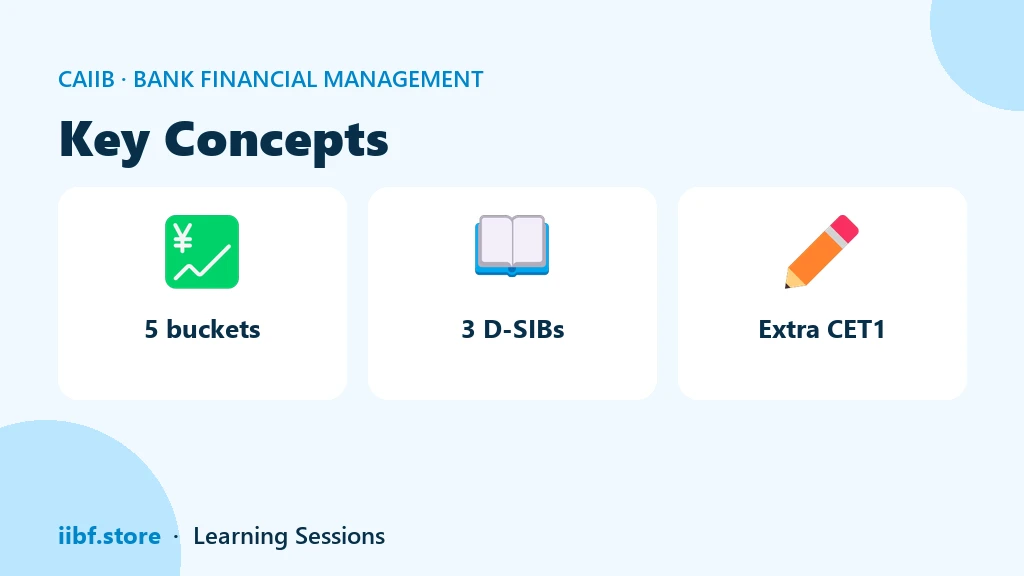
The five D-SIB capital buckets, and what each one costs
| Bucket | Additional CET1 requirement (% of RWA) | Effective floor including CRAR 9% + CCB 2.5% |
|---|---|---|
| Bucket 5 | 1.00% | 12.50% |
| Bucket 4 | 0.80% | 12.30% |
| Bucket 3 | 0.60% | 12.10% |
| Bucket 2 | 0.40% | 11.90% |
| Bucket 1 | 0.20% | 11.70% |
Two things to fix in memory. First, the surcharge is additional CET1 — it cannot be met with AT1 or Tier 2 instruments. Second, it sits on top of the conservation buffer, not inside it. That is why the right-hand column simply adds the surcharge to 11.5%.
Who is on the list right now
RBI's published D-SIB list names three banks. State Bank of India sits in bucket 4 with a 0.80% surcharge. HDFC Bank sits in bucket 2 at 0.40%. ICICI Bank — the third bank the reel leaves hanging — sits in bucket 1 at 0.20%.
The movement is worth knowing because it explains a real supervisory decision. SBI moved up from bucket 3 to bucket 4 and HDFC Bank from bucket 1 to bucket 2, with the higher surcharges applying from 1 April 2025. HDFC Bank's move followed the merger of the erstwhile HDFC Limited into the bank on 1 July 2023, which materially increased its size and interconnectedness. That is the framework working as designed: grow systemically, hold more capital.
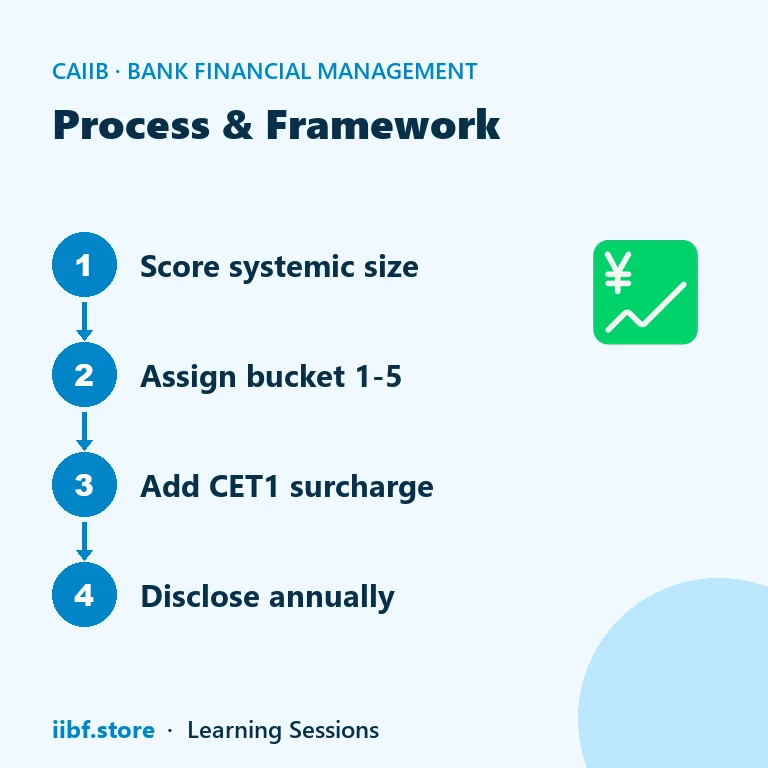
Worked example: what a bucket 4 bank's floor looks like
Take a D-SIB in bucket 4 with risk-weighted assets of ₹40,00,000 crore. Its minimum CRAR is 9%, or ₹3,60,000 crore. The conservation buffer adds 2.5%, another ₹1,00,000 crore of pure CET1. The bucket-4 surcharge adds a further 0.80%, or ₹32,000 crore, again in CET1 only.
Total effective requirement: 12.30% of RWA, or ₹4,92,000 crore. Note how much of that has to be common equity — 5.5% minimum CET1, plus 2.5% CCB, plus 0.80% surcharge, comes to 8.80% of RWA in CET1 alone, against 5.5% for a bank that is not on the list. The surcharge bites harder than the headline 0.80% suggests, and that is exactly the point.
Exam traps to watch for
- Bucket 5 is empty. No Indian bank currently sits there. The 1.00% figure exists in the framework but applies to nobody, so a question asking for the highest surcharge currently applicable wants 0.80%, not 1.00%.
- D-SIB is not G-SIB. No Indian bank features on the global list. Questions that mix the two are testing whether you noticed.
- The surcharge is CET1-only. Options offering to meet it with Tier 2 are always wrong.
- It stacks, it does not replace. The D-SIB capital buckets add to the 11.5%; they never substitute for the conservation buffer.
- The list is annual. RBI reviews and publishes it every year, so bucket placements can shift — check the latest release before the exam rather than trusting a two-year-old note.
How to revise this without over-reading it
This topic rewards a table, not paragraphs. Write the five D-SIB capital buckets down the left, surcharges in the middle, effective floors on the right, and add the three bank names against their buckets. That single card covers almost everything the paper asks. Then attach it mentally to the capital adequacy ladder you already know, because every question here is really a capital adequacy question with one extra line.
For structured coverage of the whole module, the CAIIB course page sequences capital adequacy before the D-SIB and leverage topics, which is the order that makes them stick. Reinforce with the chapter-wise tests, keep the numerical inputs current from the RBI rates reference, and if your revision is drifting, rebuild the schedule on the study planner. The primary source for bucket placements is RBI's own D-SIB press release page, which is where the annual update appears first.
One extra line on a balance sheet, one extra row in your revision table. That is the whole topic — and it is worth marks every single session.
Frequently asked questions
Which banks are currently designated as D-SIBs in India?
Three: State Bank of India, HDFC Bank and ICICI Bank. SBI is in bucket 4, HDFC Bank in bucket 2 and ICICI Bank in bucket 1. RBI reviews and republishes the list annually.
How much extra capital do the D-SIB capital buckets require?
Bucket 1 requires an additional 0.20% of risk-weighted assets in CET1, rising in steps of 0.20 percentage points to 1.00% for bucket 5. The surcharge is over and above the 9% minimum CRAR and the 2.5% conservation buffer.
Can a D-SIB surcharge be met using Tier 2 capital?
No. The additional requirement must be met with Common Equity Tier 1 only. Instruments that qualify as Additional Tier 1 or Tier 2 cannot be counted towards it.
What is the difference between a D-SIB and a G-SIB?
D-SIBs are identified by the national regulator, in India by RBI, based on domestic systemic importance. G-SIBs are identified by the Financial Stability Board using a global methodology. No Indian bank is currently on the G-SIB list.
Quick quiz on this topic
5 exam-style questions from our free test bank — check yourself before you move on.
Practice this topic
Take a free mock test, download chapter PDFs, or watch a video class — all included on iibf.store.
Keep reading